A Witness to a Shattered World: The Life and Art of Claggett Wilson
Claggett Wilson, born in 1887, emerged as a significant, though often overlooked, voice within the burgeoning American modernist movement. His life was inextricably linked to the seismic events of the early 20th century, most notably the First World War, which profoundly shaped his artistic vision and propelled him into the role of an official war artist. Unlike many artists who found inspiration in idyllic landscapes or portraits of societal elites, Wilson’s canvas became a space for confronting the brutal realities of conflict, psychological trauma, and the disintegration of traditional values. He wasn't merely documenting events; he was attempting to capture the *feeling* of a world irrevocably altered by mechanized warfare.
Wilson received his formal training at the Pennsylvania Academy of Fine Arts under Hugh Breckenridge and Thomas Anshutz, where he initially embraced a realist style influenced by European masters like Gustave Courbet. However, this foundation would soon be challenged as he sought new modes of expression capable of conveying the complexities of modern experience. His early works demonstrate a keen observational skill and a sensitivity to light and atmosphere, but it was his experiences during WWI that catalyzed a dramatic shift in his artistic approach. Commissioned by the U.S. government, Wilson traveled to France in 1918 as part of the American Expeditionary Forces’ art program. This wasn't a commission for heroic depictions of battle; rather, he was tasked with recording the everyday life and aftermath of war – the ruined landscapes, the exhausted soldiers, the silent suffering that lay beneath the surface of official narratives.
The Horrors of War Transformed into Symbolic Language
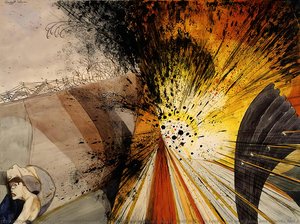
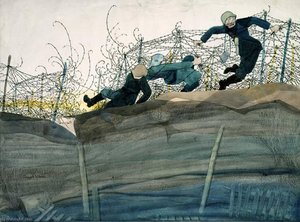
Wilson’s wartime paintings are far removed from traditional battlefield scenes. He eschewed glorification or romanticism, instead focusing on the psychological toll of war and its impact on both individuals and the environment. His most powerful works, such as his series depicting shell craters and abandoned trenches, are characterized by a stark, almost abstract quality. The landscapes aren’t rendered with topographical accuracy; they are distorted, fragmented, and imbued with a sense of desolation. These weren't simply depictions of physical destruction but metaphors for the shattered psyches of those who had endured it. He employed a muted palette dominated by grays, browns, and ochres, further emphasizing the bleakness and despair of his subject matter.
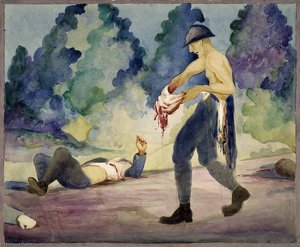
Wilson’s use of symbolism is particularly striking. Recurring motifs like broken trees, skeletal figures, and desolate fields serve as potent reminders of loss, mortality, and the fragility of human life.
He often incorporated elements of Cubism and Futurism into his compositions, reflecting the fragmentation and dynamism of modern warfare.
His paintings frequently lack a clear narrative focus, inviting viewers to contemplate the broader themes of trauma, alienation, and the search for meaning in a chaotic world.
The influence of artists like Giorgio de Chirico, with his unsettling metaphysical landscapes, is evident in Wilson’s work. He shared De Chirico's interest in creating dreamlike spaces that evoke a sense of unease and psychological disturbance. However, while De Chirico often focused on the anxieties of modern urban life, Wilson directed his attention to the specific horrors of war.
Post-War Reflections: Trauma and the Search for Renewal
Following his return from France, Wilson continued to explore themes related to trauma and loss in his art. He struggled with what he had witnessed, and this emotional burden is palpable in his post-war paintings. While he experimented with various styles throughout his career, including Surrealism and Abstract Expressionism, he never fully abandoned the symbolic language that he developed during WWI. His later works often feature religious imagery and mythological references, suggesting a search for spiritual meaning in the aftermath of devastation. He attempted to reconcile the horrors of war with a sense of hope and renewal, but his paintings remain deeply ambivalent, reflecting the enduring scars of conflict.
Wilson’s artistic development wasn't linear; he constantly experimented with new techniques and approaches. However, a consistent thread running through his entire oeuvre is his commitment to confronting difficult truths and challenging conventional notions of beauty and representation. He was not interested in creating aesthetically pleasing images but rather in provoking emotional responses and prompting viewers to reflect on the human condition.
Legacy and Historical Significance
Claggett Wilson’s work, though often overshadowed by more celebrated artists of the modernist period, holds a unique place in American art history. As a war artist, he provided a powerful and unflinching depiction of the psychological realities of WWI, challenging the prevailing narratives of heroism and patriotism. His paintings serve as a poignant reminder of the human cost of conflict and the enduring trauma it inflicts on individuals and societies. He anticipated many of the themes that would become central to post-war art, including alienation, fragmentation, and the search for meaning in a chaotic world.
While he didn’t achieve widespread recognition during his lifetime – he died in relative obscurity in 1952 – Wilson's work has experienced a resurgence of interest in recent years. His paintings are now recognized as important contributions to American modernism and valuable historical documents that offer a unique perspective on one of the most devastating conflicts in human history. He stands as a testament to the power of art to bear witness, to confront trauma, and to challenge us to remember the lessons of the past.