Early Life and Artistic Foundations
Cleve Gray, born Cleve Ginsberg in New York City on September 22, 1918, embarked on a journey that would establish him as a significant figure within the landscape of American Abstract Expressionism. A pivotal moment arrived in 1936 when the family formally changed their name to Gray—a symbolic shift perhaps foreshadowing the artist’s own evolving identity and aesthetic direction. His early exposure to art was nurtured through formal training at the Ethical Culture School, followed by studies with Antonia Nell, a student of George Bellows, instilling in him foundational skills and an appreciation for representational form. Further academic pursuits at Phillips Academy in Andover, Massachusetts, where he studied under Bartlett Hayes and earned the Samuel F. B. Morse Prize, solidified his commitment to painting.
Gray’s intellectual curiosity extended beyond the studio, culminating in a summa cum laude graduation from Princeton University with degrees in Art and Archeology. His thesis, focused on Yuan dynasty landscape painting under the guidance of George Rowley, reveals an early fascination with Eastern philosophies and artistic traditions—influences that would subtly permeate his later abstract work. This period wasn’t merely academic; it laid the groundwork for a lifelong exploration of form, space, and emotional resonance.
Wartime Experiences and Parisian Influences
The outbreak of World War II interrupted Gray's artistic trajectory, leading him to enlist in the United States Army in 1942. His service within the signal intelligence service took him across Europe—to Britain, France, and Germany—a transformative experience that profoundly impacted his worldview and artistic sensibilities. Rising to the rank of sergeant, he witnessed firsthand the devastation of war, sketching scenes of destruction that served as a stark counterpoint to the serene landscapes of his earlier work. A particularly poignant moment occurred in Paris after its liberation, where Gray became the first American GI to greet Pablo Picasso and Gertrude Stein—an encounter that ignited his imagination and fueled his artistic ambitions.
Following the war, Gray sought further training in Paris, studying informally with André Lhote and Jacques Villon. This immersion in European modernism broadened his understanding of abstraction and provided a crucial bridge between American Expressionism and the avant-garde traditions of the continent. The Parisian art scene offered a fertile ground for experimentation, shaping his evolving style and preparing him for his return to the United States.
The Emergence of Abstract Expressionism
Upon returning to the US in 1946, Gray began exhibiting his work at the Galerie Durand-Ruel in Paris and held his first solo exhibition at the Jacques Seligmann Gallery in New York City in 1947. He settled in Warren, Connecticut, in 1949, establishing a secluded studio on a sprawling 94-acre property where he would live and work for the remainder of his life. This move signaled a period of intense artistic exploration as Gray began to distance himself from earlier Cubist and Cézanne-inspired paintings.
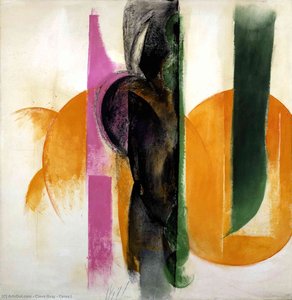
Gray’s critical essay, “Narcissus in Chaos,” published in 1959, proved controversial—a scathing critique of the perceived egotism and sensationalism within Abstract Expressionism. Ironically, this very act of questioning propelled him toward his own unique brand of abstraction. He sought a more contemplative, ego-free approach, focusing on distilled color and gestural expression. This period marked a turning point in his career, leading to a series of paintings characterized by luminous fields of color and dynamic compositions.
Later Years, Recognition, and Legacy
In 1957, Gray married the acclaimed author Francine du Plessix, forging an intellectual partnership that enriched both their lives. They maintained separate studios on their Connecticut property, fostering a creative dialogue while pursuing individual artistic visions. Throughout his career, Gray participated in numerous exhibitions, showcasing his evolving style and gaining recognition for his distinctive approach to abstraction.
Gray’s later work often explored themes of political activism—particularly his opposition to the Vietnam War—reflecting his commitment to social justice. His epic suite of 14 large-scale abstract paintings, “Threnody” (1973), stands as a powerful testament to this engagement. In recent years, there has been renewed interest in Gray’s work, with posthumous retrospectives at the Boca Raton Museum of Art and other institutions highlighting his significant contribution to American art.
Cleve Gray passed away on December 8, 2004, leaving behind a rich legacy of paintings that embody a unique blend of intellectual rigor, emotional depth, and artistic innovation. His work continues to resonate with audiences today, offering a compelling vision of abstraction—one rooted in contemplation, social consciousness, and a profound appreciation for the power of color and form.
질의응답
Cleve Gray의 작품 세계는 시간이 흐름에 따라 어떻게 변화했나요?
Cleve Gray의 작품 세계를 시간순으로 정리한 기록은 아티스트 연대기 페이지에서 확인하실 수 있으며, 이곳에서는 각 시기별로 분류된 챕터를 따라 작품들을 제작 순서대로 만나보실 수 있습니다.
Cleve Gray의 작품을 매체별로 찾아볼 수 있나요?
특정 매체로 제작된 Cleve Gray의 모든 작품을 확인하시려면, 작가의 모든 매체 페이지를 이용해 주세요.
Cleve Gray가 그린 모든 주제를 한눈에 볼 수 있는 개요가 있나요?
Cleve Gray의 주제별 아틀라스는 작가의 작품들을 주제별로 분류하여 보여주는 페이지입니다.