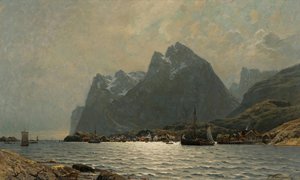
The Painter of Norway's Majestic Fjords
Eilert Adelsteen Normann stands as a luminous figure in the history of Nordic art, a painter whose brush captured the very soul of the Norwegian landscape. Born in Bodø, Norway, his life was a journey between the rugged, breathtaking beauty of his homeland and the vibrant, cosmopolitan art circles of Germany. While he spent much of his professional career based in Berlin, his heart and inspiration remained tethered to the deep waters and steep mountains of Norway. His work did more than merely document scenery; it acted as a window for the rest of Europe, famously credited with making the Norwegian fjords a premier destination for travelers seeking the sublime wonders of the North.
His artistic evolution was shaped by rigorous classical training within the prestigious Düsseldorf School. Moving to Germany in 1869, he studied at the Kunstakademie Düsseldorf, where he honed his skills under the guidance of masters such as the Estonian painter Eugen Dücker. This period of intense study instilled in him a technical precision that would define his later mastery. As his style matured, Normann moved beyond simple representation, embracing elements of Realism and Impressionism to capture the ephemeral qualities of light and atmosphere. He developed a distinctive approach, sometimes utilizing a pointillist technique with small dots of color to create a sense of luminosity, particularly when depicting the way sunlight dances upon the surface of mountain-ringed waters.
A Legacy of Light and Connection
The subject matter of Normann’s oeuvre was remarkably consistent, yet it never lacked for emotional depth. He focused almost exclusively on the coastal landscapes of Northern and Western Norway, creating compositions where the elements of earth, water, and sky exist in a delicate, dramatic balance. His paintings often feature:
- The Majestic Fjords: Deep, reflective waters that serve as the mirror for the heavens.
- Coastal Life: Small, nestled houses and tiny boats that provide a sense of scale and human presence against the vastness of nature.
- Imposing Topography: Steep, rugged mountainsides that frame the scenes with a sense of awe and permanence.
Beyond his own canvases, Normann’s historical significance is inextricably linked to the broader movement of modern art. He was not merely an observer of change but a catalyst for it. Most notably, he played a pivotal role in the career of Edvard Munch. Recognizing the raw talent of his fellow countryman, Normann extended an invitation to Munch to exhibit in Berlin. This move proved transformative, leading to the sensational exhibitions that eventually sparked the formation of the Berlin Secession movement. In this way, the man who painted the tranquil beauty of the fjords also helped ignite the fires of artistic revolution in Europe.
질의응답
특정 매체로 분류된 Eilert Adelsteen Normann의 모든 작품을 어떻게 찾을 수 있나요?
모든 매체 페이지에서는 Eilert Adelsteen Normann의 작품을 기법별로 모아볼 수 있습니다.
특정 팔레트의 Eilert Adelsteen Normann 작품은 어떻게 찾을 수 있나요?
특정 색상 팔레트의 Eilert Adelsteen Normann 작품을 찾으시려면, 작가의 컬러 팔레트별 페이지를 이용해 보세요.
Eilert Adelsteen Normann 작가의 다른 활동명이나 알려진 이름이 있나요?
Eilert Adelsteen Normann은(는) Adelsteen Normann라는 다른 이름으로도 알려져 있습니다.