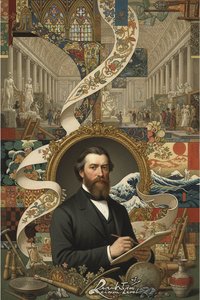
A Life Immersed in Light and Landscape
Eugène Fromentin, born in the port city of La Rochelle, France, in 1820, was a figure uniquely positioned at the intersection of painting and prose. His life wasn’t one of dramatic upheaval, but rather a steady immersion into observation—a meticulous study of both the physical world and the human spirit. Initially destined for a legal career, Fromentin abandoned law to pursue his artistic inclinations, a decision that would lead him down a path defined by vibrant color, evocative landscapes, and a profound fascination with North Africa. His early training under Louis Cabat provided a foundation in landscape painting, but it was the burgeoning Romanticism of Eugène Delacroix that truly ignited his artistic vision, influencing his bold use of color and dynamic compositions. However, Fromentin wasn’t merely an imitator; he sought to forge his own path, one guided by direct experience and a desire to capture the essence of life as he witnessed it.The Allure of Algeria: An Orientalist Vision
Fromentin's artistic trajectory was irrevocably altered by his first journey to Algeria in 1845. This wasn’t simply a trip for picturesque scenery; it was an immersion into a culture vastly different from his own, a world brimming with exoticism and untamed beauty. He returned repeatedly to North Africa, each visit deepening his understanding of the land and its people. These travels weren't undertaken as a colonial observer but rather as someone genuinely captivated by the lives unfolding before him. He aimed not to document Algeria for a European audience, but to convey its intrinsic grandeur—the “unconscious grandeur of barbarian and animal attitudes and gestures,” as he himself described it. This pursuit established Fromentin as a key figure in the Orientalist movement, though his approach was distinguished by a remarkable degree of realism and sensitivity. Paintings like Les Gorges de la Chiffa (1847), which garnered early acclaim at the Salon, demonstrated his ability to capture both the dramatic landscapes and the subtle nuances of Algerian life. Later works such as Arabs Resting (1871) and Moroccan Horsemen at the Foot of the Chiffra Cliff further solidified his reputation, showcasing his mastery of depicting movement, light, and atmosphere.Beyond the Canvas: A Literary Voice
Fromentin’s creative output extended far beyond the realm of painting. He was a prolific writer, producing travelogues, fiction, and art criticism that revealed a keen intellect and a refined sensibility. His literary works weren't merely supplements to his paintings; they were independent explorations of similar themes—the allure of exotic lands, the beauty of nature, and the complexities of human experience. Un Été dans le Sahara (1857) and Une Année dans le Sahel (1858) offered vivid accounts of his travels, capturing not just the physical landscape but also the cultural nuances and everyday lives of the people he encountered. However, it was his collection of essays, Les Maîtres d'Autrefois (The Old Masters), published in 1876, that cemented his legacy as a discerning art critic. In this work, Fromentin demonstrated an insightful understanding of art history, offering perceptive analyses of the works of Rubens, Rembrandt, and other masters of the Northern Renaissance and Baroque periods. He approached these artists not merely as historical figures but as fellow creators grappling with similar artistic challenges—a perspective that resonated deeply with his contemporaries.A Lasting Legacy: Bridging Worlds
Eugène Fromentin’s death in Paris in 1876 marked the end of a remarkable career, one that seamlessly blended artistic and literary pursuits. His contribution to the Orientalist movement was significant, popularizing images of North Africa within European art circles while simultaneously offering a more nuanced and respectful portrayal than many of his contemporaries. He wasn’t simply painting exotic scenes; he was attempting to understand and convey the essence of a different culture. Moreover, Fromentin's unique ability to bridge the worlds of art and literature set him apart. He demonstrated that artistic vision could be expressed through multiple mediums, enriching both his paintings and his writings. His influence extended beyond his immediate circle, inspiring subsequent generations of artists interested in depicting exotic landscapes and cultures with sensitivity and authenticity. Today, Fromentin’s works continue to captivate audiences with their vibrant colors, evocative atmospheres, and insightful observations—a testament to the enduring power of an artist who dared to look beyond the familiar and embrace the beauty of the unknown.Major Works
- Les Gorges de la Chiffa (1847): A pivotal early work that established Fromentin’s reputation.
- Arabs Resting (1871): Captures the tranquility and essence of Arab life in Algeria.
- Moroccan Horsemen at the Foot of the Chiffra Cliff: Showcases his skill in depicting dynamic movement and expansive landscapes.
- Un Souvenir d'Esneh (1876): A mature work reflecting a refined artistic sensibility, painted shortly before his death.
- Les Maîtres d’Autrefois (The Old Masters) (1876): His most celebrated literary contribution—a collection of insightful essays on the old masters.
Q&A
Eugène Fromentin 작가 작품의 컬러 프로필은 어디에서 확인할 수 있나요?
Eugène Fromentin의 팔레트 지놈에서는 작가의 작품 세계를 구성하는 컬러 프로필을 확인하실 수 있습니다.
Eugène Fromentin의 작품 중 조회수가 가장 높은 것은 무엇인가요?
이 사이트에서 Eugène Fromentin의 작품에 관한 통계를 확인할 수 있는 방문 통계 페이지를 만나보세요.
Eugène Fromentin 작가는 어떤 사조의 작품 활동을 했나요?
Eugène Fromentin의 작품은 작가의 모든 미술 사조 페이지에서 사조별로 만나보실 수 있습니다.