The Luminous Legacy of Frank Edwin Scott
Born into a lineage defined by the pursuit of discovery, Frank Edwin Scott entered the world on November 27, 1863, in Edinburgh, Scotland. His heritage was one of profound exploration; his father, Robert Falcon Scott, would become a legendary figure in Antarctic exploration, while his mother, Eleanor Falconer Scott, nurtured a deep devotion to the intricate wonders of botany. This unique upbringing, steeped in both the rigorous observation of science and the delicate beauty of the natural world, provided the foundational duality of Scott’s artistic soul. From his earliest years, he possessed an innate ability to translate the textures of life onto paper, a talent that would eventually lead him away from the rugged landscapes of his youth toward the vibrant, light-drenched streets of Paris.
Scott's formal journey into the realm of fine art began at the prestigious Slade School of Fine Art in London. Under the tutelage of masters such as Frederic Leighton and Joseph Hibbert, he mastered the disciplined techniques of the Beaux Arts aesthetic. Yet, the rigid confines of academic tradition could not contain his burgeoning spirit. Driven by a desire to capture the ephemeral, Scott found himself drawn to the revolutionary movement of Impressionism. He sought to move beyond static representation, instead chasing the fleeting dance of light and the atmospheric shifts that define a single moment in time. This transition marked his true emergence as an artist, as he began to prioritize the sensory experience of the eye over the structured dictates of the academy.
A Parisian Vision: Light, Color, and Movement
The heart of Scott’s creative evolution beat within the bustling studios of Montmartre. Immersing himself in the epicenter of the Impressionist movement, he found a kindred spirit in the works of Claude Monet, Pierre-Auguste Renoir, and Alfred Sisley. These encounters were more than mere social engagements; they were intellectual catalysts that fueled his experimentation with plein air painting. By venturing outdoors to directly observe the world, Scott learned to manipulate oil on canvas to replicate the shimmering reflections of the Seine and the soft, hazy glow of Parisian twilight. His brushwork became increasingly fluid, characterized by a luminous quality that breathed life into his subjects.
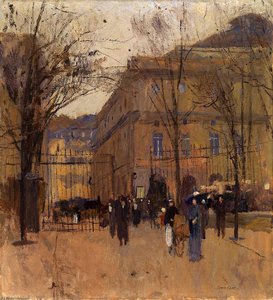
His repertoire serves as a visual love letter to Paris, capturing iconic landmarks with an intimacy that transcends mere topography. In works such as Place de la Concorde no. V, one can witness his mastery of depth and texture, where statues atop pillars and the distant silhouette of a clock tower are brought to life through energetic strokes and the inclusion of dynamic elements like scattered birds. Similarly, his depictions of Place St. Germain des Pres showcase his ability to render the bustling energy of city streets, balancing the grandeur of historic churches with the transient movement of pedestrians. Whether capturing the melancholic atmosphere of a twilight scene at Quai de la Seine or the somber realism of a Portrait de Jeune Homme, Scott’s work remains anchored in an acute sensitivity to tonal variation and the emotional weight of light.
Historical Significance and Artistic Endurance
Though his life was cut short in 1929, Frank Edwin Scott left behind a body of work that stands as a testament to the enduring charm of the Impressionist era. His ability to bridge the gap between the scientific precision inherited from his family and the emotive freedom of modernism allowed him to create scenes that feel both structurally sound and atmospherically ethereal. The presence of his works in esteemed institutions, such as the Smithsonian American Art Museum and the Hirshhorn Museum and Sculpture Garden, underscores his lasting contribution to the transatlantic art dialogue.
Today, Scott’s paintings continue to resonate with viewers who seek the nostalgic beauty of a bygone Paris. His legacy is found in:
- The mastery of light: His unique ability to render sunlight on water and foliage.
- Urban intimacy: His skill in transforming crowded cityscapes into poetic, atmospheric narratives.
- Technical evolution: The transition from academic rigor to the expressive freedom of Impressionistic brushstrokes.
Through his eyes, the streets of Paris were not merely locations, but living, breathing canvases of color and emotion, forever preserved in the soft, luminous glow of his enduring masterpieces.