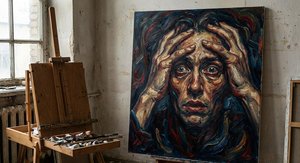
A Life Etched in Texture: The World of Fritz Blumenthal
Fritz Blumenthal, born Friedrich Salomon Perls in 1913, was an artist whose life journey mirrored the tumultuous currents of the 20th century. Though perhaps best known under his adopted name, Blumenthal’s artistic identity emerged from a crucible of displacement and reinvention. His story begins not with brushes and canvases, but with the vibrant intellectual atmosphere of Berlin in the early years of the Weimar Republic. Perls' family was Jewish, and as the political climate darkened with the rise of Nazism, his path diverged sharply from the academic pursuits initially envisioned for him. Forced to flee Germany in 1936, he found refuge first in England, then ultimately in the United States, settling in New York City in 1941. This experience of exile profoundly shaped his artistic vision, instilling a sense of urgency and a deep empathy for the human condition that would permeate his work. He deliberately chose “Blumenthal” as his professional name, shedding his birth name as a symbolic act of creating a new self amidst profound loss and upheaval.From Early Studies to Abstract Expressionism
Blumenthal’s formal artistic training was fragmented by the exigencies of war and migration. He received some instruction at the Reimann School in Berlin before his departure, but much of his early development was self-directed, fueled by an insatiable curiosity and a relentless experimentation with materials. Initially drawn to figurative work, he quickly moved beyond representational accuracy, embracing abstraction as a means of conveying emotional truths that words could not capture. His early New York period saw him immersed in the burgeoning Abstract Expressionist movement. While never fully aligning himself with any particular school, Blumenthal absorbed the energy and innovation of artists like Jackson Pollock, Mark Rothko, and Willem de Kooning. However, his work distinguished itself through a unique emphasis on texture – not merely as an aesthetic element, but as a fundamental carrier of meaning. He built up surfaces layer upon layer, incorporating sand, gesso, and other materials to create paintings that were almost sculptural in their physicality.The Language of Surface: Technique and Symbolism
Blumenthal’s signature technique involved the meticulous application of thick impasto, often using palette knives rather than brushes. This process wasn't simply about creating a visually interesting surface; it was an act of excavation, revealing hidden depths and suggesting layers of memory and experience. His paintings frequently feature muted palettes – ochres, grays, browns, and blacks – evoking a sense of melancholy and introspection. Within these somber tones, however, there often emerge subtle hints of color and light, representing glimmers of hope or resilience. Portraits, though abstracted, remained a central theme throughout his career. He wasn’t interested in capturing likeness; rather, he sought to convey the inner life of his subjects – their vulnerabilities, anxieties, and quiet dignity. The textured surfaces themselves became metaphors for the complexities of human personality, suggesting the scars and layers that accumulate over time. Quiet Moments, scenes of everyday life rendered with a profound sensitivity, also populate his oeuvre, offering poignant reflections on solitude, loss, and the search for meaning in a fragmented world.Major Achievements and Artistic Legacy
While Blumenthal enjoyed critical recognition throughout his career – exhibiting widely in New York galleries and museums – he remained somewhat outside the mainstream art market. He was included in significant group exhibitions such as “Abstract Expressionists at the American Academy of Arts and Letters” and “The Second Generation Abstract Expressionists,” solidifying his position within the post-war artistic landscape. His work, however, often defied easy categorization, blending elements of abstraction, figuration, and a deeply personal symbolism.- Blumenthal’s consistent exploration of texture as a means of emotional expression set him apart from many of his contemporaries.
- He successfully navigated the challenges of artistic reinvention following his exile from Germany, forging a unique voice that reflected both his personal history and the broader anxieties of the post-war era.
- His paintings continue to resonate with viewers today due to their raw honesty, psychological depth, and enduring relevance.
Historical Significance: A Witness to an Era
Fritz Blumenthal’s art is more than just a collection of aesthetically pleasing surfaces; it's a testament to the resilience of the human spirit in the face of adversity. His work serves as a powerful reminder of the trauma and displacement experienced by so many during the 20th century, while simultaneously offering a message of hope and renewal. He wasn’t an artist who sought to shock or provoke; rather, he aimed to create paintings that were deeply contemplative and emotionally resonant. In a world increasingly defined by superficiality and instant gratification, Blumenthal's art invites us to slow down, look closely, and engage with the complexities of human experience. His legacy lies not in grand pronouncements or stylistic innovations, but in the quiet power of his textured surfaces – surfaces that bear witness to a life etched in loss, memory, and ultimately, enduring beauty. He passed away in 2002, leaving behind a body of work that continues to inspire and challenge viewers to look beyond the surface and connect with the deeper truths of the human condition.Q&A
Fritz Blumenthal의 작품 전체 목록을 볼 수 있는 곳이 있나요?
이 사이트에 등록된 Fritz Blumenthal의 모든 작품은 작가의 전체 작품 보기 페이지에서 만나보실 수 있습니다.
Fritz Blumenthal의 전 작품에 걸친 색채 활용을 살펴볼 수 있을까요?
이 사이트에 등록된 작품 전반에 나타나는 Fritz Blumenthal의 색채 활용은 작가의 팔레트 지놈 페이지에서 자세히 살펴보실 수 있습니다.
특정 매체로 분류된 Fritz Blumenthal의 모든 작품을 어떻게 찾을 수 있나요?
특정 매체로 제작된 Fritz Blumenthal의 모든 작품을 확인하시려면, 작가의 모든 매체별 페이지를 이용해 주세요.
특정 색상 팔레트의 Fritz Blumenthal 작품은 어디에서 찾아볼 수 있나요?
특정 색상 팔레트의 Fritz Blumenthal 작품을 찾으시려면, 작가의 컬러 팔레트별로 보기 페이지를 이용해 보세요.