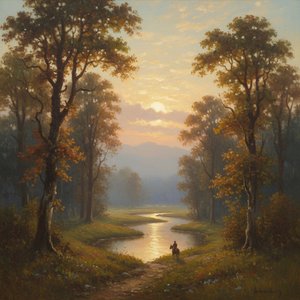
The Master of Light and Atmosphere: The Life of George Loring Brown
In the grand tapestry of nineteenth-century American art, few threads shimmer with as much luminous grace as those woven by George Loring Brown. Born in Boston in 1814, Brown emerged from a background of meticulous craftsmanship to become one of the most celebrated expatriate painters of his era. His journey began not with the broad, sweeping strokes of an oil brush, but with the disciplined, precise lines of a wood engraver. Apprenticeship under masters like Alonzo Hartwell instilled in him a profound respect for detail and composition—a foundation that would later allow him to capture the most delicate atmospheric shifts in his landscapes. This early mastery of printmaking provided him with a unique visual vocabulary, one where light was not merely an effect but a structural element capable of defining the very soul of a scene.
As his talent blossomed, Brown’s ambitions carried him far beyond the shores of New England. Encouraged by the success of his early works, he sought the artistic heart of Europe, traveling to Paris to study under the French Romanticist Eugene Isabey. It was during these formative years in Europe that Brown truly found his voice, wandering the halls of the Louvre to commune with the ghosts of masters past. He drew deep inspiration from the classical compositions of Claude Lorrain and the rugged, emotive textures of John Constable. His devotion to the luminous, idealized landscapes of the French master was so profound that he earned the affectionate moniker “Claude Brown,” a testament to his ability to recreate the golden, ethereal glow of the Old World for an American audience.
A Journey Through Italian Splendor and American Grandeur
For much of his adult life, Brown lived as a cosmopolitan wanderer, finding his most profound inspiration in the sun-drenched landscapes of Italy. His time spent in the Bay of Naples, Genoa, and Rome allowed him to cultivate a style that blended Romantic idealism with an almost Impressionistic sensitivity to light. His canvases from this period, such as “Sunset in Genoa” and his breathtaking views of the Bay of Naples, are characterized by a sense of timelessness and grandeur. These works were not merely topographical records but emotional evocations of the sublime, capturing the fleeting interplay of shadow and sun across ancient coastlines and tranquil waters.
However, Brown’s artistic identity was never solely defined by his European sojourns. Upon returning to America in 1859, he turned his observant eye toward the rugged majesty of his native landscape. The White Mountains of New Hampshire became a primary subject, providing a dramatic contrast to the soft, Mediterranean warmth of his earlier works. In masterpieces like “Sunrise, White Mountains, New Hampshire,” one can witness the evolution of his technique; he moved away from purely classical structures toward a more atmospheric approach, using tonal gradations to evoke the misty, primordial energy of the American wilderness. This ability to bridge the gap between the structured Romanticism of the past and the burgeoning light-focused sensibilities of the future solidified his historical significance.
Legacy and Artistic Achievement
The legacy of George Loring Brown is etched into the very fabric of American art history, representing a vital link between the classical traditions of Europe and the developing landscape movement in the United States. His achievements were recognized by the most prestigious institutions of his day, with numerous works exhibited at the National Academy of Design, the Brooklyn Museum of Art, and the Boston Athenæum. Even royalty took notice of his prowess; notably, “The Bay of New York” was acquired by King Edward VII during a visit to America, a remarkable testament to his international standing.
Beyond the fame of individual paintings, Brown’s true contribution lies in his role as a stylistic bridge. He successfully navigated the transition from the meticulous detail of engraving and the dramatic weight of Romanticism to the ephemeral, light-drenched beauty that would eventually define Impressionism. His life remains a testament to the power of artistic evolution—a journey from the sharp black ink of an engraver’s tool to the infinite, glowing spectrum of a sunset over the Mediterranean.
질의응답
George Loring Brown 작가 작품의 컬러 프로필은 어디에서 확인할 수 있나요?
George Loring Brown 작가 작품의 컬러 프로필은 작가의 팔레트 지놈 페이지에서 확인하실 수 있습니다.
George Loring Brown의 경력은 어떻게 시기별로 구분되어 있나요?
George Loring Brown의 연대기는 작가의 활동 시기별로 분류된 작품들을 연대순으로 보여주는 스크롤 방식의 타임라인입니다.
George Loring Brown 작가의 작품을 감상할 수 있는 3D 가상 투어가 있나요?
가상 방문이 가능합니다: George Loring Brown의 3D 뮤지엄 페이지에서 작가의 작품들을 3D 갤러리를 통해 만나보실 수 있습니다.