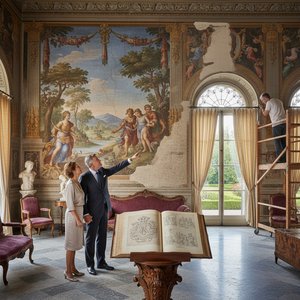
Giuseppe Bartolomeo Chiari: A Roman Baroque Visionary
Giuseppe Bartolomeo Chiari (10 March 1654 – 8 September 1727) stands as a pivotal figure in the late Baroque artistic landscape of Rome, renowned for his opulent frescoes and mosaics that graced palaces and churches alike. Born into a family opposed to his artistic ambitions—his father vehemently discouraged him from pursuing painting—Chiari defied expectations thanks to the encouragement of Carlo Antonio Gagliani, a respected painter who recognized his innate talent.
- Early Training & Apprenticeship: Chiari’s formative years were spent honing his craft under the tutelage of Carlo Maratta, arguably Rome's most celebrated Baroque artist. Alongside Giuseppe Passeri and Andrea Procaccini, he absorbed Maratta’s stylistic principles, establishing a foundation for his own distinctive artistic voice.
- The Marcaccioni Chapel Frescoes: His debut masterpiece arrived swiftly – the lateral lunettes of the Marcaccioni chapel in Santa Maria del Suffragio—where he collaborated with Giuseppe Passeri to depict scenes from the Nativity and Adoration of Magi, showcasing a masterful blend of realism and idealized beauty.
Chiari’s artistic trajectory gained momentum as he embraced commissions from influential patrons like Vittorio Ottoboni and Pope Alexander VIII, undertaking ambitious projects that cemented his reputation as one of Rome's foremost painters. Notably, he adorned the Palazzo Barberini with allegorical sketches reflecting Bellori’s interpretation of Ovids Metamorphoses—a testament to his engagement with classical mythology and humanist ideals.
- Palatial Decoration & Heraldic Symbolism: His frescoes in the Palazzo Barberini weren't merely decorative; they were laden with heraldic symbols representing prominent families – the Barberini, Vittorio Ottoboni, Colonna, and Pignatelli – skillfully interwoven into intricate compositions.
- Collaboration & Artistic Influence: Chiari’s partnership with landscape artist Jan van Bloemen on the villa di Marchese Torri exemplifies his willingness to explore diverse artistic mediums and collaborate with fellow artists, fostering a vibrant creative environment.
Beyond palaces, Chiari's artistry extended to ecclesiastical commissions, transforming churches throughout Rome with monumental frescoes and mosaics imbued with spiritual significance. He undertook the task of preparing cartoons for the mosaics in Saint Peter’s Basilica and San Giovanni Laterano, reflecting his commitment to serving the Papacy and contributing to the grandeur of Roman Catholicism.
- Notable Frescoes: Among his most celebrated works are ‘The Rest on the Flight into Egypt with Angels,’ depicting a serene biblical scene bathed in ethereal light; and ‘Saint Clement in Glory,’ commissioned for Saint Peter’s Basilica, portraying Pope Clement XI as a triumphant figure embodying divine authority.
- Teaching & Artistic Legacy: Chiari nurtured the talents of aspiring artists like William Kent, Paolo Anesi, and Giovanni Andrea Lazzarini, shaping the artistic landscape of Rome and establishing himself as a respected educator.
His studio attracted considerable attention from French artists, highlighting his influence within the broader European art scene. He served as director or principe of the Accademia di San Luca (1723–25), furthering artistic education and promoting innovation. Giuseppe Bartolomeo Chiari’s enduring legacy resides in his contribution to Baroque painting—a style characterized by dramatic emotion, opulent ornamentation, and masterful technique—leaving an indelible mark on Roman art history.
질의응답
Giuseppe Bartolomeo Chiari의 경력은 어떻게 시기별로 구분되어 있나요?
Giuseppe Bartolomeo Chiari의 예술적 여정은 연대기 페이지에서 시기별로 펼쳐집니다. 이곳에서는 작가의 활동 시기를 장(chapter)으로 나누어 작품들을 연대순 타임라인 형태로 한눈에 확인할 수 있습니다.
Giuseppe Bartolomeo Chiari가 그린 모든 주제를 한눈에 볼 수 있는 개요가 있나요?
Giuseppe Bartolomeo Chiari의 작품은 작가의 주제별 아틀라스 페이지에서 주제별로 찾아보실 수 있습니다.
Giuseppe Bartolomeo Chiari의 작품 중 몇 점을 둘러보실 수 있나요?
모든 작품 보기 페이지에서 Giuseppe Bartolomeo Chiari의 작품 작품 17점점을 만나보실 수 있습니다.