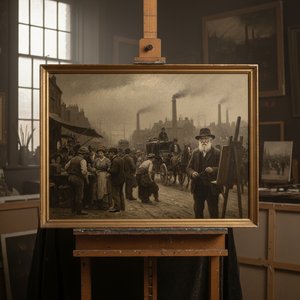
A Legacy in Likeness: The World of Guido Philipp Schmitt
Guido Philipp Schmitt occupies a fascinating, and often overlooked, niche within the pantheon of portraiture. While not a household name like Reynolds or Gainsborough, his meticulous skill and dedication to capturing the essence of Victorian society have secured him a place as a significant chronicler of his era. Born in an unspecified location – records remain elusive regarding his early life – Schmitt blossomed into a highly sought-after artist, particularly celebrated for his depictions of prominent figures and their families. His career unfolded primarily during the latter half of the 19th century, a period defined by rapid social change, industrial expansion, and a burgeoning middle class eager to immortalize themselves through art. Schmitt’s work isn't about grand historical narratives; it’s about the intimate stories held within faces, the subtle nuances of character revealed in posture and expression. He wasn’t necessarily *creating* icons, but rather faithfully preserving them for posterity.The Victorian Gaze: Style and Technique
Schmitt’s artistic style is firmly rooted in the traditions of academic realism, yet possesses a unique sensitivity that sets it apart. He masterfully employed oil on canvas, building up layers of paint to achieve an astonishing level of detail – from the delicate lace of a woman's gown to the glint of light in a gentleman’s eye. His portraits are characterized by their precise rendering of anatomy, rich color palettes (often favoring deep reds, blues and browns), and a remarkable ability to convey texture. Light plays a crucial role in his compositions; he skillfully used chiaroscuro – the dramatic contrast between light and shadow – to sculpt forms and draw attention to key features. However, Schmitt wasn’t merely a technical virtuoso. He understood the psychological power of portraiture, striving to capture not just *how* someone looked, but also *who* they were. His subjects rarely appear overtly posed; instead, there's a sense of naturalness and immediacy that invites the viewer into their world. This ability to blend technical precision with emotional depth is perhaps his greatest strength.Influences and Artistic Lineage
Pinpointing Schmitt’s direct artistic influences proves challenging due to limited biographical information. However, it's clear he was deeply familiar with the works of earlier portrait masters. The influence of Sir Thomas Lawrence, known for his elegant and refined portraits of British aristocracy, is readily apparent in Schmitt’s attention to detail and flattering depictions of his sitters. The compositional principles employed by Anthony van Dyck, particularly his use of flowing drapery and sophisticated poses, also resonate within Schmitt's oeuvre. Furthermore, the rise of photography during the Victorian era undoubtedly impacted his work. While not attempting to replicate photographic realism, Schmitt likely absorbed its emphasis on accurate representation and capturing fleeting moments in time. He skillfully integrated these influences into a style that was distinctly his own – one characterized by both technical mastery and psychological insight.A Chronicler of Society: Major Achievements
While a comprehensive catalogue raisonné of Schmitt’s work remains unavailable, numerous examples of his portraits can be found in private collections and museums across Europe and North America. He received commissions from prominent families, industrialists, and members of the British gentry, establishing himself as a highly respected – though relatively discreet – figure within the art world. His most celebrated works are undoubtedly his full-length portraits of Victorian ladies and gentlemen, often depicted in opulent interiors or picturesque landscapes. These paintings offer invaluable glimpses into the fashion, social customs, and material culture of the era.- Schmitt’s ability to capture the personality of his sitters is consistently praised by art historians.
- His meticulous attention to detail provides a wealth of information about Victorian clothing, accessories, and interior design.
- The enduring appeal of his portraits lies in their timeless elegance and emotional resonance.
Historical Significance and Enduring Appeal
Guido Philipp Schmitt’s historical significance resides not in revolutionary artistic innovation, but rather in his exceptional skill as a portraitist and his dedication to documenting Victorian society. He wasn't attempting to break new ground; he was perfecting an existing tradition, elevating it through his technical prowess and psychological sensitivity. In an age of mass production and rapid change, Schmitt’s portraits offer a poignant reminder of the value placed on individuality and personal representation. His work serves as a valuable historical resource, providing insights into the lives, values, and aspirations of the Victorian middle class. Today, his paintings continue to captivate audiences with their beauty, elegance, and enduring emotional power – a testament to the timeless appeal of masterful portraiture. He remains a vital link to understanding the nuances of a bygone era, one face at a time.질의응답
Guido Philipp Schmitt의 작품을 기법별로 모아볼 수 있는 곳은 어디인가요?
특정 매체로 제작된 Guido Philipp Schmitt의 모든 작품을 확인하시려면, 작가의 모든 매체 페이지를 이용해 주세요.
Guido Philipp Schmitt 작가 작품에 대한 통계 정보는 어디에서 확인할 수 있나요?
Guido Philipp Schmitt의 작품에 관한 통계를 보여주는 통계 페이지가 본 웹사이트에 마련되어 있습니다.
Guido Philipp Schmitt의 모든 작품에 나타나는 색채 활용을 살펴볼 수 있을까요?
Guido Philipp Schmitt의 팔레트 지놈는 작가의 작품 세계를 구성하는 컬러 프로필을 보여주는 페이지입니다.