Henry Keyworth Raine: The Cellar Artist of Victorian London
Henry Keyworth Raine (1872–1934) remains a quietly compelling figure in the annals of 19th-century British portraiture. Often overshadowed by his more celebrated contemporaries, Raine’s unique approach to painting—a deliberate embrace of darkness and a masterful manipulation of light—yielded strikingly intimate and psychologically astute portraits that continue to resonate with viewers today. His story is one of unconventional methods, relentless dedication, and a profound understanding of the human spirit, all forged within the confines of his famously secretive “cellar studio” in Westminster.
Born into a respectable middle-class family in York, Raine’s early life was steeped in the values of Victorian society—a blend of earnest morality, burgeoning industrial progress, and an unwavering belief in the power of art to reflect and shape the world. His lineage included William Powell Frith, a prominent artist known for his grand historical paintings, providing Raine with a subtle but significant connection to the established artistic circles of London. However, unlike Frith’s public exhibitions and formal training, Raine's path was markedly different. He eschewed the conventional routes to success, choosing instead to cultivate his craft in near-seclusion, a decision that would ultimately define his artistic identity.
The Secret Studio and Method
Raine’s most remarkable characteristic was undoubtedly his studio—a small, subterranean space beneath Hanover Square, Westminster. Legend had it that he worked entirely by candlelight, relying on just three colors – black, white, and a single shade of red – to create his paintings. This deliberate restriction, coupled with the limited light, forced him to develop an extraordinary sensitivity to tonal values and subtle gradations of color. As contemporary newspapers reported, Raine’s technique involved meticulously building up layers of paint, creating a remarkably luminous effect despite the darkness. He claimed to be attempting to emulate the techniques of masters like Titian, Rembrandt, and Velázquez, artists renowned for their ability to capture light and shadow with unparalleled skill.
The process was intensely demanding, requiring hours of painstaking work. Raine’s clients would typically visit his studio only once, allowing him to complete a portrait in as little as five hours. This remarkable efficiency stemmed not from speed but from an incredibly focused and deliberate approach—a testament to his mastery of the medium. The secrecy surrounding his methods further fueled speculation and intrigue, solidifying his reputation as “The Cellar Artist,” a moniker that perfectly encapsulated his enigmatic persona.
A Portraiture of His Time
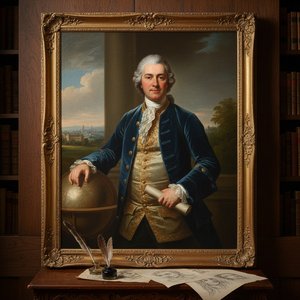
Raine’s subjects were primarily members of the British upper class—aristocrats, politicians, and prominent figures in various fields. He produced portraits of notable individuals such as Francis Foljambe, a Liberal politician, and Henry Edwyn King-Tenison, 9th Earl of Kingston. His paintings are characterized by their remarkable likenesses, capturing not just physical appearance but also the personalities and inner lives of his subjects. Raine possessed an uncanny ability to convey emotion through subtle gestures, expressions, and the interplay of light and shadow.
His portraits offer a fascinating glimpse into Victorian society—a world of rigid social conventions, burgeoning wealth, and complex relationships. Through his art, Raine subtly explored themes of power, status, and identity, reflecting the anxieties and aspirations of the era. While he never sought public recognition or exhibited his work, his paintings nonetheless became highly valued by his clientele, serving as enduring testaments to their position and influence.
Legacy and Recognition
Despite his remarkable talent and unique approach, Raine remained largely unknown during his lifetime. He shunned the limelight, preferring the solitude of his studio to the demands of public exhibition. However, in recent decades, scholarly reassessments have begun to shed light on his significant contributions to British art. His paintings are now housed in several public collections, including the York Art Gallery, and are increasingly recognized for their technical brilliance and psychological depth.
Henry Keyworth Raine’s story is a reminder that artistic genius can often flourish outside of conventional channels. His dedication to his craft, coupled with his distinctive methods, resulted in a body of work that continues to captivate and intrigue viewers today—a testament to the enduring power of a truly unique artist.
질의응답
Henry Keyworth Raine의 작품 세계는 시간이 흐름에 따라 어떻게 변화했나요?
Henry Keyworth Raine의 연대기는 작가의 활동 시기별로 분류된 작품들을 연대순으로 보여주는 스크롤 방식의 타임라인입니다.
Henry Keyworth Raine가 그린 모든 주제를 한눈에 볼 수 있는 개요가 있나요?
Henry Keyworth Raine의 작품은 작가의 주제별 아틀라스 페이지에서 주제별로 찾아보실 수 있습니다.
Henry Keyworth Raine의 작품을 분위기별로 모아둔 곳은 어디인가요?
Henry Keyworth Raine의 작품은 각 작품에 담긴 분위기에 따라 분류된 아티스트의 무드 룸 페이지에서 무드별로 감상하실 수 있습니다.