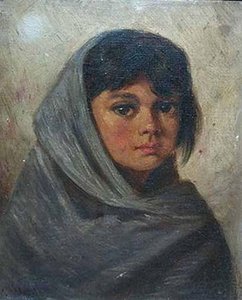
Isabel Vaill Waldo: A Connecticut Impressionist’s Quiet Brilliance
Isabel Vaill Waldo (1842-1929) remains a quietly significant figure in late 19th and early 20th century American art, largely due to the relative obscurity of her work during her lifetime. Born into a family with strong artistic leanings – her father, Daniel Waldo, was a respected surveyor and engineer – Isabel’s path wasn't immediately defined by a career as an artist. Instead, she initially pursued teaching, finding employment as a schoolteacher in Minnesota and later Connecticut, skills that would prove invaluable in shaping her future artistic endeavors. However, the pull of art remained constant, nurtured by her mother’s encouragement and a deep appreciation for the natural world. This early exposure to both education and observation laid the foundation for her distinctive style – one characterized by a serene beauty, meticulous detail, and an evocative portrayal of Connecticut's landscapes and portraits.Early Life and Artistic Training
Isabel Vaill Waldo’s formative years were spent in the Midwest, specifically Minnesota, where she developed a keen eye for observation and a deep connection to the surrounding environment. This period instilled within her a love for capturing the subtle nuances of light and shadow, as well as an appreciation for the beauty of rural life. Crucially, she received formal artistic training at the École des Beaux Arts in Paris from 1869 to 1874. This immersion in European art traditions—particularly Impressionism and Realism—significantly influenced her technique and subject matter. She studied under prominent instructors like Charles-Édouard Fortescue and Jean-Léon Gérôme, absorbing their approaches to composition, color theory, and rendering natural forms. Returning to America, she continued her artistic development, honing her skills through independent study and experimentation. Her time in Paris wasn’t merely a period of formal instruction; it was a transformative experience that broadened her artistic horizons and provided her with the tools to express herself more effectively.Connecticut Landscapes and Portraiture
Upon her return to America, Isabel Vaill Waldo established a home and studio in Connecticut, specifically in the towns of New Haven and Southport. It is here that she truly flourished as an artist, dedicating herself primarily to painting landscapes and portraits. Her Connecticut scenes are particularly noteworthy for their atmospheric quality and meticulous attention to detail. She frequently depicted the Long Island Sound, capturing its shimmering surface under various lighting conditions – from the soft glow of dawn to the dramatic intensity of a storm. Her paintings aren’t simply representations of these locations; they evoke a sense of tranquility, contemplation, and connection with nature. Similarly, her portraiture demonstrates a remarkable ability to capture not only physical likeness but also the personality and character of her subjects. She often depicted members of her family and local residents, imbuing each portrait with a quiet dignity and warmth. Her use of light and shadow, combined with subtle shifts in expression, creates compelling and intimate portraits that reveal more than just appearances.Technique and Style
Isabel Vaill Waldo’s artistic style is often described as Impressionistic Realism – a synthesis of the two approaches. She embraced the Impressionists' emphasis on capturing fleeting moments of light and color, while retaining a commitment to accurate observation and detailed rendering. Her brushwork is typically loose and expressive, yet carefully controlled, creating a sense of depth and atmosphere. She employed a rich palette, favoring muted tones—greens, blues, browns, and grays—to create a harmonious and evocative mood. A key characteristic of her work is the use of *impasto*, applying paint thickly to the canvas to build texture and add visual interest. This technique is particularly evident in her landscape paintings, where it enhances the sense of materiality and depth. Her compositions are generally balanced and well-structured, guiding the viewer’s eye through the scene with a clear sense of direction.Legacy and Historical Significance
Despite her talent and dedication, Isabel Vaill Waldo's work received relatively little recognition during her lifetime. She primarily sold her paintings to friends, family, and local patrons, and few were exhibited in major galleries or museums. However, in recent decades, there has been a growing interest in her art, fueled by the rediscovery of her oeuvre through archival research and private collections. Today, Isabel Vaill Waldo is increasingly recognized as an important figure in American art—a quiet but accomplished artist who captured the beauty and serenity of Connecticut’s landscapes with remarkable skill and sensitivity. Her work offers a valuable glimpse into the artistic landscape of late 19th-century America, demonstrating the evolving role of women artists and the enduring appeal of naturalistic painting. Her legacy lies not only in her beautiful paintings but also in her perseverance and dedication to her craft—a testament to the power of quiet brilliance.질의응답
Isabel Vaill Waldo의 작품을 연도순으로 어디에서 볼 수 있나요?
Isabel Vaill Waldo의 작품 연표를 확인해 보세요: 작품 연대기 페이지에서 작품들을 제작 날짜순으로 보실 수 있습니다.
주제별로 Isabel Vaill Waldo의 작품을 탐색할 수 있나요?
Isabel Vaill Waldo의 주제별 아틀라스는 작가의 작품들을 주제별로 분류하여 보여주는 페이지입니다.
Isabel Vaill Waldo의 작품을 팔레트별로 모아둔 곳은 어디인가요?
특정 색상 팔레트의 Isabel Vaill Waldo 작품을 찾으시려면, 작가의 컬러 팔레트별 페이지를 이용해 보세요.