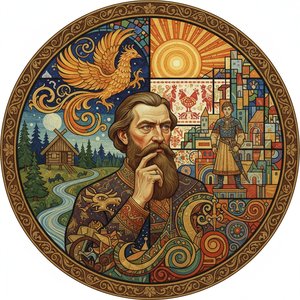
Ivan Yakovlevich Bilibin: A Life in Art
Early Life and Education
- Born: 1876 in Tarkhovka, a suburb of St. Petersburg, Russia.
- Ivan Bilibin demonstrated an early aptitude for art, nurtured by the vibrant cultural atmosphere of his surroundings.
- He initially studied law at the University of St. Petersburg but soon abandoned it to pursue his artistic passions.
- Bilibin received formal training at Anton Ažbe's School of Art in Munich (1898), where he was exposed to Art Nouveau and German satirical illustration, particularly the journal *Simplicissimus*.
- He further honed his skills under the tutelage of Ilya Repin at the Imperial Academy of Arts in St. Petersburg.
Artistic Development and Influences
- Early Influences: Bilibin’s artistic development was profoundly shaped by his ethnographic expeditions to northern Russia (Vologda, Olonetsk, Arkhangelsk governorates) between 1902-1904.
- These travels sparked a deep fascination with Russian folk art, wooden architecture, and the rich traditions of the peasantry. He documented his findings in *Narodnoye tvorchestvo russkogo severa* (Folk Arts of the Russian North) published in 1904.
- Japanese prints, with their emphasis on line, composition, and narrative storytelling, also exerted a significant influence on his style.
- He embraced a distinctive aesthetic that blended elements of traditional Russian iconography, folk art motifs, and the decorative qualities of Art Nouveau.
Key Works and Artistic Style
- Illustrations of Fairy Tales: Bilibin achieved widespread recognition for his enchanting illustrations of Russian fairy tales, beginning in 1899. Notable works include depictions of *Baba Yaga*, *Vasilisa the Beautiful*, and *Ivan Tsarevich catching the Firebird’s feather*.
- Stage Design: He became a sought-after stage designer, collaborating with Sergei Diaghilev's Ballets Russes. His designs for Nikolai Rimsky-Korsakov’s *The Golden Cockerel* (1909) are particularly celebrated.
- Distinctive Style: Bilibin’s style is characterized by its elegant lines, flattened perspective, symbolic use of color, and meticulous attention to detail. He often incorporated elements of medieval Russian manuscript illumination into his work.
- He also created posters and book illustrations for various publications, including *Dog Rose* and the Moscow Publishing House.
Political Engagement and Later Life
- Revolutionary Period: During the Russian Revolution of 1905, Bilibin created politically charged cartoons for the magazine *Župel*, which was later banned.
- Exile and Return: Following the October Revolution in 1917, disillusioned with the new regime, he left Russia. He lived in Cairo, Alexandria, and eventually settled in Paris (1925), where he worked as a decorator.
- Despite his initial departure, Bilibin harbored a longing for his homeland and returned to the Soviet Union in 1936 after decorating the Soviet Embassy.
- Tragic End: He died during the Siege of Leningrad in 1942, refusing to evacuate despite the dire conditions.
Legacy and Historical Significance
- Ivan Bilibin is considered one of Russia’s most important illustrators and stage designers.
- Revival of National Identity: His work played a crucial role in reviving interest in Russian folklore and national identity during a period of rapid social and political change.
- Influence on Modern Art: Bilibin’s distinctive style influenced subsequent generations of artists, particularly those interested in exploring the intersection of art, folklore, and national culture.
- His illustrations continue to captivate audiences worldwide with their beauty, imagination, and evocative portrayal of a bygone era.
질의응답
Ivan Yakovlevich Bilibin 작가 작품에 대한 통계 정보는 어디에서 확인할 수 있나요?
Ivan Yakovlevich Bilibin의 작품에 관한 통계를 보여주는 통계 페이지가 본 웹사이트에 마련되어 있습니다.
특정 매체로 분류된 Ivan Yakovlevich Bilibin의 모든 작품을 어떻게 찾을 수 있나요?
Ivan Yakovlevich Bilibin의 작품은 작가 페이지인 모든 매체에서 매체별로 둘러보실 수 있습니다.
Ivan Yakovlevich Bilibin의 작품 세계는 시간이 흐름에 따라 어떻게 변화했나요?
Ivan Yakovlevich Bilibin의 연대기는 작가의 활동 시기별로 분류된 작품들을 연대순으로 보여주는 스크롤 방식의 타임라인입니다.