Early Life and Apprenticeship
Jack Clarkson, born in the Yorkshire mill town of Silsden in 1906, emerged into a world steeped in industrial grit and burgeoning artistic expression. His early life was marked by a practical upbringing; his father, a clog iron maker, instilled a sense of craftsmanship that would later permeate Clarkson’s meticulous approach to painting. However, the allure of art proved too strong to resist. After initial studies at Keighley School of Art, where he received foundational training, Clarkson ventured to the Royal College of Art in London – a pivotal moment that exposed him to a wider range of influences and techniques. Crucially, it was here he came under the tutelage of Henry Moore, whose emphasis on form and simplification would subtly shape Clarkson’s developing style.
This period wasn't solely about formal education; it was a time of exploration and self-discovery. While many artists of his generation were drawn to abstract movements, Clarkson found himself increasingly captivated by the everyday scenes unfolding around him – the bustling streets, the quiet canals, the solid architecture of Birmingham, which would become his lifelong muse. He wasn’t immediately destined for fame or recognition; instead, he embarked on a path defined by dedicated observation and a commitment to capturing the essence of urban life.
Birmingham: A City as Subject
Clarkson's artistic identity became inextricably linked with Birmingham. Unlike many landscape painters who sought out idyllic rural vistas, Clarkson turned his gaze inward, finding beauty in the industrial heartland. He wasn’t merely documenting the city; he was interpreting it – revealing a poetic sensibility within its brick and mortar. His watercolors, often executed with remarkable detail, depict canals winding through the urban fabric, squares teeming with life, and the interiors of historic inns like the Red Lion Square and Market Inn. These weren't grand historical narratives but intimate glimpses into the rhythm of daily existence.
His work from this period showcases a unique blend of realism and impressionistic light. He possessed an extraordinary ability to capture the atmosphere of Birmingham – the dampness of the canals, the warmth of pub interiors, the subtle gradations of color in the sky above the industrial skyline. While his technique was precise, it never felt sterile; instead, there’s a palpable sense of empathy and affection for his subject matter. He wasn't interested in romanticizing Birmingham but in presenting an honest and nuanced portrayal of its character.
Influences and Artistic Development
While Clarkson didn’t adhere to any single artistic school, several influences shaped his development. The legacy of Victorian watercolorists – artists like Frederick Stanfield, whose dramatic seascapes and landscapes resonated with a sense of Romanticism – can be detected in Clarkson's meticulous brushwork and atmospheric effects. However, he diverged from the grand scale and theatricality of Stanfield, opting for a more intimate and understated approach.
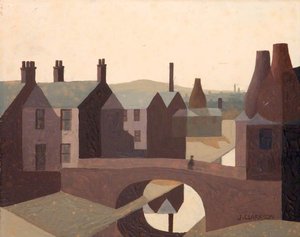
The rise of Modernism also left its mark on his work, particularly in his use of geometric forms and muted tones. His ‘Potteries View with Canal,’ for example, exhibits a stylized quality that hints at the influence of Cubism and other avant-garde movements. Yet, Clarkson never fully embraced abstraction; he remained committed to representing recognizable subjects, albeit through a distinctly modernist lens. This tension between realism and stylization is what gives his work its unique character.
Legacy and Historical Significance
Jack Clarkson’s contribution to British art lies in his ability to elevate the ordinary to the level of artistic significance. He demonstrated that beauty could be found not only in picturesque landscapes but also in the gritty realities of urban life. His paintings offer a valuable glimpse into Birmingham's past – a time of industrial growth, social change, and evolving cultural identity.
Although he didn’t achieve widespread fame during his lifetime, his work has gained increasing recognition in recent years. Art historians have praised his meticulous technique, atmospheric sensitivity, and unique perspective on the British landscape. His paintings are now held in numerous public and private collections, serving as a testament to his enduring artistic vision.
- Key Characteristics: Detailed watercolors, urban scenes, Birmingham landscapes, canals, squares, inns, realism blended with impressionistic light.
- Influences: Victorian watercolorists (Frederick Stanfield), Modernism, Henry Moore.
- Major Themes: Urban life, industrial landscape, social observation, the beauty of everyday scenes.
Clarkson’s legacy extends beyond his paintings; he represents a generation of artists who challenged conventional notions of artistic subject matter and embraced the complexities of modern life. His work continues to resonate with viewers today, offering a poignant reminder that art can be found in the most unexpected places.
Q&A
Jack Clarkson의 모든 작품을 어디에서 볼 수 있나요?
이 사이트에 등록된 Jack Clarkson의 모든 작품은 작가의 전체 작품 보기 페이지에서 만나보실 수 있습니다.
Jack Clarkson의 작품을 분위기별로 찾아볼 수 있나요?
Jack Clarkson의 작품은 각 작품이 지닌 분위기에 따라 분류된 무드 룸 페이지에서 무드별로 감상하실 수 있습니다.
Jack Clarkson의 작품을 컬러 팔레트별로 둘러볼 수 있나요?
컬러 팔레트별로 보기 페이지에서는 Jack Clarkson의 작품들을 색상 팔레트별로 모아볼 수 있습니다.
Jack Clarkson의 연도별 활동 기록이 있나요?
Jack Clarkson의 작품 세계를 시간순으로 정리한 기록은 아티스트 연대기 페이지에서 확인하실 수 있으며, 이곳에서는 각 시기별로 분류된 챕터를 따라 작품들을 제작 순서대로 만나보실 수 있습니다.