The Delicate Precision of a Master Miniaturist
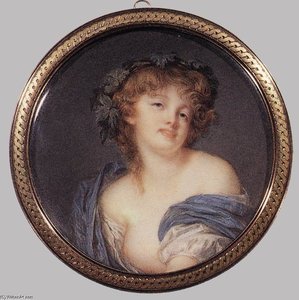
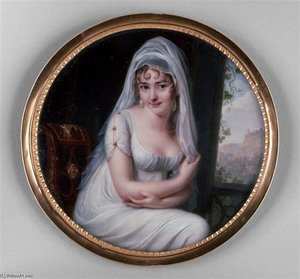
In the grand tapestry of French art history, few hands possessed the delicate touch required to capture the fleeting essence of a soul upon such a minuscule scale as Jean-Baptiste Jacques Augustin. Born in Saint-Dié-des-Vosges, France, his journey from the son of a master glazier to a celebrated painter of the royal court is a testament to an innate, luminous talent. From his earliest years, Augustin displayed a profound aptitude for drawing, a gift that caught the eye of local clergy and paved his way toward formal training in Nancy. It was here, under the guidance of masters such as Jean-Baptiste Claudot, that he began to refine the technical precision that would later define his career.
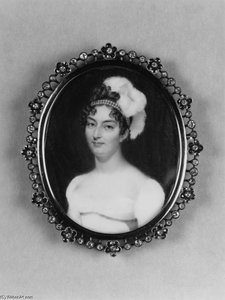
The pursuit of excellence eventually drew him to Paris, where the vibrant energy of the late eighteenth century provided the perfect stage for his burgeoning skill. After a brief period in Dijon alongside his brother Georges-Nicolas, Augustin immersed himself in the competitive Parisian art scene. He initially honed his craft within the studios of Pierre Gatien Philipon, but his true destiny lay in the intimate world of portrait miniatures. His ability to marry Rococo elegance with neoclassical detail allowed him to develop a prestigious clientele that spanned the social strata of a changing France.
A Life Amidst Revolution and Royalty
The trajectory of Augustin’s life was inextricably linked to the turbulent political tides of his era. During the height of the French Revolution, he sought refuge in his hometown, yet his artistic connection to the capital remained unbroken. When he returned to exhibit at the Paris Salon, his work reflected the duality of the age, capturing portraits of both the old nobility and the new revolutionaries with equal grace. This remarkable versatility ensured his survival and continued relevance through profound regime changes.
As the dust of revolution settled, Augustin found himself embraced by the rising Napoleonic era, eventually earning the distinction of working for Napoleon and his entourage. His accolades were numerous; in 1806, he was honored with a gold medal, and by 1814, the restored monarchy recognized his unparalleled skill by appointing him peintre ordinaire du Cabinet du roi. He held several prestigious titles, including painter of foreign affairs and miniature painter of the royal court. Even as he achieved the Legion of Honor in 1821, the shifting whims of political favor would eventually see his position replaced by his own talented pupil, Lizinska de Mirbel.
Legacy and Artistic Influence
Beyond his individual portraits, Augustin’s impact was felt through the lineage of artists he nurtured. As a popular teacher, he shaped the next generation of miniaturists, including Alexandre de Latour and Fanny Charrin. His personal life also mirrored his professional devotion, as he married his pupil Pauline du Cruet, an artist who shared his delicate aesthetic and contributed to the enduring legacy of their shared style.
The works of Jean-Baptiste Jacques Augustin remain cherished treasures in the world's most esteemed institutions, such as The Walters Art Museum and the British Museum. His miniatures, characterized by a serene beauty and an exquisite command of light, continue to offer a window into the intimate lives of the past. Though his later years were marked by the physical decline of gout, his contribution to the art of portraiture remains an indelible mark on the history of French fine art.
질의응답
Jean Baptiste Jacques Augustin의 작품을 색상별로 모아둔 곳은 어디인가요?
Jean Baptiste Jacques Augustin의 색상별 인덱스는 작가의 작품들을 색상별로 정리하여 보여주는 페이지입니다.
Jean Baptiste Jacques Augustin의 출생 도시와 국가는 어디인가요?
Jean Baptiste Jacques Augustin은(는) France의 Saint-Dié-des-Vosges에서 태어났습니다.
키워드로 Jean Baptiste Jacques Augustin의 작품을 찾아볼 수 있나요?
특정 주제의 Jean Baptiste Jacques Augustin 작품을 찾으려면 키워드별로 작품이 분류된 작가의 키워드별로 페이지를 이용해 보세요.