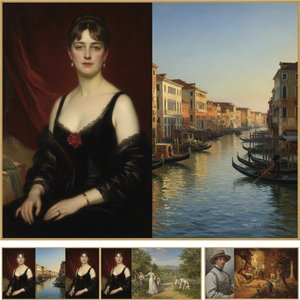
John Cranch (1807–1891): A Painter of Victorian Dignity
John Cranch, born in 1807 in Kingsbridge, Devonshire, England, emerged as a prominent figure in the artistic landscape of his era—the Victorian period. Though initially self-taught through drawing, writing and music, he benefited from early instruction from a Roman Catholic priest, shaping his foundational skills before venturing into London’s art scene. His ambition to join the Royal Academy was thwarted, yet he found considerable success with the Society of Artists and the British Institution, establishing himself as a respected painter known for his refined style and meticulous attention to detail.- Early Life & Education: Cranch's formative years were marked by a passion for artistic pursuits fostered by familial connections to influential figures like Sir Joshua Reynolds. His upbringing instilled in him a deep appreciation for classical ideals and humanist values, which would permeate his artistic vision.
- Notable Works: Cranch’s oeuvre encompasses both portraits and historical scenes, demonstrating versatility and technical prowess. Among his most celebrated paintings are “Playing with Baby,” housed in the Victoria and Albert Museum, and “The Miser,” a poignant depiction of human vulnerability and moral contemplation. His masterpiece, "The Death of Chatterton," now owned by Sir James Winter Lake, showcases his ability to convey emotion through subtle shading and expressive composition.
- Technique & Style: Cranch’s artistic style is characterized by its dignified composure and meticulous realism—a hallmark of Victorian art. He skillfully employed glazing techniques to achieve luminous surfaces and create depth, capturing the nuances of human expression with remarkable accuracy. His penchant for “poker-pictures”—images that convey complex psychological states—established him as a pioneer in exploring the inner lives of his subjects.
- Recognition & Legacy: Cranch’s membership in prestigious organizations like the American Academy of Arts and Sciences and the American Antiquarian Society cemented his reputation as an intellectual artist. His contributions to art scholarship, particularly “On the Economy of Testaments” and “Inducements to Promote the Fine Arts,” further solidified his legacy as a champion of artistic excellence and national pride.
Influences & Artistic Context
Cranch’s artistic sensibilities were profoundly shaped by the prevailing intellectual currents of Victorian England—a period marked by scientific inquiry, moral reform, and a renewed interest in classical art history. Reynolds' influence was particularly significant, guiding Cranch toward a style rooted in observation and psychological insight. Furthermore, Cranch absorbed inspiration from Romantic painters like Turner and Constable, incorporating elements of atmospheric perspective and dramatic lighting into his compositions.Major Achievements & Artistic Contributions
Cranch’s artistic achievements spanned across multiple mediums and genres, reflecting the breadth of his creative vision. He excelled in portraiture, capturing the likenesses of prominent figures with unwavering precision—a skill that earned him considerable acclaim during his lifetime. Simultaneously, he tackled ambitious historical narratives, meticulously reconstructing past events with meticulous detail and conveying their significance through evocative imagery. His enduring legacy resides not only in his celebrated paintings but also in his scholarly writings, which championed artistic innovation and fostered a deeper understanding of the human condition.Concluding Remarks
John Cranch’s life and work stand as testament to the transformative power of artistic dedication and intellectual curiosity—qualities that defined him as both an artist and a humanist. His paintings continue to resonate with audiences today, offering glimpses into Victorian society and capturing the essence of human emotion with enduring grace. As a painter who skillfully blended observation, technique, and psychological insight, Cranch secured his place among the most distinguished artists of his time—a figure whose legacy persists as an exemplar of artistic excellence and intellectual engagement.질의응답
John Cranch은(는) 어느 시대에 활동했나요?
John Cranch은(는) 19th Century 시대에 활동했습니다. 이 시기는 역사적 맥락에서 작가의 활동 위치를 보여줍니다.
John Cranch 작가는 어떤 사조에 참여했나요?
John Cranch 작가가 활동했던 예술 사조는 작품을 사조별로 분류하여 보여주는 작가의 모든 사조 페이지에서 확인하실 수 있습니다.
John Cranch의 모든 작품은 어디에서 볼 수 있나요?
본 웹사이트에 등록된 John Cranch의 모든 작품은 작가의 모든 작품 보기 페이지에서 확인하실 수 있습니다.