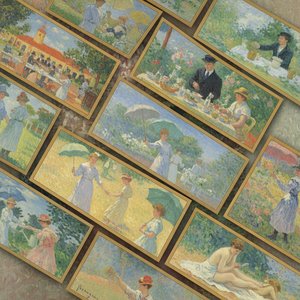
The Legacy of Light: The Life and Art of Karl Pierre Daubigny
In the golden age of French landscape painting, few artists captured the ephemeral dance of light and shadow as intimately as Karl Pierre Daubigny. Born in Paris in 1846, Daubigny was destined for a life steeped in the pigments and textures of the natural world. As the son of the renowned Charles François Daubigny, a pillar of the Barbizon school, his very existence was intertwined with the evolution of French realism and the burgeoning Impressionist movement. This profound artistic lineage provided him with more than just technical instruction; it gifted him an ancestral eye for the subtle shifts in atmosphere that define the soul of a landscape.
Daubigny’s journey into the heart of the art world began remarkably early. At the tender age of seventeen, he made his triumphant debut at the prestigious Salon of 1863. Works such as Un Sentier (A Track) and Île de Vaux in Auvers immediately signaled to critics and peers alike a profound sensitivity to the vitality of spring. While his early brushwork bore the unmistakable influence of his father’s grounded, realist approach, a unique spirit began to emerge from his canvases—one that sought not just to document the earth, but to evoke its breathing, changing essence.
A Mastery of Atmosphere and Technique
As his career matured, Daubigny moved beyond mere representation, venturing into a more personal and somber stylistic realm. He became a master of the atmospheric nuance, particularly in his depictions of the Seine and Oise valleys. His technique was characterized by an exquisite command over the interplay of color and light, often employing broken brushstrokes to simulate the shimmering reflections found on moving water. To gaze upon a Daubigny landscape is to witness the meticulous study of sunlight as it strikes a ripple or filters through a canopy of leaves.
<- Tonal Depth: He favored a sophisticated palette of earthy ochres, siennas, and umbers, which provided a warm, grounded foundation for his more luminous highlights.
- Textural Realism: His ability to render the tactile qualities of nature—the roughness of bark, the softness of moss, and the fluidity of river currents—created a palpable sense of presence.
- Luminous Innovation: By layering colors with precision, he achieved a vibrating quality in his work that anticipated the full flowering of Impressionism.
His fascination with the natural world led him far beyond the studio, as he sought inspiration in the rugged coastlines of Brittany and Normandy, as well as the dense, mysterious depths of the Fontainebleau forest. Each location offered a new vocabulary of light for him to translate onto canvas.
Historical Significance and Enduring Impression
The trajectory of Daubigny’s career was marked by significant recognition within the French art establishment. His consistent presence at the Salon, including notable exhibitions in 1866 and 1874, earned him prestigious medals that solidified his reputation as a formidable talent. Yet, his true significance lies in his role as a bridge between the structured realism of the Barbizon school and the sensory revolution of Impressionism. He possessed the rare ability to maintain a sense of structural integrity while embracing the fleeting, subjective experience of sight.
Though his life was tragically short, ending in 1886 in Auvers-sur-Oise, the impact of his work remains profound. Daubigny did not merely paint landscapes; he captured the very breath of the French countryside. His ability to find the extraordinary within the ordinary—a quiet pond at dusk or a sun-drenched path through the woods—continues to resonate with anyone who finds beauty in the transient moments of our world. Today, his works stand as serene monuments to a period of unparalleled artistic transformation, inviting viewers to rediscover the tranquil majesty of the natural landscape.
질의응답
Karl Pierre Daubigny의 작품을 연도순으로 어디에서 볼 수 있나요?
Karl Pierre Daubigny의 작품 연표를 확인해 보세요: 작품 연대기 페이지에서 작품들을 제작 날짜순으로 보실 수 있습니다.
키워드로 Karl Pierre Daubigny의 작품을 찾아볼 수 있나요?
Karl Pierre Daubigny의 작품은 아티스트의 키워드별로 페이지에서 키워드별로 찾아보실 수 있습니다. 각 키워드는 관련 작품들을 그룹화하여 보여줍니다.
Karl Pierre Daubigny의 작품을 컬러 팔레트별로 둘러볼 수 있나요?
특정 색상 팔레트의 Karl Pierre Daubigny 작품을 찾으시려면, 작가의 컬러 팔레트별 페이지를 이용해 보세요.