The Genesis of a Perceptual Pioneer
Born in the German town of Grünstadt in 1927, Ludwig Wilding would eventually emerge as a master of the unseen, a sculptor of light and shadow who redefined the boundaries of visual perception. His intellectual foundation was as much rooted in philosophy as it was in pigment; his early studies in the History of Art and Philosophy at Mainz University provided a profound conceptual framework for his later explorations into the mechanics of sight. This academic rigor was soon paired with technical mastery during his time at the State Academy of Fine Arts Stuttgart, where he studied under the legendary Willi Baumeister. It was here that the seeds of geometric abstraction were sown, blending the disciplined principles of the Bauhaus movement with a burgeoning fascination for the kinetic potential of form.The Architecture of Optical Illusion
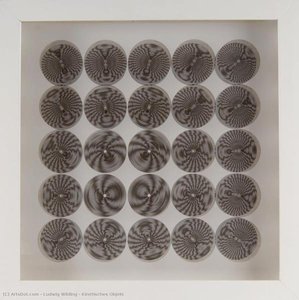
Wilding’s true genius lay in his ability to transcend the two-dimensional plane, breathing life into static objects through meticulously crafted three-dimensional structures. His work is characterized by a striking, monochromatic palette—a stark dance of black and white that serves as the stage for complex visual phenomena. These were not merely sculptures but active participants in a dialogue with the viewer. By manipulating depth and surface, Wilding created works that seemed to pulse and shift with every change in perspective or flicker of light. The technical precision required for such feats was immense, as he sought to capture the very essence of movement within a fixed medium through several key elements:- Geometric Abstraction: Utilizing clean lines and mathematical precision to guide the eye across the surface.
- Kinetic Energy: Creating the illusion of motion through subtle shifts in illumination and viewer position.
- Stereoscopic Depth: Using three-dimensional elements to challenge the boundaries between reality and illusion.
A Legacy Written in Light and Shadow
The impact of Wilding’s vision resonated far beyond the borders of Germany, placing him at the heart of the mid-century explosion of Op Art and Kinetic Art. His inclusion in the seminal The Responsive Eye exhibition at the Museum of Modern Art in New York in 1965 cemented his status as a global figure alongside contemporaries like Bridget Riley and Victor Vasarely. Throughout his career, his work traveled from the prestigious halls of the Hayward Gallery in London to the Columbus Museum of Art in Ohio, proving that the language of optical illusion is universal. Even decades after his passing in 2010, Wilding’s legacy remains a vital part of the art historical canon, reminding us that true art is not just something we look at, but something we experience with our entire sensory being.Q&A
Ludwig Wilding의 출생 도시와 국가는 어디인가요?
Ludwig Wilding은(는) Germany Grünstadt에서 태어났습니다.
Ludwig Wilding의 예술 세계는 시간이 흐름에 따라 어떻게 진화했나요?
Ludwig Wilding의 작품 세계를 시간순으로 정리한 기록은 아티스트 연대기 페이지에서 확인하실 수 있으며, 이곳에서는 각 시기별로 분류된 챕터를 따라 작품들을 제작 순서대로 만나보실 수 있습니다.
Ludwig Wilding의 작품을 사조별로 둘러볼 수 있나요?
Ludwig Wilding의 작품은 작가의 모든 미술 사조 페이지에서 사조별로 만나보실 수 있습니다.
키워드로 Ludwig Wilding의 작품을 찾아볼 수 있나요?
Ludwig Wilding의 키워드별 탐색 페이지에서는 작가의 작품들을 키워드별로 모아볼 수 있습니다.