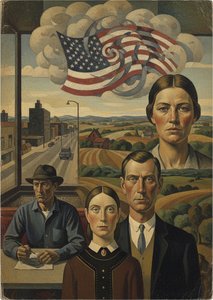
A Tapestry of Color and Form: The Life of Margo Hoff
Margo Hoff (1910–2008) was far more than a mere painter; she was a weaver of visual narratives, a pioneer who transformed the humble medium of collage into a profound language of expression. Born in Carthage, Missouri, and raised amidst the landscapes of Tulsa, Oklahoma, her artistic soul was forged in moments of both stillness and vitality. A pivotal childhood bout with typhoid fever in 1923, which left her bedridden for an entire summer, became an unexpected crucible for her creativity. During those isolated months, she turned to drawing and paper cutouts, inadvertently discovering the rhythmic power of layered shapes—a fascination that would eventually define her legendary career.
Her formal education provided the structural scaffolding for this burgeoning talent. From the foundational studies at Tulsa University to the rigorous artistic training at the National Academy of Art in Chicago and the prestigious Art Institute of Chicago, Hoff absorbed the evolving currents of modernism. Her journey was one of constant expansion, moving through the intellectual atmosphere of Hull House and even auditing art history at the University of Chicago. This diverse academic background allowed her to bridge the gap between classical technique and the avant-garde experimentation that characterized the mid-20th century.
The Mexican Influence and the Evolution of Style
While her roots were firmly planted in the American Midwest, Hoff’s creative spirit found its most vibrant resonance in the sun-drenched landscapes of Mexico. During frequent expeditions to the nation in the 1940s, she became deeply enamored with the works of Mexican muralists and the rich, indigenous motifs that permeated the culture. This encounter acted as a transformative catalyst; her palette shifted, and her compositions began to pulse with a new, rhythmic energy. The influence of Mexico is etched into the very texture of her most celebrated works, such as “Vermillion Banner” and “Disco,” where bold, saturated colors and layered textures evoke the warmth and cultural depth of the Mexican spirit.
As her career progressed, Hoff’s stylistic evolution mirrored the shifting tides of the art world. In the 1950s, her work often reflected the urbanity of mid-century modernism, capturing the structured essence of Chicago landscapes with a sophisticated, earth-toned palette. However, her move to New York City in 1960 signaled a dramatic metamorphosis. The city’s frenetic energy pushed her toward even brighter hues and a more experimental approach to materials. It was here that she truly mastered the art of collage, transitioning from delicate paper cutouts to working with canvas itself, creating multidimensional works that challenged the boundaries between painting and sculpture.
Legacy and Artistic Significance
The significance of Margo Hoff’s contribution to American art lies in her ability to marry the figurative with the abstract through a uniquely tactile medium. Her work has been graced by prestigious institutions, with pieces held in the permanent collections of the Metropolitan Museum of Art, the Art Institute of Chicago, and the Smithsonian American Art Museum. These accolades serve as a testament to her ability to capture the zeitgeist of her era while maintaining a deeply personal, emotive touch.
Throughout her long and illustrious life, Hoff achieved milestones that few artists reach, including a momentous solo exhibition at the Wildenstein Galleries in Paris in 1955. Her career was marked by several notable honors, such as:
- The Mr. and Mrs. Frank G. Logan Art Institute Prize (1944)
- The Armstrong Award for Exhibition (1945)
Ultimately, Margo Hoff remains a singular figure in the history of 20th-century art. She was an artist who could find the infinite within a scrap of paper and the universal within a local landscape. Her legacy lives on in every vibrant layer of her collages, reminding us that art is not merely something to be seen, but something to be felt through the very texture of existence.
질의응답
Margo Hoff의 모든 작품에 나타나는 색채 활용을 살펴볼 수 있을까요?
Margo Hoff 작가 작품의 컬러 프로필은 작가의 팔레트 지놈 페이지에서 확인하실 수 있습니다.
Margo Hoff의 작품 중 몇 점을 둘러보실 수 있나요?
모든 작품 보기 페이지에서 Margo Hoff의 작품 작품 5점점을 만나보실 수 있습니다.
Margo Hoff 작가는 어떤 사조에 참여했나요?
Margo Hoff의 작품은 작가의 모든 사조 페이지에서 사조별로 둘러보실 수 있습니다.