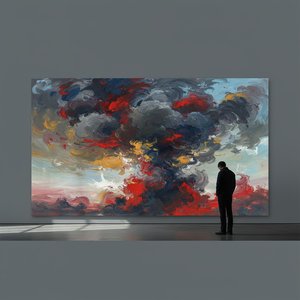
The Harmonious Synthesis of East and West
Born in Auckland, New Zealand, in 1935, Maxwell Harold Gimblett has emerged as a profound bridge between disparate worlds. His life's work represents a rare and beautiful convergence, where the raw, emotive power of Post-War American Abstract Expressionism meets the disciplined, meditative grace of Japanese Zen calligraphy. This unique artistic identity allows him to navigate the space between the spontaneous gesture and the intentional stroke, creating a visual language that speaks to both the physical and the spiritual realms.
Gimblett’s journey is one of deep cultural immersion. By weaving together the philosophies of Eastern and Western traditions, he has developed a style characterized by spiritual abstraction. His practice is not merely about the application of pigment to canvas, but an exploration of the void, the breath, and the eternal flow of existence. This mastery of form and spirit has led him to become a global educator, leading sumi ink workshops that invite others to experience the meditative depths of Japanese ink painting.
A Legacy in Global Collections
The significance of Gimblett’s contribution to modern art is reflected in the prestigious institutions that house his works. His inclusion in the landmark exhibition The Third Mind: American Artists Contemplate Asia, 1869-1989 at the Guggenheim Museum serves as a testament to his role in the dialogue between American modernism and Asian aesthetics. Today, his masterpieces can be found in some of the world's most esteemed galleries, including:
- The Museum of Modern Art (MoMA), New York
- The Whitney Museum of American Art, New York
- The National Gallery of Art, Washington, D.C.
- San Francisco Museum of Modern Art (SFMOMA)
- Te Papa Tongarewa, the Museum of New Zealand
- Auckland Art Gallery Toi o Tāmaki
One of his most profound achievements is the monumental work Buddha Amida. Created in 1985, this massive acrylic on canvas piece measures an imposing 305 x 305 cm, serving as a breathtaking embodiment of the spiritual and philosophical traditions that define his career. Through such works, Gimblett captures the essence of transcendence, making the intangible tangible through the medium of paint.
Honors and Artistic Contributions
Beyond the canvas, Gimblett’s impact on the academic and cultural landscape of New Zealand and beyond is immense. His dedication to the intersection of art and philosophy has earned him significant recognition from the scholarly community. He has been honored with honorary doctorates from both Waikato University and the Auckland University of Technology, acknowledging his profound influence on contemporary art practice.
In recognition of his service to the arts and his cultural contributions, he was awarded the Officer of the New Zealand Order of Merit (ONZM). This distinction underscores his status not just as a painter, but as a cultural figure whose work continues to resonate across borders, inviting viewers to contemplate the profound unity found within the diversity of human expression.
질의응답
Maxwell Harold Gimblett의 작품 중 조회수가 가장 높은 것은 무엇인가요?
Maxwell Harold Gimblett의 통계 페이지에서는 본 웹사이트에 등록된 작가의 작품들을 바탕으로 산출된 통계 정보를 제공합니다.
Maxwell Harold Gimblett 작가의 작품을 감상할 수 있는 가상 박물관에 방문할 수 있나요?
Maxwell Harold Gimblett의 3D 뮤지엄는 작가의 작품들을 가상 3D 갤러리로 선보이는 페이지입니다.
Maxwell Harold Gimblett 작가의 다른 활동명이나 알려진 이름이 있나요?
Maxwell Harold Gimblett은(는) Max Gimblett(으)로도 알려져 있습니다.