Early Life and Artistic Foundations
Paul John Wonner, born in Tucson, Arizona, in 1920, embarked on a remarkable artistic journey that spanned six decades, evolving from the abstract currents of post-war America to the hyperrealist still lifes for which he is best known. His early exposure to art came through local California artists hired by his parents, sparking an initial interest that led him to the California College of Arts and Crafts in Oakland in 1941. However, the trajectory of his education was interrupted by military service during World War II, a common experience for many aspiring artists of his generation.
Following his discharge, Wonner briefly pursued studies at the Art Students’ League in New York City, absorbing the diverse influences of the East Coast art scene. Yet, it was his return to California and enrollment at the University of California, Berkeley—where he earned a B.A. (1952), M.A. (1953), and M.L.S. (1955)—that proved pivotal. It was during this period that he met William Theophilus Brown, a partnership that would not only shape his artistic development but also define a significant aspect of his personal life as openly gay artists in an era of societal constraints.
The Bay Area Figurative Movement and Early Expression
Wonner rose to prominence in the 1950s as a key figure within the burgeoning Bay Area Figurative Movement. This group, reacting against the dominant abstract expressionism emanating from New York, sought to reconnect with representational painting, albeit infused with a distinctly Californian sensibility. Along with artists like Richard Diebenkorn and David Park, Wonner explored themes of everyday life, often employing a loose, gestural brushstroke reminiscent of earlier expressionist styles.
His early works were characterized by dreamlike scenes—particularly those featuring male bathers and boys with bouquets—evoking a sense of intimacy and psychological depth. These paintings, imbued with a subtle homoeroticism, reflected the personal experiences of Wonner and Brown while challenging conventional notions of masculinity and representation. The 1957 exhibition *Contemporary Bay Area Figurative Painting* at the Oakland Museum cemented his position within this influential circle, bringing his work to wider attention.
A Shift Towards Hyperrealism
The late 1960s marked a significant turning point in Wonner’s artistic trajectory. He abandoned his loose figurative style, embarking on a period of intense experimentation that ultimately led him towards hyperrealism. This transition wasn't abrupt; it involved a phase of surrealistic watercolors before he fully committed to the meticulous detail and precise rendering that would define his mature work.
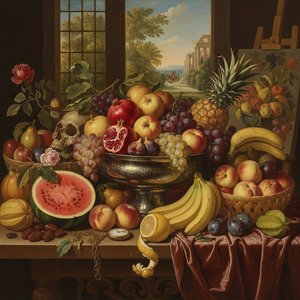
Inspired by 17th-century Dutch still life painting, Wonner began creating large-scale compositions featuring contemporary objects arranged in distended, often unsettling spaces. These paintings were not mere copies of reality; they were carefully constructed arrangements imbued with symbolic meaning and psychological tension. The sharp light, dramatic shadows, and precise textures created a sense of heightened awareness, inviting viewers to contemplate the beauty and fragility of everyday life.
Later Years and Lasting Legacy
Wonner continued to refine his hyperrealist style throughout the 1970s and beyond, achieving widespread recognition for his distinctive vision. He taught at institutions such as UC Santa Barbara and the Otis Art Institute, influencing a new generation of artists. In his later years, he returned to figuration, exploring themes of youth and old age in intimate watercolors depicting studio scenes with models.
Paul Wonner’s work is held in numerous prestigious public collections, including the Cantor Arts Center at Stanford University, the San Francisco Museum of Modern Art, the Smithsonian American Art Museum, and the Solomon R. Guggenheim Museum. His paintings stand as a testament to his artistic versatility, technical mastery, and unwavering commitment to exploring the complexities of human experience. The 2023 retrospective *Breaking the Rules: Paul Wonner and William Theophilus Brown* at the Crocker Art Museum underscored the importance of both artists’ contributions to California art history and their pioneering role in challenging societal norms.
- Influences: Dutch Baroque still life painting, Abstract Expressionism, Bay Area Figurative Movement
- Key Themes: Intimacy, psychological depth, symbolism, the everyday, representation of masculinity
- Major Achievements: Pioneering figure in the Bay Area Figurative Movement, development of a distinctive hyperrealist style, widespread recognition and inclusion in major museum collections.