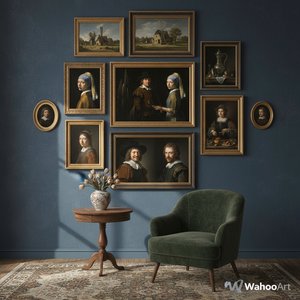
The Master of Light and Lineage: The Life of Philip van Dijk
In the grand tapestry of the Dutch Baroque, few threads are woven with as much elegance and courtly grace as those left by Philip van Dijk. Born in the vibrant artistic hub of Haarlem on January 10, 1683, Van Dijk emerged during an era when the Dutch Republic was transitioning from the rugged realism of the Golden Age into a more refined, sophisticated aesthetic. His journey was one of constant movement and prestigious associations, shaped by the shadows of masters and the bright lights of royal courts. From his early training under Arnold Boonen in Amsterdam to the transformative influence of Adriaen van der Werff in Rotterdam, Van Dijk developed a stylistic language that balanced meticulous precision with an evocative, psychological depth.
The artist’s development was deeply rooted in the rigorous traditions of the Dutch guilds. After marrying in 1708, he joined the prestigious Guild of St. Luke in Middelburg, a move that signaled his arrival as a professional of significant standing. His talent soon earned him membership in the Confrerie Pictura, where his reputation flourished among the artistic elite. This period of his life was marked by an increasing ability to capture not just the physical likeness of his subjects, and even their social status, but the very essence of their character through a delicate interplay of light and texture.
A Journey Through Royal Courts and Artistic Legacy
The true zenith of Van Dijk’s career was reached when his brush moved beyond the merchant classes of the Netherlands to serve the highest echelons of European nobility. In 1726, a decade-long departure from The Hague saw him travel to Kassel, where he assumed the prestigious role of court painter for William VIII, Landgrave of Hesse-Cassel. It was in this setting of aristocratic splendor that his mastery of portraiture truly blossomed. He captured the dignity of Landgravine Marie Louise of Hesse-Kassel and her family with a grandeur that solidified his place in the annals of Baroque history.
His influence and reach were not confined to Germany alone; by 1750, he had returned to The Hague to serve as court painter to William IV, Prince of Orange. This appointment to the House of Orange-Nassau cemented his legacy as a chronicler of royal lineage. His work remains a vital window into the social fabric of the 18th century, characterized by:
- Technical Precision: A profound ability to render the tactile qualities of silk, lace, and skin, inherited from the refined style of Adriaen van der Werff.
- Psychological Nuance: The capacity to imbue formal portraits with a sense of quiet introspection and human presence.
- Cultural Iconography: His ability to weave symbols of status—such as hunting dogs, fine linens, or classical architecture—into the narrative of his subjects.
Beyond the halls of power, Van Dijk’s impact resonated through the generations of artists he mentored at the drawing academy, including Jan Augustini and Hendrik Pothoven. Perhaps most charmingly, his artistic reach extended into the everyday lives of the Dutch people; his depiction of a Lute Player was so iconic that it served as the inspiration for the design of the Dutch 100 guilder banknote centuries later. When he passed away on February 2, 1753, he left behind a body of work that continues to resonate with the timeless beauty of the Baroque spirit.
Q&A
키워드로 Philip van Dijk의 작품을 찾아볼 수 있나요?
특정 주제의 Philip van Dijk 작품을 찾으려면 키워드별로 작품이 분류된 작가의 키워드별 탐색 페이지를 이용해 보세요.
Philip van Dijk의 작품을 분위기별로 찾아볼 수 있나요?
Philip van Dijk의 무드 룸에서는 작가의 작품들을 분위기별로 만나보실 수 있습니다.
특정 매체로 분류된 Philip van Dijk의 모든 작품을 어떻게 찾을 수 있나요?
모든 매체별 페이지에서는 Philip van Dijk의 작품을 기법별로 모아볼 수 있습니다.
Philip van Dijk은(는) 어느 시대의 작품을 남겼나요?
Philip van Dijk은(는) Early Modern 시대에 활동했습니다. 이 시기는 역사적 맥락 속에서 작가의 예술적 위치를 보여줍니다.