Salomon Leonardus Verveer: A Master of Dutch Romantic Landscape
Salomon Leonardus Verveer (1813-1876) stands as a pivotal figure in the Dutch Romantic landscape movement, celebrated for his ability to capture both the grandeur and intimacy of the Dutch countryside. Born in The Hague, he emerged from a family steeped in Jewish tradition—his father was a prominent rabbi—and received an artistic education under the tutelage of Bartholomeus Johannes van Hove, establishing him firmly within the artistic circles of his time. This formative influence would prove invaluable as Verveer honed his skills alongside fellow artist Jan Hendrik Weissenbruch, fostering a collaborative spirit that enriched their respective oeuvres.- Early Years and Training: Verveer’s initial training focused on traditional painting techniques, equipping him with the foundational knowledge necessary for mastering various mediums. Notably, he studied under van Hove, absorbing the principles of academic realism—a style prevalent during his era—which would later inform his artistic vision.
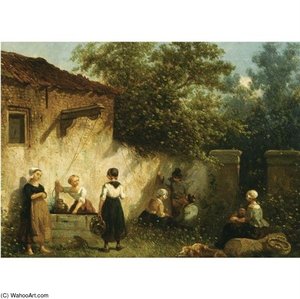
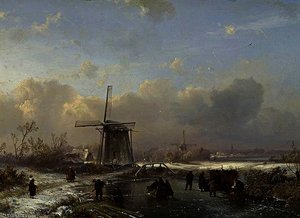
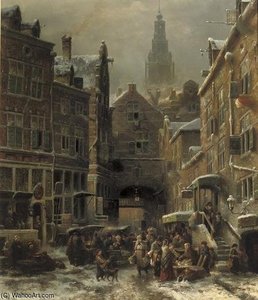
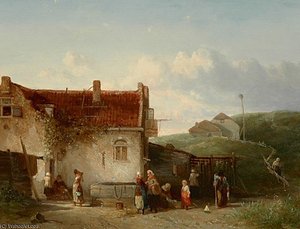
- Exploring Diverse Landscapes: Verveer’s artistic journey began with depictions of urban scenes and harbor vistas – reflections of The Hague's bustling port activity. However, he swiftly transitioned to capturing the serene beauty of Dutch rivers and villages, demonstrating a remarkable adaptability that characterized his oeuvre.
- The Dunes and Jewish Neighborhoods: Recognizing the distinctive character of the Dutch landscape, Verveer dedicated considerable effort to portraying the dunes of Scheveningen and the vibrant Jewish neighborhoods of Amsterdam. These subjects resonated deeply with him personally, reflecting his heritage and fostering a profound connection to his surroundings.
Technique and Style: Sepia Gouache and Charcoal Drawings
Verveer’s artistic style is instantly recognizable by his masterful use of sepia gouache—a technique that lends remarkable tonal subtlety and atmospheric depth to his landscapes. He skillfully blended pigments to achieve nuanced gradations of color, creating images imbued with a palpable sense of realism and emotion. Furthermore, Verveer experimented extensively with charcoal drawings, capturing fleeting moments of light and shadow with exceptional precision. This dual approach – gouache for luminous beauty and charcoal for textural detail – cemented his reputation as one of the most versatile artists of his generation.- Recognition and Awards: Verveer’s talent garnered considerable acclaim during his lifetime. He was awarded double silver medals by the Felix Meritis Society in 1836, followed by a gold-plated silver medal at the Brussels Exhibition of 1842—a testament to his artistic prowess.
- Salon Exhibitions and Patronage: His paintings consistently achieved success at Salon exhibitions, attracting the attention of influential patrons like Sylvain van de Weyer (Minister of State) and George Hamilton Seymour (British Ambassador). Particularly noteworthy was Verveer’s depiction of Dordrecht—a scene that captivated the British diplomat.
- Royal Honors: Verveer ascended to prominence through his appointment as Officer of the Order of Leopold by King Leopold I in 1874 and Knight of the Order of the Netherlands Lion in 1863—honors bestowed upon him for his contributions to Dutch art and culture.
Legacy and Historical Significance
Salomon Leonardus Verveer’s legacy extends far beyond his individual artworks. He served as a teacher, nurturing the talents of younger artists like Frederik Hendrik Kaemmerer, ensuring that his artistic principles endured. His landscapes continue to inspire admiration for their evocative beauty and meticulous realism—capturing not merely visual impressions but also conveying a deep understanding of Dutch culture and identity. Moreover, Verveer’s work stands as an emblem of the Dutch Romantic period, embodying its fascination with nature, emotion, and spiritual contemplation. His tomb at the Scheveningseweg Jewish Cemetery serves as a poignant reminder of his life's journey and artistic achievement—a testament to a remarkable artist who left an indelible mark on Dutch art history.질의응답
Salomon Leonardus Verveer의 출생지와 출생 연도는 언제인가요?
Salomon Leonardus Verveer은(는) 1813년 The Hague에서 태어났습니다.
Salomon Leonardus Verveer의 작품 세계는 시간이 흐름에 따라 어떻게 변화했나요?
Salomon Leonardus Verveer의 예술적 여정은 연대기 페이지에서 시기별로 펼쳐집니다. 이곳에서는 작가의 활동 시기를 장(chapter)으로 나누어 작품들을 연대순 타임라인 형태로 한눈에 확인할 수 있습니다.
Salomon Leonardus Verveer의 작품은 얼마나 인기가 있나요?
Salomon Leonardus Verveer의 통계 페이지에서는 본 웹사이트에 등록된 작가의 작품들을 바탕으로 산출된 통계 정보를 제공합니다.