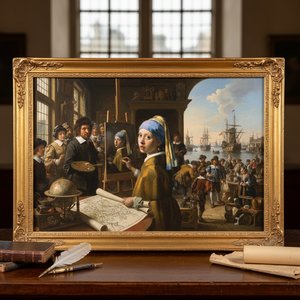
A Shadow in the Golden Age: Simon Henrixz (Copy After)
The name Simon Henrixz, when qualified by “copy after,” presents a fascinating enigma within the rich tapestry of the Dutch Golden Age. He wasn’t a master forging an entirely new path, but rather a skilled hand meticulously recreating the visions of others—a ghost in the machine of artistic production. While biographical details remain elusive, his existence speaks volumes about the demand for art during this period and the complex network of workshops and patronage that fueled it. Henrixz operated not as an independent innovator, but as a vital link in disseminating powerful imagery, particularly historical narratives, to a wider audience. His work, therefore, isn’t defined by personal style so much as by technical proficiency and fidelity to the original compositions he emulated.The Art of Replication: A Workshop Practice
To understand Henrixz, one must grasp the realities of 17th-century art production. The concept of a single artist’s hand completing every aspect of a painting was often an illusion. Workshops thrived, employing assistants and copyists to fulfill commissions that exceeded the capacity of a lone master. Copying wasn't seen as mere imitation; it was a respected form of training, a way for aspiring artists to learn technique and composition by directly engaging with established masterpieces. Henrixz likely headed such a workshop, specializing in reproducing works—or fragments of works—for clients who desired grand historical scenes but perhaps lacked the resources for an original commission. His known work centers around a dramatic depiction of “Willem III, Count of Holland, Ordering the Beheadal of the Bailiff of Zuid Holland, 1336,” suggesting a particular specialization or a consistent source of patronage interested in this specific subject matter. The painting itself, dating from approximately 1620-1649, is a testament to his skill—a dynamic composition filled with tension and detail, even if it’s ultimately derived from another artist's vision.Historical Echoes: Subject Matter and Symbolism
The subject matter of Henrixz’s most prominent work – the execution ordered by Willem III – is steeped in Dutch history and political symbolism. The scene depicts a pivotal moment of justice, or perhaps injustice, depending on perspective. Count William III asserts his authority through a brutal act, reinforcing the power of the ruling class. The painting likely resonated with contemporary audiences who were grappling with issues of governance, rebellion, and the legitimacy of power. The dramatic lighting, the expressions of fear and resolve on the faces of those involved, all contribute to a powerful narrative. Henrixz’s skill lay in faithfully reproducing these emotional cues, ensuring that the impact of the original composition was preserved for his patrons. The choice of this particular scene suggests an interest—or perhaps a commission from someone with an interest—in themes of law, order, and the consequences of defiance.Influences and Artistic Lineage
Pinpointing Henrixz’s direct influences is challenging given his role as a copyist. However, analyzing the style of “Willem III” reveals connections to broader artistic trends of the period. The composition exhibits characteristics reminiscent of Baroque painting—dynamic movement, strong contrasts between light and shadow (chiaroscuro), and a focus on emotional intensity. It’s plausible that Henrixz drew inspiration from artists like Rembrandt van Rijn or Jan Lievens, whose works were widely admired and imitated during this era. The original artist responsible for the composition upon which Henrixz based his work remains debated, adding another layer of mystery to his artistic lineage. Regardless, Henrixz demonstrates a clear understanding of these stylistic conventions, skillfully adapting them to recreate a compelling historical scene.Legacy and Historical Significance
Simon Henrixz (Copy After) may not be celebrated as an original genius, but his work offers valuable insights into the art market and workshop practices of the Dutch Golden Age. He represents a crucial, often overlooked, element in the dissemination of artistic ideas—the skilled craftsman who brought masterpieces to a wider audience. His paintings serve as tangible reminders of the demand for historical narratives and the complex relationship between artists, patrons, and the reproduction of imagery. While his name may remain relatively obscure, Henrixz’s contribution lies in preserving and perpetuating the visual language of a pivotal period in art history—a shadow artist illuminating the brilliance of others.질의응답
Simon Henrixz (Copy After)의 작품 세계는 시간이 흐름에 따라 어떻게 변화했나요?
Simon Henrixz (Copy After)의 작품 세계를 시간순으로 정리한 기록은 아티스트 연대기 페이지에서 확인하실 수 있으며, 이곳에서는 각 시기별로 분류된 챕터를 따라 작품들을 제작 순서대로 만나보실 수 있습니다.
Simon Henrixz (Copy After)의 작품을 팔레트별로 모아둔 곳은 어디인가요?
특정 색상 팔레트의 Simon Henrixz (Copy After) 작품을 찾으시려면, 작가의 컬러 팔레트별 페이지를 이용해 보세요.
Simon Henrixz (Copy After) 작품의 연도별 타임라인이 있나요?
Simon Henrixz (Copy After)의 작품을 연도별로 정리하여 보여주는 작품 연대기 페이지입니다.