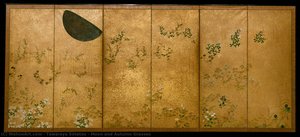
The Genesis of a Visual Revolution
In the transformative era of the early Edo period, as Japan emerged from the shadows of civil war into a time of unprecedented cultural flourishing, the artistic landscape was forever altered by the hand of Tawaraya Sōtatsu. Though the precise details of his early life remain shrouded in the mists of history, scholars trace his origins to around 1570 in Nantou, Japan. Born into a family of skilled craftsmen specializing in the intricate art of lacquerware, Sōtatsu possessed an innate understanding of material, texture, and the interplay of light and surface. This foundational connection to craftsmanship would later become the bedrock of his painterly genius, allowing him to approach the canvas not merely as a storyteller, but as a designer of profound aesthetic impact. His early exposure to the meticulous demands of lacquerwork instilled in him a reverence for bold, decorative elements that would eventually define the Rinpa school.A Symbiosis of Spirit and Form
The trajectory of Sōtatsu’s career was irrevocably changed through his legendary collaboration with the visionary Hon'ami Kōetsu. This partnership was far more than a mere professional alliance; it was a creative crucible where calligraphy, design, and painting merged into a singular, revolutionary language. Together, they pioneered an aesthetic that moved away from the rigid traditions of the past toward something much more dynamic and ornamental. Sōlarity and movement became hallmarks of their work, as Sōtatsu applied his masterful designs to Kōetsu’s calligraphic masterpieces. This era saw the birth of a style characterized by lavish use of gold leaf, vibrant pigments, and a rhythmic composition that felt both ancient and startlingly modern. Through this synergy, the duo helped establish the Rinpa movement, an artistic lineage that would influence Japanese visual culture for centuries to come.Technique as Transcendence
Beyond his collaborative triumphs, Sōtatsu’s individual technical innovations set him apart as a true master of illusion. He is perhaps most celebrated for the development of the tarashikomi technique—a method in which a second layer of wet pigment is dropped into a still-damp first layer. This process creates unpredictable, bleeding edges and ethereal textures that mimic the organic spontaneity of nature, such as the frothing crest of a wave or the delicate veins of a leaf. This mastery of fluid motion is nowhere more evident than in his iconic Wind God and Thunder God folding screens, which stand as National Treasures of Japan. In these works, the divine forces of nature are captured with a breathtaking balance of stylized power and atmospheric grace.An Enduring Legacy
The impact of Tawaraya Sōtatsu extends far beyond the borders of the Edo period. His ability to weave narrative depth with decorative splendor is seen in his evocative paintings from The Tale of Genji, where he transformed literary elegance into visual poetry. Whether through the rhythmic energy of his coastal landscapes or the intricate patterns of his furniture designs, Sōtatsu’s work continues to resonate with a sense of timelessness. His legacy remains etched in the very fabric of Japanese art, reminding us that true mastery lies in the ability to find the infinite within the beautifully designed.- Key Contributions:
- Co-founding the Rinpa school of painting.
- Pioneering the tarashikomi technique for organic textures.
- Revolutionizing the use of gold leaf and bold, decorative compositions in byōbu screens.
질의응답
Tawaraya Sōtatsu의 작품은 얼마나 인기가 있나요?
Tawaraya Sōtatsu의 통계 페이지에서는 본 웹사이트에 등록된 작가의 작품들을 바탕으로 산출된 통계 정보를 제공합니다.
Tawaraya Sōtatsu의 작품 세계는 시간이 흐름에 따라 어떻게 변화했나요?
Tawaraya Sōtatsu의 연대기는 작가의 활동 시기별로 분류된 작품들을 연대순으로 보여주는 스크롤 방식의 타임라인입니다.
Tawaraya Sōtatsu의 작품을 컬러 팔레트별로 둘러볼 수 있나요?
특정 색상 팔레트의 Tawaraya Sōtatsu 작품을 찾으시려면, 작가의 컬러 팔레트별 페이지를 이용해 보세요.