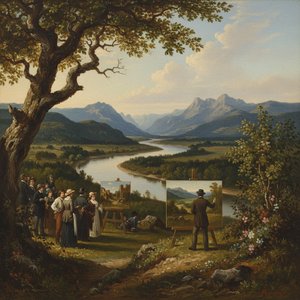
Theodor Leopold Weller: A Master of Everyday Life
Theodor Leopold Weller (May 29, 1802 – December 10, 1880), born in Mannheim, Germany, stands as a pivotal figure within the Munich School of painting—a movement dedicated to portraying scenes from ordinary life with remarkable precision and psychological insight. Initially envisioned for a legal profession by his father, Weller’s passion for art swiftly took precedence, embarking on formal studies at the Academy of Fine Arts in Munich under Johann Peter von Langer, where he encountered the influential Peter von Cornelius, brought to Munich by Ludwig II to oversee the Glyptothek. Unlike many of his contemporaries who pursued grand historical narratives or mythological subjects, Weller deliberately gravitated towards depictions of daily existence and the natural world—a decision that profoundly shaped his artistic trajectory.- Early Influences & Training: Langer’s guidance instilled in Weller a foundational understanding of academic painting principles, while Cornelius's presence exposed him to the burgeoning Romantic spirit prevalent in Munich.
- The Pursuit of Detail: Weller honed his technique under Peter von Hess, mastering meticulous observation and rendering—a characteristic that would become synonymous with his oeuvre.
- Roman Exploration & Artistic Growth: Weller’s journey to Rome in 1825 alongside Ernst Fries marked a crucial period of artistic maturation, fostering an appreciation for classical ideals and broadening his visual vocabulary. He diligently documented his travels through Italy, including Naples, capturing the essence of Italian landscapes and culture.
Career Highlights & Artistic Output
Returning to Mannheim in 1833, Weller established himself as a respected artist and educator, accepting the role of Director of the Mannheim Kunstverein (Art Association) from 1839 to 1848. During this tenure, he served on the board for twenty-three years and diligently curated the Verein’s collection—resulting in a comprehensive catalog documenting 124 of his own works. This catalogue serves as invaluable evidence of Weller's prolific output and demonstrates his unwavering commitment to capturing the subtleties of human experience within accessible subjects.- Directorate & Artistic Legacy: Weller’s leadership at the Kunstverein solidified his reputation as a champion of German Romanticism and fostered an environment conducive to artistic innovation.
- Notable Paintings: His extensive body of work includes captivating genre scenes—such as “Studies on a Bagpiper” (1851) and “Standing Woman in the Costume of Cervara,” showcasing his mastery of watercolor and capturing nuanced emotional states.
The Munich School & Weller’s Contribution Weller's dedication to portraying everyday life—combined with his meticulous technique—established him as a cornerstone of the Munich School, alongside artists like Cornelius and Hess. He championed realism within Romanticism, prioritizing psychological depth over mere visual spectacle. His paintings offer poignant glimpses into the lives of ordinary people—reflecting the social consciousness of his time while simultaneously elevating genre painting to new heights of artistic accomplishment. Weller’s legacy continues to inspire artists today who strive for authenticity and emotional resonance in their depictions of human experience.
Concluding Remarks Theodor Leopold Weller passed away peacefully in Mannheim on December 10, 1880, succumbing to a stroke—a tragic end for an artist whose life’s work embodied the spirit of observation, empathy, and artistic excellence. His enduring influence can be seen in subsequent generations of German painters who embraced his commitment to portraying the human condition with sensitivity and unwavering detail.
질의응답
키워드로 Theodor Leopold Weller의 작품을 찾아볼 수 있나요?
Theodor Leopold Weller의 키워드별로 페이지에서는 작가의 작품들을 키워드별로 모아볼 수 있습니다.
Theodor Leopold Weller의 작품 중 몇 점을 둘러보실 수 있나요?
모든 작품 보기 페이지에서 Theodor Leopold Weller의 작품 작품 20점점을 만나보실 수 있습니다.
Theodor Leopold Weller의 작품 세계는 시간이 흐름에 따라 어떻게 변화했나요?
Theodor Leopold Weller의 작품 세계를 시간순으로 정리한 기록은 아티스트 연대기 페이지에서 확인하실 수 있으며, 이곳에서는 각 시기별로 분류된 챕터를 따라 작품들을 제작 순서대로 만나보실 수 있습니다.