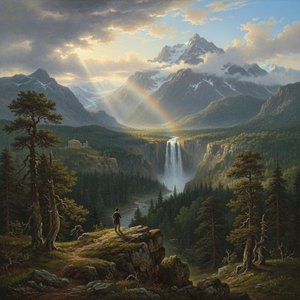
Tina Blau: A Pioneering Austrian Landscape Painter
Early Life and Education
- Born: Vienna, Austria in 1845.
- Tina Blau, later known as Tina Blau-Lang, demonstrated a strong desire to pursue painting from a young age. Her father, a doctor in the Austro-Hungarian medical corps, provided unwavering support for her artistic ambitions.
- She began formal training in Munich (1869–1873) with August Schaeffer and then Wilhelm Lindenschmit.
- From 1875 to 1876, she shared a studio with Emil Jakob Schindler, though their collaboration ended after a disagreement. She briefly revisited his tutelage at Plankenberg Castle.
Artistic Development and Influences
- Blau’s early work reflects the influence of her teachers, focusing on landscape painting.
- Emil Jakob Schindler's impact is notable, though their relationship was complex. His emphasis on plein air painting likely influenced Blau’s later style.
- Her artistic development saw a shift towards capturing the nuances of light and atmosphere in her landscapes.
Personal Life and Career
- In 1883, Blau converted from Judaism to the Evangelical Lutheran Church and married Heinrich Lang, a painter specializing in horses and battle scenes.
- The couple moved to Munich where, starting in 1889, Blau taught landscape and still life painting at the Women's Academy of the Münchner Künstlerinnenverein (Munich Women Artists' Association).
- Her first major exhibition was held there in 1890.
- She exhibited her work at the Palace of Fine Arts during the 1893 World's Columbian Exposition in Chicago, Illinois.
Major Achievements and Contributions
- Following her husband’s death, Blau traveled extensively through Holland and Italy for a decade, enriching her artistic perspective.
- In 1897, she co-founded the Wiener Frauenakademie, an art school dedicated to women's education, alongside Olga Prager, Rosa Mayreder, and Karl Federn. She taught there until 1915.
- Her paintings often depict serene scenes of Vienna, Italy, and Holland, characterized by a delicate use of color and light.
Later Life and Legacy
- Blau spent her final summer working in Bad Gastein before seeking medical attention in Vienna.
- She died of cardiac arrest in 1916 and was granted an Ehrengrab (honor grave) in the Zentralfriedhof cemetery.
- A major retrospective exhibition of her work was held by the Vienna Künstlerhaus in 1917, showcasing her significant contribution to Austrian art.
- Historical Significance: Tina Blau is recognized as a pioneering female artist who challenged conventional norms and played a vital role in advancing art education for women. Her landscapes capture a unique sensitivity to the natural world and remain admired for their atmospheric qualities.
질의응답
Tina Blau의 작품을 연도순으로 어디에서 볼 수 있나요?
Tina Blau의 작품은 작가의 작품 연대기 페이지에서 연도별로 확인하실 수 있습니다.
Tina Blau 작가의 작품을 감상할 수 있는 3D 가상 투어가 있나요?
가상 방문이 가능합니다: Tina Blau의 3D 뮤지엄 페이지에서 작가의 작품들을 3D 갤러리를 통해 만나보실 수 있습니다.
Tina Blau의 작품 세계는 시간이 흐름에 따라 어떻게 변화했나요?
Tina Blau의 연대기는 작가의 활동 시기별로 분류된 작품들을 연대순으로 보여주는 스크롤 방식의 타임라인입니다.