The Genesis of a Genoese Visionary
Valerio Castello emerged from the shadows of a noble Genoese lineage, a life marked by both the prestige of his birth and the sudden sting of financial hardship following his father’s untimely death. While his path might have led toward the quiet halls of scholarly pursuit, an innate, profound connection to the art of drawing redirected his destiny toward the canvas. Under the watchful eyes of masters such as Domenico Fiasella and Giovanni Andrea De Ferrari, the young Castello began to weave his technical prowess with a burgeoning artistic ambition. This formative period was not merely about mastering the brush; it was about absorbing the very essence of the Ligurian spirit, preparing him for a career that would soon illuminate the heights of the Baroque era.A Tapestry of Light and Motion
The trajectory of Castello’s genius was irrevocably altered by his transformative travels through Milan and Parma between 1640 and 1645. These wanderings served as a vital immersion into the vibrant currents of Venetian art, where he encountered the dramatic intensity of Camillo Procaccini. His style began to coalesce into a magnificent synthesis, blending the theatrical dynamism of Tintoretto with the opulent, sun-drenched grandeur of Veronese. This unique alchemy allowed him to master the complexities of composition and perspective, particularly in his celebrated battle scenes, which captured the chaotic energy and heroic scale favored by the European elite. His ability to blend these disparate influences created a visual language that was both muscular and exquisitely graceful.An Enduring Baroque Legacy
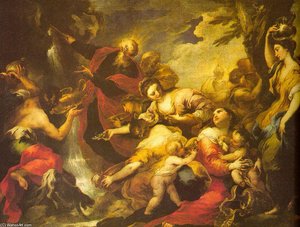
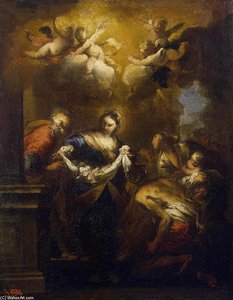
Though his life was tragically brief, ending in 1659, the impact of Castello’s hand remains etched into the architectural and spiritual fabric of Genoa. His ability to command both the intimate canvas and the monumental fresco is evident in works such as Moses Striking the Rock, a 1653 masterpiece that embodies divine power through visceral movement, and his breathtaking frescoes within the Basilica della Santissima Annunziata del Vastato. Whether depicting the poignant biblical narratives of Rebecca at the Well or the grand, collaborative triumphs at the Palazzo Balbi, Castello infused every stroke with a sense of spiritual transcendence. His influence rippled through generations, notably shaping the development of Domenico Piola and cementing his status as a pre-eminent figure of the Baroque, leaving behind a legacy of light, drama, and profound human emotion.질의응답
Valerio Castello의 모든 작품은 어디에서 볼 수 있나요?
본 웹사이트에 등록된 Valerio Castello의 모든 작품은 작가의 모든 작품 보기 페이지에서 확인하실 수 있습니다.
Valerio Castello의 출생지와 출생 연도는 언제인가요?
Valerio Castello은(는) 1624년 Genoa에서 태어났습니다.
미술 사조별로 분류된 Valerio Castello의 작품은 어디에서 볼 수 있나요?
Valerio Castello의 작품은 작가의 모든 사조 페이지에서 사조별로 둘러보실 수 있습니다.