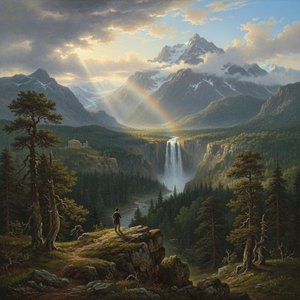
William Luker (1867-1909): A Victorian Master of Pastoral Light
William Luker, a British artist working primarily during the late 19th and early 20th centuries, remains a captivating figure within the landscape art tradition. Often overshadowed by his more prominent contemporaries, Luker’s meticulous detail and evocative use of light have secured him a devoted following amongst collectors and scholars alike. Born in London in 1867, he inherited a passion for painting from his father, William Luker Sr., a renowned artist celebrated for his depictions of rural England – a lineage that profoundly shaped Luker's artistic trajectory.
Luker’s early life was marked by familial challenges. His father’s struggles with depression and financial instability cast a long shadow over the family, influencing the young William to seek solace and creative expression through art. This period of hardship instilled in him a deep appreciation for the beauty of the natural world – a refuge from personal turmoil. He received his initial artistic training under his father, absorbing not only technical skills but also a particular sensibility towards capturing the serene essence of the English countryside.
The Language of Light and Landscape
Luker’s distinctive style is immediately recognizable through his masterful manipulation of light and color. He eschewed the dramatic, often brooding tones favored by some of his contemporaries, instead opting for a softer, more luminous palette. His paintings are characterized by an almost ethereal quality – as if bathed in the golden glow of late afternoon sunlight. This deliberate choice wasn’t merely aesthetic; it reflected Luker's desire to convey a sense of tranquility and harmony with nature.
His subjects typically centered around idyllic rural scenes: rolling hills dotted with sheep, meticulously rendered hunts in Scottish glens, and charming village life. However, Luker’s skill extended beyond simple representation. He possessed an uncanny ability to capture the fleeting effects of light on water, foliage, and stone – transforming ordinary landscapes into moments of breathtaking beauty. He frequently employed a technique of layering thin washes of color, building up depth and atmosphere with subtle gradations.
Notable Works and Artistic Development
Among Luker’s most celebrated works is “Two Hunting Horses in a Landscape” (1852), a dynamic depiction of a Victorian hunting scene. The painting showcases his remarkable ability to convey movement and drama, capturing the energy of the horses and the intensity of the hunt with impressive detail. “A Halt in the Desert” (circa 1890) offers a contrasting study – a quiet, contemplative scene featuring a lone rider against a vast expanse of sand, demonstrating Luker’s versatility across different subject matter.
“Stag Hunt in Scotland” (1852), a particularly striking example of his work, exemplifies the artist's meticulous attention to detail and his ability to capture the rugged beauty of the Scottish Highlands. The painting is renowned for its dramatic lighting and the realistic portrayal of the animals and hunters. Luker’s artistic style evolved subtly throughout his career, reflecting both his technical mastery and his growing personal vision.
Legacy and Influence
Despite not achieving widespread fame during his lifetime, William Luker's work has gained increasing recognition in recent decades. His paintings are now held in prestigious collections worldwide, and his influence can be seen in the works of later landscape artists. Luker’s legacy lies not only in his individual achievements but also in his embodiment of a particular aesthetic sensibility – a quiet reverence for nature and a profound understanding of light.
His dedication to capturing the subtle nuances of the English countryside, combined with his exceptional technical skill, ensures that William Luker remains a significant figure in Victorian art history. Further research into his life and work continues to reveal new insights into this talented and often overlooked artist.
질의응답
William Luker의 다른 이름이나 별칭에는 무엇이 있나요?
William Luker은(는) William Luker Jr., William Luker Ii(으)로도 알려져 있습니다.
William Luker의 작품 세계는 시간이 흐름에 따라 어떻게 변화했나요?
William Luker의 예술적 여정은 연대기 페이지에서 시기별로 펼쳐집니다. 이곳에서는 작가의 활동 시기를 장(chapter)으로 나누어 작품들을 연대순 타임라인 형태로 한눈에 확인할 수 있습니다.
William Luker의 작품을 색상별로 모아둔 곳은 어디인가요?
William Luker의 작품은 작가의 색상별 인덱스 페이지에서 색상별로 살펴보실 수 있습니다.