

1915. Acrylic On Canvas, 51.0 x 33.0 cm.

§ 1Catalogue data
 Acrylic On Canvas
- WallArt
- Cubism
 1915
1915- Modern
 51.0 x 33.0 cm
§ 2Abstract
Kolekcinio objekto aprašas
Discover "Raimondo" by Modigliani – a captivating Cubist portrait from 1915! Explore angular forms, warm colors & expressive brushwork. A unique piece for art collectors.
 Skaityti daugiau
Autoriaus biografija
Amedeo Modigliani: italų dailininkas, žinomas poetiškais portretais ir figūromis su ilgomis kaktytėmis. Atverkite jo unikalų stilių, kuriame susijungia ekspresionizmas ir senovės Italijos menas.
§ 3Commentary
A Fragmented Gaze: Exploring Modigliani’s *Raimondo* (1915)
This captivating portrait, *Raimondo*, painted in 1915 by Italian artist Amedeo Modigliani, offers a compelling example of his brief but impactful foray into Cubist principles. Measuring 51 x 33 cm, the work showcases Modigliani’s distinctive style as he navigated the avant-garde art scene of early 20th-century Paris. While not a pure Cubist painting, *Raimondo* demonstrates a clear engagement with the movement's fragmentation and geometric abstraction, blended seamlessly with his emerging personal aesthetic.Deconstructing Form: Style & Technique
The artwork is immediately striking for its angularity. Modigliani breaks down the subject’s face and form into simplified planes, echoing the Cubist approach pioneered by Picasso and Braque. However, unlike the often analytical and detached nature of early Cubism, *Raimondo* retains a sense of emotional resonance. The warm palette – dominated by oranges, reds, and browns – is juxtaposed against cooler greens and whites in the background, creating visual depth through overlapping shapes rather than traditional perspective. The brushwork appears loose and expressive, suggesting a textured surface built up with layers of paint, adding dynamism to the fractured composition. The sharp lines and geometric forms contribute to a feeling of controlled energy, while the diffused lighting subtly emphasizes the angularity of the figure.Modigliani in Context: 1915 & Artistic Influences
1915 was a pivotal year for Modigliani. Having arrived in Paris in 1906, he had immersed himself in the city’s vibrant artistic community, encountering key figures like Picasso and Brâncuși. This exposure profoundly influenced his development. While initially experimenting with various styles, including sculpture, Modigliani began to forge his own path – a synthesis of influences that included Cubism, African art (particularly masks), and the Italian Renaissance tradition he studied in his youth. *Raimondo* represents this transitional period, showcasing his willingness to experiment while simultaneously hinting at the elongated forms and stylized features that would become hallmarks of his mature portraiture.Beyond Likeness: Subject & Symbolism
The subject of *Raimondo*, a young woman, is presented not as a literal representation but rather as an exploration of form and essence. Modigliani wasn’t concerned with capturing a perfect likeness; instead, he sought to convey the inner life and psychological state of his sitter through abstracted forms. The fragmented face invites viewers to piece together their own interpretation, fostering a sense of introspection. While specific symbolism remains open to debate, the painting's overall effect is one of quiet contemplation and perhaps even a subtle melancholy – emotions often associated with Modigliani’s work.Emotional Resonance & Interior Appeal
*Raimondo* evokes a complex emotional response. The fragmented representation can feel unsettling yet intriguing, prompting viewers to engage actively with the artwork. Its warm color palette and dynamic composition make it a visually stimulating piece that would add sophistication to any interior space.- Its relatively small size makes it suitable for both intimate settings and larger collections.
- The painting’s blend of abstraction and figuration offers versatility, complementing modern or traditional décor.
- As a work from a significant period in Modigliani's artistic development, *Raimondo* represents a valuable addition to any art collection.
Klausimai ir atsakymai
Kaip „Raimondo“ – Amedėjas Modiljanis spalvos susiję su jo emocine išraiška?
„Raimondo“ – Amedėjas Modiljanis Earthy paletė dera su jo Melancholic emociniu tonu. Spalva yra vienas iš būdų, keliais kūrinys perteikia jausmus.
Ar „Raimondo“ – Amedėjas Modiljanis spalvos yra ryškios ar blėdžios?
„Raimondo“ spalvų nasyginimas yra Balanced Soft, o intensyvumas – Balanced.
Kokia emocinė nuotaika lydi „Raimondo“ kūrinį, priskiriamą Cubism stiliui?
„Raimondo“ pasižymi Melancholic emociniu tonu, būdingu Cubism stiliui.


 Perjungti į spausdinamus版作品


 Dėl meno kūrinių ar reprodukcijų, kurių bet kuri pusė yra didesnė nei 105 cm (apie 41 inch), rėmas bus siunčiamas kaip išskaidytas surinkimo rinkinys. Šis metodas užtikrina saugų pristatymą ir apsaugo nuo transportavimo metu galimos žalos.


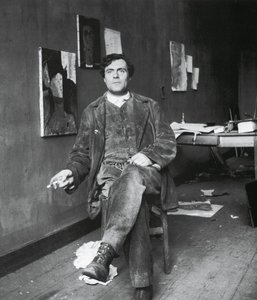
![Amedeo Clemente Modigliani (US: ; Italian: [ameˈdɛːo modiʎˈʎaːni]; 12 July 1884 – 24 January 1920) was an Italian painter and sculptor of the École de Paris who worked mainly in France. He is known for portraits and nudes in a modern style characterised b](/media/artworks/images-thumb/89/b4/89b468fd13c9cee7979c7570240f5cb8.jpg)


