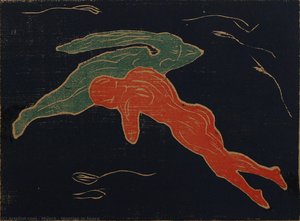
1900. Acrylic On Canvas, 84.0 x 109.0 cm.

§ 1Katalogo duomenys

- 84.0 x 109.0 cm


§ 2Abstraktus
Kolekcinio objekto aprašas
Explore Edvard Munch's evocative 'Smoke Train,' a masterpiece of Expressionism capturing the bleak beauty of Norwegian landscapes and conveying profound emotional tension through bold colors and brushstrokes.
 Skaityti daugiau
Autoriaus biografija
Ekspresionizmo pionierius Edvardas Munchas sukūrė ikonikos „Šauksmą“. Atraskite jo šiurbius nerimo ir emocijų šedevralius jau šiandien.
§ 3Komentaras
A Breath Held Captive: Edvard Munch’s “Train Smoke”
Edvard Munch's "Train Smoke," completed in 1900, isn’t merely a landscape painting; it’s an embodiment of the anxieties simmering beneath the surface of early 20th-century Europe—a visual distillation of existential dread rendered with breathtaking artistry. Housed at Oslo’s Munch Museum, this monumental canvas (84 x 109 cm) transcends its physical dimensions to deliver a profound meditation on modernity's intrusion upon the tranquility of nature and the inescapable awareness of mortality.The Expressionist Vision: Style and Technique
Munch’s stylistic allegiance firmly rests within Expressionism, a movement that prioritized emotional intensity over objective representation. Unlike Impressionists who sought to capture fleeting moments of light and color, Munch aimed to convey inner turmoil—the artist's own psychological state projected onto the canvas. The painting utilizes oil on canvas, allowing for rich textural layering and vibrant hues that contribute significantly to its emotive power. Notice the deliberate simplification of forms; Munch eschews meticulous detail in favor of bold contours and expressive brushstrokes—a technique characteristic of Expressionist painters who wished to bypass rational thought and tap directly into primal feelings. The rhythmic interplay of lines mimics the movement of wind-swept trees, mirroring a subconscious yearning for freedom amidst confinement.A Landscape Steeped in Symbolism: Composition and Motif
The scene unfolds from Ljan, overlooking Oslo fjord—a location chosen by Munch to heighten the sense of isolation and vulnerability. He captures a hillside dotted with pine trees as a train passes silently along the fjord’s edge. The artist's keen observation isn’t merely descriptive; it’s imbued with symbolic significance. The towering pines represent stability and resilience, yet their undulating lines convey an underlying restlessness—a subtle counterpoint to the locomotive’s passage. However, Munch’s gaze is drawn not to the train itself but to its smoke – a motif that dominates the composition. Rendered in rounded shapes defined by crisp contour lines, the smoke embodies the disruptive force of industrialization and encroaching urbanization, symbolizing the anxieties surrounding technological advancement and societal change. The white smoke cloud hovering above the trees further amplifies this visual metaphor for unease and impending doom.Historical Context: Art Nouveau’s Influence
“Train Smoke” operates within the broader context of Art Nouveau—a decorative style that flourished across Europe in the late 1890s and early 1900s. Munch skillfully blends Art Nouveau's lyrical tints and flowing lines with Expressionist principles, resulting in a harmonious synthesis. This stylistic choice reflects a desire to capture the beauty of the natural world while simultaneously confronting its darker aspects—a preoccupation that aligns perfectly with Munch’s artistic ethos. The painting speaks to a generation grappling with rapid industrialization, social upheaval, and growing disillusionment with traditional values.Emotional Resonance: Beyond Representation
Ultimately, “Train Smoke” succeeds in conveying an overwhelming sense of melancholy and apprehension. It's not simply a depiction of a train journey; it’s an exploration of the human condition—a confrontation with mortality and the inescapable awareness of suffering. Munch achieves this profound emotional impact through masterful use of color – predominantly shades of green and blue – punctuated by flashes of yellow and red that heighten tension and underscore the painting's psychological depth. Viewing “Train Smoke” is akin to stepping into Munch’s tormented mind, experiencing firsthand the artist’s visceral response to the world around him. It remains a testament to Expressionism’s ability to transform visual imagery into a conduit for profound emotional truth.Klausimai ir atsakymai
Ar „Train smoke“ – Edvardas Munchas spalvos yra ryškios ar blukusios?
„Train smoke“ – Edvardas Munchas kūrinys pasižymi Subtle Color nasyginimu.
Kokio išdėstymo formatas tinka kūriniui „Train smoke“ – Edvardas Munchas?
„Train smoke“ – Edvardas Munchas formatas Landscape rekomenduojamas Living Room erdvėje. Formatas ir erdvė kartu padeda tinkamai išdėsti reprodukciją.
Kur galiu rasti „Train smoke“ vadovą?
Dėl „Train smoke“ – Edvardas Munchas yra prieinama Informacinė medžiaga puslapio: spausdinamas informacinis lapelis apie kūrinį, skirtas studentams ir mokomajamiam procesui klasėje.


 Perjungti į spausdinamus版作品


 Dėl meno kūrinių ar reprodukcijų, kurių bet kuri pusė yra didesnė nei 105 cm (apie 41 inch), rėmas bus siunčiamas kaip išskaidytas surinkimo rinkinys. Šis metodas užtikrina saugų pristatymą ir apsaugo nuo transportavimo metu galimos žalos.