

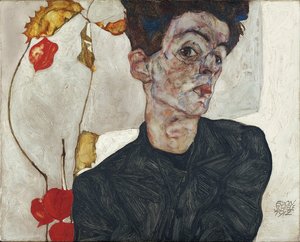
1911. Akrilas ant drobės, 315.0 x 478.0 cm. Leopold Museum.

§ 1Catalogue data

- 315.0 x 478.0 cm


§ 2Abstract
Kolekcinio objekto aprašas
Egon Schiele's 'Moa': A haunting Expressionist watercolor capturing a dancer’s enigmatic pose from 1911. Explore this pivotal work and its bold geometric style – discover or own a masterpiece of early 20th-century art.
 Skaityti daugiau
Autoriaus biografija
Egon Šylė – Austrių ekspresionizmo dailininkas. Žiūrėkite į jo reikšmę Vienoje ir pasaulyje! Ekspresionistinio meno srovės atstovas, žinomas dėl savo psichologinės gilumo ir išraiškos.
§ 3Commentary
A Portrait of Modernity: Egon Schiele’s ‘Moa’ (1911)
This striking watercolor, *Moa*, offers a compelling glimpse into the burgeoning Expressionist style of early 20th-century Vienna and the artistic revolution spearheaded by Egon Schiele. Painted in 1911, this work transcends a simple portrait; it’s a powerful statement about identity, abstraction, and the rejection of established artistic conventions.The Subject & Her Circle
Moa was not merely a model but an integral part of Schiele's creative world – a dancer and close friend who, along with her partner Erwin Osen, frequently posed for the artist between 1910 and 1911. Their presence in Schiele’s work reflects his fascination with the performing arts and the human form as vehicles for emotional expression. The intimate connection he shared with his models is palpable in the intensity of their portrayals.Style & Technique: Breaking from Klimt
*Moa* exemplifies Schiele's departure from the decorative, often sensual style of his mentor, Gustav Klimt. While Klimt enveloped his figures in opulent ornamentation, Schiele strips away extraneous detail, focusing instead on a stark contrast between the realistically rendered face and the dramatically abstracted drapery. The watercolor technique itself – loose, gestural brushstrokes and layered washes – contributes to the painting’s raw emotional energy. The large scale of the work (315 x 478 cm) further amplifies its impact, enveloping the viewer in its presence.Decoding the Symbolism
The robe is not simply clothing; it's a symbolic enclosure. Its austere, geometric design completely conceals Moa’s body, creating a sense of mystery and perhaps even confinement. The angular shapes and blocks of color within the garment can be interpreted as representing fragmentation or internal emotional turmoil. This abstraction isn’t about hiding the figure but rather exploring the psychological space *around* her. The intentional flattening of perspective further emphasizes this symbolic weight, prioritizing shape and color over realistic representation.Historical Context: From Jugendstil to Expressionism
Schiele's work emerged during a period of profound social and artistic change. Vienna at the turn of the century was a hotbed of intellectual and creative ferment, witnessing the decline of the *Jugendstil* (Art Nouveau) and the rise of Expressionism. *Moa* is pivotal in this transition – it takes the robed figure motif from Klimt but transforms it into something entirely new, abandoning “seductive illusion” for a more direct and emotionally charged aesthetic.Emotional Impact & Legacy
The painting evokes a sense of melancholy and introspection. Moa’s gaze is bold yet distant, suggesting an inner life that remains partially obscured. The somber color palette reinforces this mood. *Moa* isn't simply a visual experience; it’s an invitation to contemplate the complexities of human emotion and the search for identity in a rapidly changing world. Schiele’s influence on subsequent generations of artists is undeniable, solidifying his place as a key figure in modern art history.Further Exploration
- Discover more about Egon Schiele's life and work at the AllPaintingsStore artist page.
- Explore related works like "Reclining Girl, with Round Head" to understand the evolution of Schiele’s style.
- Visit the Leopold Museum in Vienna to view an extensive collection of his paintings.
Klausimai ir atsakymai
Kokia buvo Egon Šylė amžius sukuriant „Moa"]?
Kai 1911 m. buvo sukurta „Moa“, Egon Šylė – gimęs 1890 m. – buvo 21 metų amžiaus.
Kokio Egon Šylė kūrybos etapo dalis yra „Moa“?
„Moa“ priklauso Egon Šylė kūrybos karjeros Early Period etapui. Ši klasifikacija atspindi kūrinio ryšį su menininko evoliucija.
Kaip suformuota „Moa“ – Egon Šylė spalvų kompozicija?
„Moa“ – Egon Šylė spalvų analizėje fiksuojamas Pareiškimas kontrastas ir Stiprus spalvų vientisumas harmonija.


 Perjungti į spausdinamus版作品


 Dėl meno kūrinių ar reprodukcijų, kurių bet kuri pusė yra didesnė nei 105 cm (apie 41 inch), rėmas bus siunčiamas kaip išskaidytas surinkimo rinkinys. Šis metodas užtikrina saugų pristatymą ir apsaugo nuo transportavimo metu galimos žalos.


