Pinigų grąžinimo garantija · 100 dienų Nemokamas pristatymas į visas pasaulio valstybes
449.587kūriniai 30.613menininkai 4.660muziejai 32kalbos
Valiuta
    Kalba
      Ateljė · Įkurta 2015 m. · Paris, Prancūzija
      AllPaintingsStore
      allpaintingsstore.com
      Catalogue entry

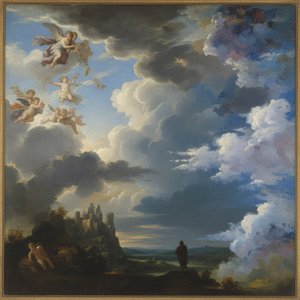
      Study for Clouds (Contre-jour)

      1970. Oil On Canvas, 80.0 x 100.0 cm.

      Fig. 1. Gerhardas Richter, Study for Clouds (Contre-jour), 1970. Shown as the reproduction you are specifying: , .

      § 1Catalogue data

      § 2Abstract

      Kolekcinio objekto aprašas

      Explore Gerhard Richter's 'Study for Clouds (Contre-jour)' – an evocative oil painting capturing the ethereal beauty of sunset clouds with masterful layering and dramatic lighting. Discover more about this iconic piece.

      Autoriaus biografija

      Gerhardas Richteris – XX a. antros pusės ir XXI a. pr. Vokietijos menininkas, tapytojas, garsėjęs abstrakcijomis ir fotorealizmo stiliumi. Jo kūriniai įkvėpė daugybę šiuolaikinės meno artistas ir išliko svarbia Šiaurės Amerikos muziejaus kolekcijoje.

      § 3Commentary

      A Window into Richter’s Soul: The Poetic Study of Light and Form

      Gerhard Richter's *Study for Clouds (Contre-jour)*, executed in 1970, stands as a testament to his pioneering approach within Abstract Expressionism. More than just a depiction of natural phenomena—a sunset viewed through swirling clouds—it’s an exploration of perception itself, capturing the elusive beauty and transformative power of light against textured surfaces.

      • Subject Matter: The artwork centers on a simple yet profound observation: the dramatic interplay between sunlight and cloud formations. Richter eschews representational accuracy, prioritizing instead the emotional resonance of color and texture.
      • Style & Technique: Richter’s masterful use of oil paint—applied in multiple layers with meticulous blending—creates an illusionistic surface that mimics the organic irregularities of clouds. The technique is characterized by a deliberate ambiguity; it's neither fully abstract nor entirely realistic, existing somewhere between these two poles.
      • Color Palette: Dominated by cool blues and grays, punctuated by flashes of pale yellow where sunlight penetrates the cloud cover, the palette reflects the subdued grandeur of twilight. Richter’s color choices are carefully calibrated to convey mood and atmosphere—a sense of quiet contemplation amidst a dynamic visual experience.

      The Influence of Friedrich and Beyond

      Richter's work is deeply rooted in the Romantic tradition, particularly influenced by Caspar David Friedrich’s landscapes imbued with sublime emotion. Like Friedrich, Richter seeks to capture the awe-inspiring grandeur of nature while simultaneously conveying a feeling of vulnerability and insignificance. However, Richter departs from Friedrich’s meticulous detail, favoring instead a looser brushstroke that emphasizes tonal variation and textural depth.

      • Historical Context: Created during the formative years of Richter's artistic career—a period marked by experimentation and intellectual engagement—the painting reflects the broader stylistic currents of the time. It aligns with the burgeoning interest in abstraction as a means of expressing subjective experience.
      • Symbolism: Clouds themselves hold symbolic significance, representing change, impermanence, and the sublime beauty of the natural world. Richter’s depiction captures this essence—a fleeting glimpse of light and color that evokes feelings of wonder and melancholy.

      A Meditation on Perception

      *Study for Clouds (Contre-jour)* isn't merely a visual representation; it's an invitation to contemplate the nature of perception. Richter’s technique—characterized by layering, blurring, and subtle tonal shifts—challenges viewers to consider how our senses interpret reality. The painting encourages us to appreciate the beauty of imperfection and to embrace the ambiguity inherent in artistic expression.

      • Materials Used: Oil paint on canvas – Richter’s choice of medium underscores his commitment to capturing the materiality of the artwork itself, mirroring the textures and nuances of the observed landscape.
      • Perspective & Depth: Atmospheric perspective—the gradual lightening and diminishing of color intensity as distance increases—creates a convincing illusion of depth, immersing the viewer in the contemplative mood of the scene.

      Klausimai ir atsakymai

      Ar galėčiau pamatyti „Study for Clouds (Contre-jour)“ – Gerhardas Richter ant savo sienos prieš pirkdama/pirkdamas?

      „Study for Clouds (Contre-jour)“ – Gerhardas Richter galite išbandyti ant savo sienos naudodami papildytoji realybės funkciją suderinamame įrenginyje per šio kūrinio Peržiūra papildintajai realybei puslapį.

      Ar „Study for Clouds (Contre-jour)“ bendroje apimatyje yra labiau šviesus ar tamsus kūrinys?

      Įrašytos „Study for Clouds (Contre-jour)“ – Gerhardas Richter reikšmės: šviesos intensyvumas – bright, luminansas – Gentle Luminance.

      Kiek žmonių žiūri į „Study for Clouds (Contre-jour)“?

      Statistika apie „Study for Clouds (Contre-jour)“ – Gerhardas Richter pateikiama kūrinio Statistika puslapio: mėnesiniai kūrinio apsilankėjimai, kito šio autoriaus kūrinių apsilankėjimai bei neseniai apsilankiusiųjų skirstymas pagal šalis ir kalbas.

      § 4The artist

      Gerhardas Richter

      Gerhardas Richter

      1932 - , Vokietija

      Quick facts about Gerhardas Richter

      • Artistic Movement Or Style: Fotorealizmas ir abstrakcija
      • Artists Who Influenced This Artist:
        • Pablo Picasso
        • Jean Arp
      • Date Of Birth: Vasario 9 d.
      • Full Name: Gerhard Richter
      • Nationality: Vokiečių
      • Notable Artworks:
        • Abstraktas Bild (610-1)
        • Gilbert
        • S. su vaiką
      • Place Of Birth: Dresdenas, Vokietija

      Autoriaus biografija

      A Life Shaped by Division: The Early Years and Artistic Formation of Gerhard Richter

      Gerhard Richter’s story is inextricably linked to the fractured history of 20th-century Germany. Born in Dresden in 1932, his childhood unfolded under the shadow of a rising National Socialist regime. This formative period, marked by displacement – his family moved several times during the war years – instilled within him a profound sense of uncertainty and a questioning spirit that would permeate his artistic practice for decades to come. The idyllic landscapes of his early upbringing in Reichenau and Waltersdorf were soon disrupted by conflict, leaving an indelible mark on his psyche. His father, though not a fervent supporter of the Nazi party, navigated the complexities of life under authoritarian rule as a schoolteacher, while his mother fostered a love for literature and music within the family. This duality – a pragmatic acceptance of circumstance alongside a yearning for cultural expression – became a defining characteristic of Richter’s own artistic approach. He began formal training at the Dresden Academy of Fine Arts in 1951, initially immersed in the tradition of socialist realism demanded by the East German state. However, even within this constrained environment, a desire for artistic freedom simmered beneath the surface, fueled by a growing dissatisfaction with ideological constraints and a longing to explore more expansive creative possibilities.

      Escaping Constraints: Düsseldorf and the Exploration of Style

      The year 1961 proved pivotal. Richter, along with his wife Marianne Eufinger, made the daring decision to flee East Germany, seeking refuge in the burgeoning art scene of Düsseldorf. This move marked a radical shift in his artistic trajectory. The West German landscape offered a liberating environment where experimentation and innovation were not only permitted but actively encouraged. In Düsseldorf, he encountered a vibrant community of artists grappling with questions of identity, representation, and the legacy of history. He quickly began to dismantle the rigid stylistic conventions of socialist realism, embarking on a period of intense exploration that would define his early mature work. This era saw him oscillate between seemingly disparate approaches – from photorealism, meticulously recreating photographic images with astonishing precision, to abstract compositions characterized by bold colors and dynamic brushstrokes. His collaboration with Sigmar Polke led to the coining of the term ‘Capitalist Realism,’ a deliberately ambiguous label that reflected their shared skepticism towards established artistic norms and their appropriation of imagery from advertising and mass media. This period wasn’t about finding *a* style, but rather questioning the very notion of stylistic coherence, embracing contradiction as a fundamental principle.

      Blurring Boundaries: Photorealism, Abstraction, and the Power of Chance

      Richter's artistic vocabulary expanded throughout the 1960s and beyond, encompassing a remarkable range of techniques and themes. His photorealistic paintings, often based on family photographs or newspaper images, are not merely copies of reality but rather investigations into the nature of perception and representation. By meticulously rendering these images with an almost clinical detachment, he forces viewers to confront the inherent ambiguity of photographic truth. Simultaneously, Richter delved deeper into abstraction, creating canvases layered with vibrant colors and gestural marks. These abstract works are often created using a unique technique involving squeegees – tools typically used for cleaning windows – which he drags across the surface of the canvas, manipulating the paint in unpredictable ways. This embrace of chance and spontaneity is central to his artistic philosophy, allowing him to relinquish control and invite unexpected outcomes. His ‘Color Charts,’ systematic arrangements of colored squares, further challenge traditional notions of artistic expression, questioning the very definition of painting itself. These works are not about individual aesthetic preferences but rather about exploring the inherent properties of color and its organizational possibilities.

      Legacy and Influence: A Master of Contemporary Art

      Gerhard Richter’s impact on contemporary art is undeniable. His willingness to challenge conventions, his relentless experimentation with technique, and his profound engagement with historical and political themes have established him as one of the most important artists of our time. He has consistently resisted easy categorization, defying attempts to pigeonhole his work into a single stylistic framework. This refusal to be defined, coupled with his technical virtuosity and intellectual rigor, has earned him widespread critical acclaim and commercial success – his paintings regularly fetch record prices at auction. His influence can be seen in the work of countless artists who have followed in his footsteps, drawn to his innovative techniques and his unwavering commitment to artistic exploration. Richter’s legacy is not simply about creating beautiful objects; it's about expanding the possibilities of painting itself. He remains a vital force in contemporary art, continuing to inspire and provoke audiences with his challenging and deeply resonant work.

      § 5Comparanda

      § 6Questions

      Trumpa informacija

      • Dimensions: 80 × 100 cm
      • Artistic style: Realist abstraction
      • Artist: Gerhard Richter
      • Location: Private Collection
      • Influences: Romantic Landscape Painting
      • Notable elements or techniques: Atmospheric perspective; Layered painting

      Karo viktorina

      Kiekviename klausime yra tik vienas teisingas atsakymas.

      Klausimas 1:
      What artistic movement is Gerhard Richter’s ‘Study for Clouds (Contre-jour)’ associated with?
      Klausimas 2:
      The technique employed by Richter in this piece is primarily characterized by:
      Klausimas 3:
      What does the term ‘contre-jour’ refer to in relation to the artwork?
      Klausimas 4:
      What is a symbolic representation conveyed by the depiction of clouds in ‘Study for Clouds (Contre-jour)?
      Klausimas 5:
      Where was Gerhard Richter born?

      § 7Cite this entry

      AllPaintingsStore.com, “Gerhardas Richter, Study for Clouds (Contre-jour) (1970)”, https://allpaintingsstore.com/lt/art/gerhard-richter-study-for-clouds-contre-jour-D2XRB9-en/ArtistReproduction/ (accessed 2 spalis 2026).

      § 8The reproduction

      Rankų darbo aliejinės reprodukcijos

      Rankiniu būdu tapytas aliejus ant droblio jūsų pageidaujamame dydį ir rėmuose – tai mūsų menininkų pagal užsakymą sukurtas darbas. ( Perjungti į spausdinamus版作品 Perejti prie skaitmeninių vaizdų)

      It is specified on the order sheet in the margin; the present state of that sheet reads as follows.

      Study for Clouds (Contre-jour)

      Reprodukcijos technika

      Reprodukcijos matmenys

      -

      Aukščiausios klasės meistras

      Daugiau detalių, meistriškumo ir papildomo gamybos laiko

      -

      Reprodukcijos rėmėjimo parinktys

      -

      -

      Dėl meno kūrinių ar reprodukcijų, kurių bet kuri pusė yra didesnė nei 105 cm (apie 41 inch), rėmas bus siunčiamas kaip išskaidytas surinkimo rinkinys. Šis metodas užtikrina saugų pristatymą ir apsaugo nuo transportavimo metu galimos žalos.

      Reikalingas profesionalus surinkimas – tai nėra „pasidaryk pats“ (DIY) produktas.
      Rinkinys turi būti surinktas, o drobė išplėsta naudojant patyrį profesionalų rėmininką, medžio klijus (nėra įtraukti į rinkinį), drobės plėšimo kleslę bei presas, kad rėmo rėžiai išliktų tiesūs, kol klijai išdžiūvus. Netinkamas surinkimas arba netolydus drobės įtampa gali negrįžtamai sugadinti meno kūrinį, todėl šie atvejai nėra užtraukiami mūsų garantijos.

      • Į komplektą įeina visi vientisos medienos elementai, tiksliai išpjauti pagal dydį.

      • Surmontinama naudojant pridėtus varžtus bei papildomai reikalingą medžio kliją kampų jungtims, kuris nėra pridėtas ir turi būti parinktas rėmininkui.

      • Reikalingi profesionalūs įrankiai, kurie nėra įtraukti į rinkinį: drobės kėlimo plytelės (stiprintuvai) ir klemiai, laikantys rėmo strygius tiesiu kampu, kol džiūsta lipas.

      Svarbu:
      Kampų jungtims reikalingi medžio klijai, barams reikia laikyti naudojant presas, kol klijai visiškai išdžiūvės, o surinktam rėmui įtempiamai privilgti būtinos drobės įtempimo plytযুক্ত. Šios priemonės į rinkinį neįtrauktos. Prieš užsakydami šio dydžio rinkinį, rekomenduojame pasimalkoti patyrusiu rėmų meistru.

      Pavadinimo lentelė

      -

      -

      Apsauginis lakas

      Blizgus lakas (ryškina spalvas, saugo nuo šviesos ir drėgmės)

      -

      Personalizuoti kūrinį

      Ką galima pakeisti (pavyzdžiui): pakeisti veidą klientui skirta nuotrauka; pridėti augintinį (pvz., katę pakeisti šuniu); įtraukti paslėptą žinutę fone; pakeisti fono kraštovaizdį ar elementus.

      -

      Skubiai

      Pristatymas visame pasaulyje () per 3–4 savaites, o ne įprastai – per 5 savaites. (30 spalis). Kokybė lieka nepakeičiama.

      -

      Skubus pristatymas

      Pristatymas visame pasaulyje () per 5 weeks. (6 lapkritis).

      Įskaičiuota

      Bendroji kaina

      € 229

      Included with every order

      • Nemokamas greitasis pristatymas visame pasaulyje
      • Aukštos kokybės lininis drobė
      • Pilnas siuntimo draudimas
      • Muitinės mokesčių grąžinimo garantija
      • Tikro spalvų atitikimo garantija
      • 100 dienų grąžinimo politika (tik esant įtaigoms)
      • 100% pinigų grąžinimo garantija
      • Nuolaida dideliems užsakymams
      Order sheet