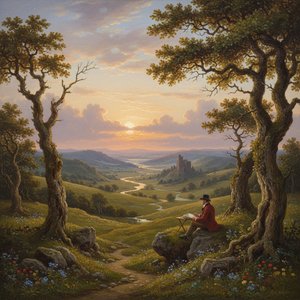
1817. Oil On Canvas, 127.0 x 102.0 cm. Britų meno Jėilos centras.

§ 1Katalogo duomenys

- 127.0 x 102.0 cm


§ 2Abstraktus
Kolekcinio objekto aprašas
Experience the sublime grandeur of John Martin's 'The Bard,' a monumental Romantic landscape painting depicting biblical drama amidst turbulent mountains and echoing with Thomas Gray’s poetic vision.
 Skaityti daugiau
Autoriaus biografija
Atraskite Johno Martina, garsųjo anglo romantiškojo stiliaus paveikslautoją! Tyrinėkite jo dramatiškas biblijines escenas ir fantastinius kraštžemius, pilnus smulkių figūrų bei grandingų mastų.
§ 3Komentaras
A Vision of Sublime Terror and Eternal Grandeur
In the annals of Romanticism, few canvases command the eye with such visceral intensity as John Martin’s “The Bard.” Completed around 1817, this masterpiece serves as a profound window into the soul of an era obsessed with the sublime—that breathtaking intersection where beauty meets overwhelming terror. The painting does not merely depict a landscape; it orchestrates a cosmic drama. As the viewer’s gaze is drawn into the turbulent gorge, they are met with a world sculpted by elemental fury. Jagged cliffs and towering mountains loom like silent sentinels over a raging river that plunges into abyssal depths, creating a sense of vertigo that is both unsettling and deeply captivating. This is a landscape where the earth itself seems to tremble under the weight of divine or mythological significance.
At the heart of this tempestuous scene stands a solitary figure, a bard perched upon a rugged outcrop. Clad in the gravity of his role, he appears to be playing a stringed instrument—perhaps a harp—his music acting as a defiant melody against the roar of the cascading waters and the whistling winds. This figure serves as the emotional anchor of the composition, a tiny but resilient spark of human spirit amidst the vast, indifferent machinery of nature. The presence of distant, fortified structures clinging to the highest peaks suggests a lost age of heroism and myth, hinting at a world where the boundaries between the mortal and the divine are perilously thin.
Mastery of Light, Shadow, and Scale
Technically, Martin demonstrates his unparalleled command over the oil medium to achieve a sense of atmospheric depth that few of his contemporaries could replicate. His use of light is nothing short of theatrical; he employs dramatic chiaroscuro to pull the viewer’s eye through layers of mist, spray, and shadow. The color palette is a sophisticated study in contrasts, where the somber, earthy tones of the rocky terrain are pierced by the brilliant, ethereal whites of the churning foam and the shifting, turbulent clouds above. This interplay of light and dark does more than create three-dimensionality; it breathes life into the very air of the painting, making the atmosphere feel heavy with impending storm or divine revelation.
For the discerning collector or interior designer, "The Bard" offers an unparalleled opportunity to introduce a focal point of immense character. The scale of the composition—a commanding 127 x 102 cm—is designed to overwhelm and enchant. When rendered as a high-quality hand-painted reproduction, the meticulous details of Martin’s brushwork—from the minute figures of shepherds dwarfed by the landscape to the intricate textures of the weathered stone—are preserved, allowing the painting to command any room it inhabits. It is a piece that does not merely decorate a wall; it transforms an environment into a space of contemplation and awe.
Historical Resonance and Emotional Legacy
To understand "The Bard," one must look to the literary inspiration that fueled Martin’s imagination: Thomas Gray’s haunting 1817 poem of the same name. Much like Gray’s verses, which explored themes of melancholy remembrance and the fading glory of heroic ideals, Martin’s painting captures a sense of epic loss and the inexorable passage of time. The work is steeped in the cultural zeitgeist of the early 19th century, reflecting a fascination with history, mythology, and the overwhelming power of natural forces. It is an era where the progress of man was often viewed through the lens of its fragility against the backdrop of eternity.
Ultimately, the enduring appeal of this work lies in its emotional resonance. Whether one is drawn to the melancholic beauty of the landscape or the heroic defiance of the bard, the painting evokes a profound sense of wonder. It invites the viewer to contemplate their own place within the vastness of the universe. For those seeking to curate a collection that speaks to the heights of human imagination and the dramatic power of the Romantic movement, "The Bard" remains an essential, timeless acquisition—a window into a world where every shadow tells a story and every light reveals a legend.
Klausimai ir atsakymai
Kokią vietą Džonas Martinas pasikartojančių temų tarėje užima „The Bard“?
Tarp užfiksuotų Džonas Martinas temų – martin’s biblical inspirations, romantic sublime landscape vision, gray poem influence detail, english power symbolism scale, dramatic narrative style artistry – kūrinys „The Bard“ akcentuoja landscape, romanticism, biblical scene, dramatic composition, medieval castle, turbulent river, atmospheric light, epic scale.
Kas sukūrė „The Bard“ ir kokiais metais?
„The Bard“ kūrybinį darbinį sukūrė Džonas Martinas 1817 metais.
Kokia yra autorinės teisės situacijos priežastis kūriniam darbui „The Bard“ – Džonas Martinas?
Autorinės teisės statusas kūriniui „The Bard“ – yra viešosios erdvės dalis – jo autorinė teisė pasibaigusi – nustatomas remiantis to, kad menininkas mirė 1854 m.


 Perjungti į spausdinamus版作品


 Dėl meno kūrinių ar reprodukcijų, kurių bet kuri pusė yra didesnė nei 105 cm (apie 41 inch), rėmas bus siunčiamas kaip išskaidytas surinkimo rinkinys. Šis metodas užtikrina saugų pristatymą ir apsaugo nuo transportavimo metu galimos žalos.