Pinigų grąžinimo garantija · 100 dienų Nemokamas pristatymas į visas pasaulio valstybes
449.587kūriniai 30.613menininkai 4.660muziejai 32kalbos
Valiuta
    Kalba
      Ateljė · Įkurta 2015 m. · Paris, Prancūzija
      AllPaintingsStore
      allpaintingsstore.com
      Catalogue entry

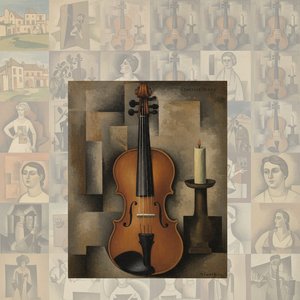
      No Space Left

      Acrylic On Canvas, 87.0 x 55.0 cm. Chrysler Museum of Art.

      Fig. 1. Mark Tobey, No Space Left. Shown as the reproduction you are specifying: , .

      § 1Catalogue data

      § 2Abstract

      Kolekcinio objekto aprašas

      Autoriaus biografija

      Mark Tobey (1890-1976): Pioneer of Abstract Expressionism & founder of the Northwest School. Explore his calligraphic, spiritually-infused paintings inspired by Asian art.

      § 3Commentary

      A Meditation on Absence: Exploring Mark Tobey’s “No Space Left”

      Mark Tobey's "No Space Left," completed in 1963, isn’t merely a painting; it’s an embodiment of existential contemplation rendered in vibrant collage and luminous calligraphy. Presented at 87 x 55 cm, this artwork transcends simple visual representation, inviting viewers into a dialogue with themes of emptiness, spirituality, and the interconnectedness of nature and human experience.

      The Style and Technique: Collage Meets Calligraphy

      Tobey’s distinctive style is immediately recognizable through his masterful blend of collage and calligraphy—a technique he honed throughout his prolific career. The canvas itself is layered with meticulously crafted paper fragments – geometric shapes interspersed with textured surfaces – creating a dynamic visual tapestry that pulsates with energy. These forms aren't randomly arranged; they are deliberately positioned to guide the eye across the composition, mirroring the flow of breath and the rhythm of contemplation.

      • Collage Elements: Fragments of paper—primarily squares and rectangles—are adhered to the canvas using PVA glue, resulting in a textured surface that captures light beautifully.
      • Calligraphy: Thin lines of ink, executed with a brush pen, dominate the upper portion of the painting. These lines resemble birds’ flight paths, conveying a sense of movement and aspiration.

      Historical Context: Surrealism's Echoes and Tobey's Spiritual Journey

      "No Space Left" emerged during Tobey’s engagement with Surrealist principles—particularly his fascination with automatism—a method championed by André Breton aimed at bypassing conscious thought and accessing the subconscious realm. However, unlike many Surrealists who sought to shock or unsettle their audiences, Tobey prioritized conveying a profound spiritual message. Influenced by Zen Buddhism and Taoism, he believed that art should serve as a conduit for inner transformation.

      Symbolism: Birds as Embodiments of Spirit

      The recurring motif of birds—represented in various sizes and orientations—is central to the painting’s symbolic significance. In Buddhist cosmology, birds symbolize liberation from earthly attachments and ascension to higher realms of consciousness. Tobey's meticulous depiction of these avian figures isn’t simply decorative; it’s a deliberate invocation of spiritual ideals – representing hope, resilience, and the yearning for transcendence.

      Emotional Impact: A Quiet Resonance

      Despite its visual complexity, “No Space Left” possesses an understated emotional power. The painting doesn't shout its message; rather, it whispers it—creating a contemplative atmosphere that encourages viewers to pause and reflect on their own experiences of emptiness and fullness. Its luminous colors and flowing lines evoke a sense of serenity and wonder, reminding us of the beauty inherent in accepting what is – leaving space for possibility and spiritual growth.

      This artwork exemplifies Tobey’s unwavering commitment to exploring the intersection between art and spirituality, offering a timeless meditation on themes of absence and aspiration.

      Klausimai ir atsakymai

      Ar „No Space Left“ pasižymi stipriais šviesos ir tamsos kontrastais?

      Kūrinio „No Space Left“ – Mark Tobey kontrasto lygis yra Bold.

      Kokia technika buvo panaudota kūriniam darbui „No Space Left“ – Mark Tobey?

      „No Space Left“ – Mark Tobey technika – Acrylic On Canvas. Kopijos siekia atkartoti šios technikos vaizdą.

      Kokie yra originalaus „No Space Left“ – Mark Tobey matmenys?

      Įrašyti kūrinio „No Space Left“ – Mark Tobey matmenys yra 87 x 55 cm. Kopijas galima užsisakyti kitais dydžiais, išlaikant tą pačius proporcijas.

      § 4The artist

      Mark Tobey

      Mark Tobey

      1890 - 1976, United States of America

      Quick facts about Mark Tobey

      • Full Name: Mark George Tobey
      • Nationality: American
      • Date Of Birth: 1890
      • Date Of Death: 1976
      • Place Of Birth: Centerville, United States of America
      • Notable Artworks:
        • Toward the West
        • Winter Leaves
        • White Journey
      • Artistic Movement Or Style: Abstract Expressionism
      • Artists Or Movements Influenced By This Artist:
        • Jackson Pollock
        • Northwest School

      Autoriaus biografija

      A Life Woven in Light and Calligraphy

      Mark George Tobey, born in Centerville, Wisconsin, in 1890, was more than just a painter; he was a spiritual seeker whose artistic journey mirrored his lifelong exploration of faith, philosophy, and the delicate balance between Eastern and Western aesthetics. His early life, steeped in the Congregationalist traditions of his parents – George Tobey, a carpenter with a penchant for carving animal figures, and Emma Cleveland Tobey – instilled within him an appreciation for craftsmanship and observation. The family’s move to Chicago in 1893 exposed young Mark to a burgeoning urban landscape and, crucially, to the Art Institute of Chicago, where he received his initial formal training. However, it was a path largely self-directed that truly shaped his artistic vision. Tobey's formative years were marked by a restless spirit, leading him to New York City in 1911 where he honed his skills as a fashion illustrator for McCall’s – a practical pursuit that nonetheless provided a foundation in draftsmanship and composition. His first solo exhibition at Knoedler & Company in 1917 signaled the emergence of an artist poised to break from convention, but it was a pivotal encounter in 1918 with Juliet Thompson, a portrait artist and devoted follower of the Baháʼí Faith, that irrevocably altered his trajectory.

      The Embrace of Eastern Thought and Artistic Transformation

      Thompson introduced Tobey to the tenets of the Baháʼí Faith, a religion emphasizing the unity of all religions and humanity’s spiritual evolution. This newfound belief system profoundly impacted his artistic philosophy, shifting his focus from mere representation to an exploration of the spiritual essence underlying reality. He began delving into Arabian literature and the profound wisdom of East Asian philosophies, seeking ways to translate these abstract concepts onto canvas. A move to Seattle in 1921, prompted by personal circumstances, proved serendipitous. There, he encountered Teng Kuei, a Chinese painter who initiated him into the art of Eastern penmanship – a revelation that would become central to his artistic identity. Tobey’s travels became increasingly frequent and purposeful, taking him across Europe, Palestine, Turkey, Lebanon, China, and Japan. Each journey was not merely geographical but an immersion into different cultures and spiritual traditions, enriching his understanding of form, space, and the expressive power of line. He founded the art department at the Cornish School in Seattle, nurturing a new generation of artists while continuing to refine his own unique style.

      The Northwest School and the Birth of “White Writing”

      Tobey’s influence extended far beyond his students; he became a leading figure in the Northwest School, alongside Guy Anderson, Kenneth Callahan, Morris Graves, and William Cumming. This group, united by their shared interest in philosophy, Eastern religions, and a rejection of traditional artistic norms, forged a distinctly American style of abstract art. While influenced by Abstract Expressionism, Tobey’s work differed fundamentally in its intent. Where Pollock sought to express raw emotion through gestural action, Tobey aimed for a more contemplative and spiritual resonance. This led to the development of his signature “white writing” technique – delicate, interwoven lines of white paint applied over dark backgrounds, evoking the calligraphic brushstrokes of East Asian art. These compositions weren’t intended as depictions of anything specific but rather as visual meditations, inviting viewers to lose themselves in the intricate patterns and experience a sense of transcendence. His work from this period is characterized by an all-over composition, lacking a central focal point, encouraging the eye to wander and discover new nuances within the complex network of lines.

      International Recognition and Lasting Legacy

      By the 1950s, Tobey had achieved international acclaim. His work was exhibited widely in Europe and the United States, earning him numerous awards and accolades. He represented the United States at the Venice Biennale in 1958, further solidifying his position as a major figure in the art world. In the early 1960s, Tobey relocated to Basel, Switzerland, with his companion Pehr Hallsten, continuing to paint and explore new artistic avenues until his death in 1976. The question of whether Tobey’s work directly influenced Jackson Pollock's drip paintings remains a subject of debate, but there is no denying the profound impact he had on the development of abstract art. Tobey’s legacy lies not only in his distinctive visual style, but also in his unwavering commitment to spiritual exploration and his ability to synthesize Eastern and Western artistic traditions into a uniquely American voice. He demonstrated that abstraction could be more than just an aesthetic exercise; it could be a pathway to deeper understanding, contemplation, and connection with the divine. His paintings continue to resonate today as testaments to the power of art to transcend boundaries and illuminate the human spirit.

      Key Characteristics & Influences

      • Asian Calligraphy: A foundational influence, evident in his use of line, space, and composition. He studied Chinese and Japanese calligraphy extensively.
      • Baháʼí Faith: Provided a spiritual framework for his art, emphasizing unity, harmony, and the search for truth.
      • Abstract Expressionism: While distinct from Pollock’s action painting, Tobey shared an interest in non-representational forms and expressive gesture.
      • Northwest School Aesthetic: A regional style characterized by a focus on nature, spirituality, and experimentation with materials.
      • Travel & Cultural Immersion: His extensive travels throughout Asia and Europe broadened his artistic horizons and informed his unique visual language.

      § 5Comparanda

      § 6Questions

      Trumpa informacija

      • Title: No Space Left
      • Subject or theme: Spiritual Exploration
      • Notable elements or techniques: Birds, Collage Composition
      • Influences:
        • Eastern Aesthetics
        • Religious Symbolism
      • Location: Private Collection

      Karo viktorina

      Kiekviename klausime yra tik vienas teisingas atsakymas.

      Klausimas 1:
      What is the primary subject matter of Mark Tobey's painting “No Space Left”?
      Klausimas 2:
      The image description highlights the presence of which elements within the artwork?
      Klausimas 3:
      Mark Tobey's artistic influences can be traced to both Eastern calligraphy traditions and Western modernist movements. Which movement is particularly prominent in shaping his style?
      Klausimas 4:
      What technique is Tobey employing to create the visual complexity of “No Space Left”?
      Klausimas 5:
      Considering Tobey's biographical details, what aspect of his upbringing contributed to his fascination with craftsmanship and observation?

      § 7Cite this entry

      AllPaintingsStore.com, “Mark Tobey, No Space Left”, https://allpaintingsstore.com/lt/art/mark-tobey-no-space-left-D4349K-en/ArtistReproduction/ (accessed 2 spalis 2026).

      § 8The reproduction

      Rankų darbo aliejinės reprodukcijos

      Rankiniu būdu tapytas aliejus ant droblio jūsų pageidaujamame dydį ir rėmuose – tai mūsų menininkų pagal užsakymą sukurtas darbas. ( Perjungti į spausdinamus版作品 Perejti prie skaitmeninių vaizdų)

      It is specified on the order sheet in the margin; the present state of that sheet reads as follows.

      No Space Left

      Reprodukcijos technika

      Reprodukcijos matmenys

      -

      Aukščiausios klasės meistras

      Daugiau detalių, meistriškumo ir papildomo gamybos laiko

      -

      Reprodukcijos rėmėjimo parinktys

      -

      -

      Dėl meno kūrinių ar reprodukcijų, kurių bet kuri pusė yra didesnė nei 105 cm (apie 41 inch), rėmas bus siunčiamas kaip išskaidytas surinkimo rinkinys. Šis metodas užtikrina saugų pristatymą ir apsaugo nuo transportavimo metu galimos žalos.

      Reikalingas profesionalus surinkimas – tai nėra „pasidaryk pats“ (DIY) produktas.
      Rinkinys turi būti surinktas, o drobė išplėsta naudojant patyrį profesionalų rėmininką, medžio klijus (nėra įtraukti į rinkinį), drobės plėšimo kleslę bei presas, kad rėmo rėžiai išliktų tiesūs, kol klijai išdžiūvus. Netinkamas surinkimas arba netolydus drobės įtampa gali negrįžtamai sugadinti meno kūrinį, todėl šie atvejai nėra užtraukiami mūsų garantijos.

      • Į komplektą įeina visi vientisos medienos elementai, tiksliai išpjauti pagal dydį.

      • Surmontinama naudojant pridėtus varžtus bei papildomai reikalingą medžio kliją kampų jungtims, kuris nėra pridėtas ir turi būti parinktas rėmininkui.

      • Reikalingi profesionalūs įrankiai, kurie nėra įtraukti į rinkinį: drobės kėlimo plytelės (stiprintuvai) ir klemiai, laikantys rėmo strygius tiesiu kampu, kol džiūsta lipas.

      Svarbu:
      Kampų jungtims reikalingi medžio klijai, barams reikia laikyti naudojant presas, kol klijai visiškai išdžiūvės, o surinktam rėmui įtempiamai privilgti būtinos drobės įtempimo plytযুক্ত. Šios priemonės į rinkinį neįtrauktos. Prieš užsakydami šio dydžio rinkinį, rekomenduojame pasimalkoti patyrusiu rėmų meistru.

      Pavadinimo lentelė

      -

      -

      Apsauginis lakas

      Blizgus lakas (ryškina spalvas, saugo nuo šviesos ir drėgmės)

      -

      Personalizuoti kūrinį

      Ką galima pakeisti (pavyzdžiui): pakeisti veidą klientui skirta nuotrauka; pridėti augintinį (pvz., katę pakeisti šuniu); įtraukti paslėptą žinutę fone; pakeisti fono kraštovaizdį ar elementus.

      -

      Skubiai

      Pristatymas visame pasaulyje () per 3–4 savaites, o ne įprastai – per 5 savaites. (30 spalis). Kokybė lieka nepakeičiama.

      -

      Skubus pristatymas

      Pristatymas visame pasaulyje () per 5 weeks. (6 lapkritis).

      Įskaičiuota

      Bendroji kaina

      € 229

      Included with every order

      • Nemokamas greitasis pristatymas visame pasaulyje
      • Aukštos kokybės lininis drobė
      • Pilnas siuntimo draudimas
      • Muitinės mokesčių grąžinimo garantija
      • Tikro spalvų atitikimo garantija
      • 100 dienų grąžinimo politika (tik esant įtaigoms)
      • 100% pinigų grąžinimo garantija
      • Nuolaida dideliems užsakymams
      Order sheet