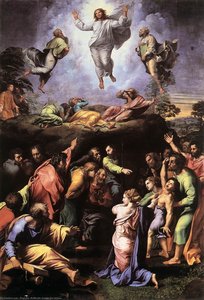
Aliejus ant drobės.

§ 1Katalogo duomenys


§ 2Abstraktus
Kolekcinio objekto aprašas
Discover Raphael’s ‘St John the Baptist,’ a masterpiece of the High Renaissance! Explore its tempera on canvas beauty, classical style & profound symbolism at the Hermitage.
 Skaityti daugiau
Autoriaus biografija
Raphelis (1483–1520) – Renesanso meistras, žinomas dėl savo serenų Madonų, architektūrinio talento ir ikoninių kūrinių, tokių kaip „Atėnų mokykla“. Ištykite jo kilmes Urbine ir meninę palikimą.
§ 3Komentaras
A Vision of Contemplation: Raphael’s St John the Baptist
Raphael’s *St John the Baptist*, painted in 1506, is a captivating early work that showcases the artist's burgeoning talent for portraying human beauty and psychological depth. This painting isn’t merely a depiction of a biblical figure; it’s an intimate study of youth, faith, and nascent spirituality. The artwork currently resides in the Hermitage Museum, St. Petersburg, offering viewers a glimpse into Raphael’s mastery even before his High Renaissance peak.Subject & Composition
The painting presents a young St John, nude save for a crimson cloak draped artfully over his shoulder, seated amidst a dark and somewhat ambiguous landscape. He holds a reed cross in his left hand – a subtle yet potent symbol of his future destiny as the herald of Christ – while his right hand is raised in a gesture that can be interpreted as both pointing towards heaven and acknowledging divine inspiration. The composition is remarkably balanced; St John’s relaxed pose, combined with the gentle curve of his body, creates a sense of serene contemplation. He isn't presented as an austere prophet but rather as a beautiful youth on the cusp of fulfilling his sacred role.Style & Technique
*St John the Baptist* exemplifies Raphael’s early style, blending influences from Umbrian masters like Perugino with emerging Renaissance ideals. The use of tempera on canvas – a technique common during this period – allows for delicate layering and luminous color application. Raphael's skill in rendering anatomy is evident, though softened by a characteristic gracefulness that distinguishes his work from the more muscular figures favored by Michelangelo. The sfumato technique, borrowed from Leonardo da Vinci, subtly blurs outlines, creating an ethereal quality and enhancing the figure’s three-dimensionality. The dark background serves to accentuate St John's form, drawing the viewer’s eye directly to his face and expressive gesture.Historical Context & Symbolism
Created during a period of intense religious fervor and artistic innovation, *St John the Baptist* reflects the Renaissance fascination with classical antiquity and humanism. The depiction of St John as an idealized nude figure draws upon ancient Greek and Roman sculptural traditions. However, Raphael imbues this classical form with Christian symbolism. The reed cross signifies St John’s role as a precursor to Christ, while his gaze directed upwards suggests a connection to the divine realm. The landscape itself, though dark, hints at the wilderness where St John preached repentance. The crimson cloak is often interpreted as foreshadowing the blood he will shed for his faith.Emotional Impact & Interpretation
This painting evokes a sense of quiet reverence and introspective beauty. It’s not a dramatic or overtly emotional work; instead, it invites viewers to contemplate the inner life of St John – his vulnerability, his devotion, and his acceptance of his divine calling. The artwork's enduring appeal lies in its ability to connect with universal themes of faith, self-discovery, and spiritual awakening. The painting’s subtle sensuality, combined with its religious subject matter, creates a compelling tension that continues to captivate audiences centuries later.For Collectors & Designers
- A high-quality reproduction of *St John the Baptist* would serve as a stunning focal point in any interior space, adding a touch of Renaissance elegance and spiritual depth.
- The painting’s muted color palette – dominated by warm earth tones and subtle reds – complements a variety of décor styles, from traditional to contemporary.
- Its intimate scale makes it suitable for both smaller rooms and larger galleries.
- As a testament to Raphael's genius, this artwork represents not only an aesthetic investment but also a connection to one of the most influential artists in history.
Klausimai ir atsakymai
Kokiam istoriniam laikotarpiui priklauso „St John the Baptist“ – Rafaelis?
„St John the Baptist“ – Rafaelis sukurta Renesansas laikotarpiu. Šis laikotarpis suteikia kūriniui istorines aplinkybes.
Kaip galiu įsigyti „St John the Baptist“ – Rafaelis spausdinį?
Norėdami užsisakyti „St John the Baptist“ – Rafaelis spausdinį, tiesiog jį užsisakykite puslapio Kūrinio spausdinimas aukščiausia kokybe skiltyje: aukščiausios kokybės spausdinys ant medžio siuvinėjamų audinių arba archyvinio kanvas tipo popieriaus.
Kokie kiti pseudonimai arba alternatyvūs vardai priklauso Rafaelis?
Rafaelis taip pat žinomas (a) pavadinimais Rafaellas Sanzio Da Urbino, Rafaello Santi.



 Perjungti į spausdinamus版作品


 Dėl meno kūrinių ar reprodukcijų, kurių bet kuri pusė yra didesnė nei 105 cm (apie 41 inch), rėmas bus siunčiamas kaip išskaidytas surinkimo rinkinys. Šis metodas užtikrina saugų pristatymą ir apsaugo nuo transportavimo metu galimos žalos.