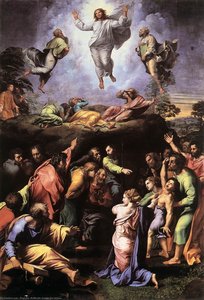
Acrylic On Canvas.

§ 1Katalogo duomenys

§ 2Abstraktus
Kolekcinio objekto aprašas
Explore Raphael’s ‘Studies for the Transfiguration,’ a stunning black & white drawing showcasing Renaissance realism & anatomical detail. A masterpiece of drypoint technique.
 Skaityti daugiau
Autoriaus biografija
Atėnų mokyklos Aukštojo Renesanso meistras. Atraskite legendines Madonas ir nuostabius Vatiko freskas jau šiandien.
§ 3Komentaras
A Study in Contemplation: Raphael’s ‘Studies for the Transfiguration’
The Ashmolean Museum’s exquisite reproduction of Raphael’s “Studies for the Transfiguration” offers a glimpse into the mind of one of Renaissance art’s most celebrated masters. This deceptively simple drawing—a black and white depiction of two male heads in profile—holds within it layers of artistic brilliance and profound symbolic resonance, reflecting the intellectual fervor of Urbino during Raphael's formative years. It wasn’t merely a sketch; it was an exercise in observation, a distillation of anatomical understanding, and a testament to Raphael’s unparalleled draughtsmanship.- Subject Matter: The drawing presents two male faces—likely idealized representations—in repose, their hands outstretched in a gesture that invites interpretation. Scholars believe this posture embodies supplication or perhaps an attempt to grasp something beyond the visible realm – mirroring themes prevalent in Christian iconography of the time.
- Style & Technique: Raphael’s style is unmistakably Renaissance portraiture, prioritizing realism and meticulous detail. The drawing exemplifies drypoint etching—a technique demanding precision and patience—where a needle meticulously scratches lines into paper to create tonal variations and define contours. This method captures the subtle nuances of skin texture and musculature with remarkable accuracy.
- Historical Context: Created during Raphael’s early career, “Studies for the Transfiguration” speaks to the humanist ideals championed by Federico Montefeltro—Raphael's patron—who fostered an environment conducive to artistic innovation and scholarly pursuits. It stands as a cornerstone of Florentine Renaissance art, demonstrating the influence of Leonardo da Vinci’s anatomical studies on Raphael’s approach.
- Symbolism: The gesture of the hands is particularly significant. Often interpreted as representing faith or aspiration, it underscores the spiritual dimension inherent in Raphael's artistic vision—a reflection of the humanist values that underpinned the Renaissance spirit.
Technical Mastery: The Art of Drypoint
The drawing's remarkable tonal range and textural depth are achieved through masterful use of drypoint etching—a technique favored by Raphael for its ability to produce subtle shading effects. Unlike engraving, which relies on incising lines into metal plates, drypoint involves scratching a needle directly onto paper, creating tiny pits that hold ink. This process yields an unparalleled level of tonal gradation and allows for the creation of incredibly delicate textures – mirroring the meticulous observation evident in Raphael’s preparatory sketches.Emotional Resonance: A Window Into Raphael's Mind
“Studies for the Transfiguration” transcends mere technical proficiency; it embodies Raphael’s contemplative spirit—a reflection of Urbino’s intellectual climate and his engagement with humanist ideals. The drawing invites viewers to contemplate the human form, mirroring the Renaissance fascination with anatomy and striving for idealized beauty. It serves as a poignant reminder of Raphael's dedication to capturing not just appearances but also inner states of mind – an achievement that cements its place among the greatest drawings of all time.Klausimai ir atsakymai
Kokia „Studies for the Transfiguration“ – Rafaelis orientacija?
„Studies for the Transfiguration“ – Rafaelis kūrinio formatas yra Portrait. Formatas aprašo kompozicijos proporcijas.
Kokia yra „Studies for the Transfiguration“ – Rafaelis dominuojanti spalva?
Dominuojantis „Studies for the Transfiguration“ – Rafaelis atspalvis yra Golden Yellow Range.
Kokia spalva dominuoja „Studies for the Transfiguration“ – Rafaelis kompozicijoje?
Pagrindinė „Studies for the Transfiguration“ spalva – Putty (#e8dcd0). Dominuojančia spalva padeda lengviau suderinti kūrinį su interjeru.



 Perjungti į spausdinamus版作品


 Dėl meno kūrinių ar reprodukcijų, kurių bet kuri pusė yra didesnė nei 105 cm (apie 41 inch), rėmas bus siunčiamas kaip išskaidytas surinkimo rinkinys. Šis metodas užtikrina saugų pristatymą ir apsaugo nuo transportavimo metu galimos žalos.