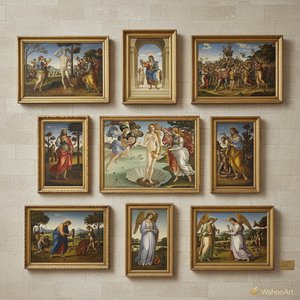
1505. Aliejus ant drobės, 72.0 x 89.0 cm. Uffizi galerija.

§ 1Catalogue data
 Aliejus ant drobės
- Sieninis menas
- Early Renaissance
 1505
1505- Renesansas
 72.0 x 89.0 cm
 Uffizi galerija
§ 2Abstract
Kolekcinio objekto aprašas
Witness Botticelli’s ‘Moses undergoing Trial by Fire’! This stunning 1505 oil on panel masterpiece showcases Renaissance artistry & biblical drama at the Uffizi Gallery.
 Skaityti daugiau
Autoriaus biografija
Atraskite Sandro Botičėlį (1445–1510), ankstyvojo Renesanso meistrą, žinoma dėl „Veneros gimimo“ ir „Pavasario“. Tyrinėkite jo elegantišką stilių, mitologines temas ir palikimą meno istorijoje!
§ 3Commentary
A Trial of Faith: Botticelli’s “Moses undergoing Trial by Fire”
Sandro Botticelli's "Moses undergoing Trial by Fire," completed in 1505, is a compelling and rarely discussed work within the artist’s *oeuvre*. This oil on panel (72 x 89 cm) currently resides in the prestigious Uffizi Gallery, Florence, offering viewers a glimpse into a pivotal biblical moment rendered with Botticelli's signature grace and nuanced storytelling.Decoding the Scene: Narrative & Composition
The painting depicts not the fiery bush of Moses’ initial encounter with God, but rather a lesser-known episode – a test of faith where Moses is challenged to prove his devotion. The composition centers around Moses, positioned near a stone table upon which rests an infant. Surrounding him are numerous figures, each engaged in observation or holding symbolic objects: a bowl, perhaps for offerings, and a book, representing divine law. Botticelli masterfully arranges these figures, creating a dynamic interplay of gazes and gestures that heighten the dramatic tension. The background subtly reveals a landscape with distant buildings, grounding the sacred event within a recognizable world.Botticelli’s Artistic Style & Technique
“Moses undergoing Trial by Fire” exemplifies Botticelli's distinctive style – a blend of late Gothic elegance and emerging Renaissance naturalism. His figures are characterized by elongated proportions, flowing drapery, and delicately modeled features. The use of line is paramount; it defines forms, creates movement, and guides the viewer’s eye. Botticelli employs a refined oil painting technique, building up layers of color to achieve subtle gradations of light and shadow. While not as vibrant as some of his more famous mythological scenes, the palette here – dominated by earth tones with accents of red and blue – contributes to the scene's solemnity and gravity.Historical & Religious Context
Created during a period of religious fervor in Florence, influenced by the Dominican friar Girolamo Savonarola, this painting reflects a renewed interest in biblical narratives. Botticelli himself was deeply affected by Savonarola’s preaching, which emphasized piety and repentance. The work likely formed part of a larger series illustrating scenes from the Old Testament, commissioned by a private patron. It's important to note that Botticelli wasn’t simply *illustrating* scripture; he was interpreting it through his artistic lens, imbuing it with emotional depth and psychological complexity.Symbolism & Interpretation
The symbolism within the painting is rich and layered. The infant on the table represents innocence and vulnerability – a life hanging in the balance. Moses’ posture conveys both determination and anxiety as he faces this divine test. The onlookers represent humanity, witnessing the unfolding drama and perhaps questioning their own faith. The architectural elements—the stone table and surrounding structures—suggest a sense of ritual and judgment. Ultimately, the painting explores themes of faith, obedience, sacrifice, and the burden of leadership.Emotional Impact & Legacy
“Moses undergoing Trial by Fire” evokes a profound sense of solemnity and tension. The viewer is drawn into Moses’ internal struggle, forced to contemplate the weight of his responsibility and the uncertainty of his fate. While less celebrated than Botticelli's "Birth of Venus" or “Primavera,” this work offers valuable insight into the artist’s religious convictions and his ability to convey complex emotions through visual storytelling.Key Features
- Artist: Sandro Botticelli (Alessandro di Mariano di Vanni Filipepi)
- Date: 1505
- Medium: Oil on Panel
- Dimensions: 72 x 89 cm
- Location: Uffizi Gallery, Florence, Italy
- Style: Early Renaissance
Klausimai ir atsakymai
Kokia yra „Moses undergoing Trial by Fire“ – Sandras Botičelis kūrybos data ir stilius?
„Moses undergoing Trial by Fire“ sukurta 1505 metais, priklausant į Early Renaissance kryptį. Data ir stilius įtvirtina šį kūrinį laiko eje.
Kur galiu įsigyti „Moses undergoing Trial by Fire“ – Sandras Botičelis skaitmeninį vaizdą?
Skaitmeninį „Moses undergoing Trial by Fire“ – Sandras Botičelis vaizdą galima įsigyti šio kūrinio Skaitmeninis vaizdas puslapio skiltyje: aukštos raiškos skaitmeninio vaizdo atsisiuntimas.
Kokią emociją perteikia Early Renaissance stiliaus kūrinys „Moses undergoing Trial by Fire“?
„Moses undergoing Trial by Fire“ pasižymi Mirusė emociniu tonu, būdingu Early Renaissance stiliui.


 Perjungti į spausdinamus版作品


 Dėl meno kūrinių ar reprodukcijų, kurių bet kuri pusė yra didesnė nei 105 cm (apie 41 inch), rėmas bus siunčiamas kaip išskaidytas surinkimo rinkinys. Šis metodas užtikrina saugų pristatymą ir apsaugo nuo transportavimo metu galimos žalos.