

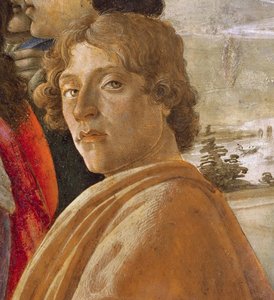
1481. Kiaušinių temperos ant medinio panoelio. Uffizi galerija.

§ 1Catalogue data


§ 2Abstract
Kolekcinio objekto aprašas
Botičelio „Cestello Prangarymas“ (1489) – ankstyvojo Renesanso šedevras, rodantis dievišką skonį ir perspektyvą ramiame Firenos fone. Atraskite jo turtingą simboliką bei meninę reikšmę.
 Skaityti daugiau
Autoriaus biografija
Atraskite Sandro Botičėlį (1445–1510), ankstyvojo Renesanso meistrą, žinoma dėl „Veneros gimimo“ ir „Pavasario“. Tyrinėkite jo elegantišką stilių, mitologines temas ir palikimą meno istorijoje!
§ 3Commentary
A Moment of Divine Revelation: Botticelli’s Annunciation
Botticelli's "Annunciation," painted in 1481, stands as a cornerstone of Early Renaissance art—a testament to humanist ideals intertwined with profound spiritual contemplation. Executed in tempera on wood panel, this masterpiece captures the pivotal biblical narrative of Gabriel informing Mary about her divine conception, an event that irrevocably shaped Christian theology and artistic representation. The painting resides within the Uffizi Gallery in Florence, Italy, where it continues to inspire awe and admiration for its ethereal beauty and masterful execution.The Composition: Harmony and Perspective
Botticelli’s genius lies not merely in depicting a sacred scene but in orchestrating it with breathtaking precision. He employs linear perspective—a revolutionary technique emerging during this period—to create an illusion of depth, anchoring the viewer's gaze within the serene Cestello garden where Mary receives Gabriel’s message. The figures are arranged symmetrically around Mary, emphasizing her central role as the vessel of divine grace. Note the careful positioning of Gabriel on the left and Mary on the right, creating a balanced visual composition that reflects the harmonious order characteristic of Renaissance aesthetics.Style and Technique: Delicate Brushstrokes and Pale Colors
Botticelli’s distinctive style is instantly recognizable—characterized by graceful lines, flowing drapery, and an almost dreamlike quality. His brushstrokes are remarkably delicate, conveying subtle nuances of color and texture. The palette is dominated by pale hues—muted greens, blues, and yellows—reflecting the Florentine landscape and contributing to the painting’s ethereal luminescence. Botticelli skillfully utilizes sfumato—a technique pioneered by Leonardo da Vinci—to soften contours and blend colors seamlessly, creating an atmosphere of tranquility and spiritual reverence.Symbolism: Echoes of Classical Antiquity
Beyond its visual splendor, "Annunciation" is laden with symbolic significance rooted in classical mythology and Christian iconography. The Cestello garden itself represents Paradise—the earthly realm mirroring the divine Jerusalem—underscoring Mary’s acceptance of God's will. Gabriel’s outstretched hand symbolizes divine grace and revelation, while Mary’s palms clasped together express humility and prayerfulness. The bird perched on Mary’s left shoulder is often interpreted as representing the Holy Spirit—God’s active presence guiding Mary toward her destiny. These elements resonate with humanist ideals emphasizing human reason and virtue alongside spiritual faith.Emotional Impact: A Vision of Graceful Beauty
“Annunciation” transcends mere representation; it evokes a profound emotional response in viewers. Botticelli's masterful depiction captures the essence of divine grace—the moment of transformative revelation that unites humanity with God. The painting’s serene beauty inspires contemplation and reverence, inviting us to contemplate themes of faith, humility, and spiritual aspiration. Its enduring legacy testifies to Botticelli’s ability to translate complex theological concepts into a visual language accessible yet deeply evocative—a testament to the power of art to communicate universal truths.Klausimai ir atsakymai
Ar galiu naudoti papildytojąjį realybės technologiją, kad pamatytumėte „Prangarymas (detale)“ – Sandras Botičelis savo kambaryje?
„Prangarymas (detale)“ – Sandras Botičelis galite išbandyti ant savo sienos naudodami papildytoji realybės funkciją suderinamame įrenginyje per šio kūrinio Peržiūra papildintajai realybei puslapį.
Kokią emociją sukelia „Prangarymas (detale)“?
„Prangarymas (detale)“ – Sandras Botičelis perteikia Dvasinis emocinę nuotaiką.
Kaip suformuota „Prangarymas (detale)“ – Sandras Botičelis spalvų kompozicija?
„Prangarymas (detale)“ – Sandras Botičelis spalvų kompozicijoje Pareiškimas kontrastas susilieja su Subalansuota harmonija harmonija.


 Perjungti į spausdinamus版作品


 Dėl meno kūrinių ar reprodukcijų, kurių bet kuri pusė yra didesnė nei 105 cm (apie 41 inch), rėmas bus siunčiamas kaip išskaidytas surinkimo rinkinys. Šis metodas užtikrina saugų pristatymą ir apsaugo nuo transportavimo metu galimos žalos.


