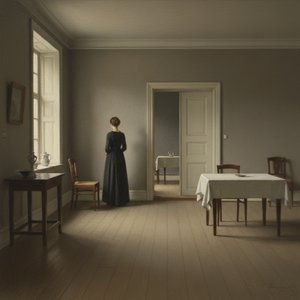
The Quiet Presence of Anna Schønheyder
In the quiet corners of Christiania, the beginnings of a life spent observing light and texture took shape. Born in 1877, Anna Schønheyder moved through the world with a steady hand, finding her way into the studios of the Norwegian National Academy of Craft and Art Industry. She did not merely paint; she worked with wood, thread, and pigment, moving between the roles of painter, textile artist, and xylographer. Her hands were trained by those who understood the weight of a brush and the grain of a surface, studying under Johan Nordhagen and later refining her eye under the guidance of Harriet Backer, Oluf Wold-Torne, Viggo Johansen, and Joakim Skovgaard.
Her work often settles into the stillness of a room or the solemnity of a building. There is a specific way she captures the atmosphere of a space, as seen in her depictions of Vågå. She had a way of documenting the light as it falls through a window or rests upon a wall, capturing a moment of pause before the world moves on.
A Life of Form and Texture
The development of her practice was marked by a commitment to the physical reality of her subjects. She did not seek to embellish, but to record. Her training allowed her to navigate different mediums with a similar, focused intent. Her life was lived alongside Wilhelm Andreas Hartmann, and her output reflected a disciplined approach to her various crafts.
- The study of light in interior spaces, such as the maidens' room at Lye in Vågå.
- The depiction of architectural stillness, including the church at Vågå before a service.
- The use of oil on cardboard to capture the subtle features of a portrait.
- The tactile nature of textile work and woodcutting.
By the time she made her debut at the Autumn Exhibition in Oslo in 1902, her voice was already established through her technical skill. She moved through the early decades of the twentieth century, leaving behind works that reside in the National Gallery of Norway and the Lillehammer Kunstmuseum. These pieces remain as traces of her specific way of seeing.
The Final Marks
She passed away in Oslo in 1927, leaving behind a body of work that speaks to the quietude of Norwegian life. Her paintings, like the portrait of a woman from the 1910s, show a preference for the intimate over the grand. She focused on the way a person sits in a room or how a church waits for its congregation. It is a record of presence, captured in oil and thread, held in the memory of the places she painted.
Klausimai ir atsakymai
Kur galiu rasti statistiką apie Anna Schønheyder kūrybinę veiklą?
Statistika apie Anna Schønheyder kūrybinį veiklą galima rasti puslapyje Statistika.
Ar galiu ieškoti Anna Schønheyder kūrybos pagal spalvų spektrą?
Anna Schønheyder Spalvų indeksas – tai puslapis, kuriame kūriniai sugruoti pagal jų spalvas.
Kiek Anna Schønheyder kūrinių galima peržiūrėti?
Visi kūriniai puslapio kataloge galite peržiūrėti 2 kūriniai kūrinius, autoriaus: Anna Schønheyder.
Ar galima pasimatričiuoti 3D virtualiame Anna Schønheyder kūrybos muzieje?
Anna Schønheyder kūrybą galite apžiūrėti 3D galerijoje, apsilankę puslapyje 3D galerija.