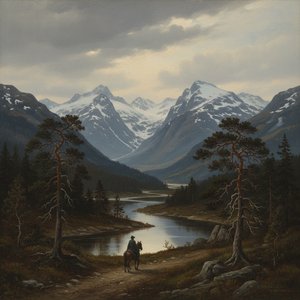
The Soul of the North: The Life and Legacy of Gunnar Berg
In the annals of Norwegian art history, few names evoke the raw, salt-sprayed atmosphere of the Arctic Circle as poignantly as Gunnar Berg. Born on May 21, 1863, on the rugged island of Svinøya in Svolvær, Berg was a child of the Lofoten archipelago. His very existence was intertwined with the rhythmic ebb and flow of the Norwegian Sea and the towering granite peaks that define his native landscape. As the eldest of twelve children born to a prosperous merchant and landowner, Lars Thodal Walnum Berg, and Lovise Johnsen, his early life was steeped in the maritime traditions and mercantile stability of the North. Yet, beneath this structured upbringing lay a burgeoning sensitivity to the dramatic natural world surrounding him—a sensitivity that would eventually lead him away from the counting house and toward the easel.
Berg’s artistic journey was one of disciplined refinement and profound observation. His formal education began at the Trondheim Cathedral School, but his true calling took shape through private instruction under the artist H.J. and later through rigorous academic training in the prestigious Düsseldorf School of Painting. Between 1883 and 1885, Berg immersed himself in the German art scene, studying alongside masters such as Wilhelm Leibl and Anton Faigl. This period was transformative; it provided him with a sophisticated technical vocabulary, particularly in the realms of realism and tonal painting. From these mentors, he learned to use subtle gradations of color and masterful brushwork not merely to replicate reality, but to imbue it with psychological depth and atmospheric weight. He returned to Norway not just as a painter of scenes, but as a chronicler of moods.
A Master of the Lofoten Atmosphere
The true heart of Berg’s oeuvre lies in his unwavering devotion to the Lofoten Islands. While many of his contemporaries sought to romanticize the North through idealized, sweeping vistas, Berg pursued a more profound truth. He focused his gaze on the everyday realities of the local fishing communities—the grit, the labor, and the quiet resilience required to survive in such an unforant environment. His paintings often feature the iconic elements of the region: the sturdy wooden boats, the weathered docks, and the small, thatched-roof dwellings that cling to the shoreline.
In works such as House and Barge, one can witness his ability to capture a moment of profound stillness. Through delicate brushwork, he renders the organic textures of thatch and wood with such sensitivity that the viewer can almost feel the dampness in the air. Conversely, his more dramatic compositions reflect the tempestuous nature of the North Atlantic. He possessed a rare talent for manipulating light—capturing the ethereal glow of a summer twilight or the heavy, oppressive shadows of an approaching winter storm. This mastery of impasto and tonal variation allowed him to document both the grandeur of the mountains and the humble dignity of the fishermen, creating a visual narrative that is as much about human endurance as it is about landscape.
An Enduring Artistic Significance
Though his life was tragically short—ending in Berlin in 1893 at the age of only thirty—Gunnar Berg left behind an indelible mark on Norwegian art. His ability to bridge the gap between the academic precision of the Düsseldorf School and the raw, emotive spirit of Norwegian naturalism helped define a unique national aesthetic. He did not merely paint landscapes; he captured the very soul of a way of life that was being shaped by the relentless forces of nature.
Today, Berg is remembered as a singular figure whose work transcends mere representation. His paintings serve as vital historical documents of a vanishing era of maritime life, preserved through his evocative use of light and texture. The legacy of Gunnar Berg continues to resonate with collectors and art historians alike, offering a window into a world where the boundary between man and the elements is beautifully, and sometimes hauntingly, blurred.
Klausimai ir atsakymai
Kaip Gunnar Berg karjera skirstoma į laikotarpius?
Gunnar Berg Karieros istorija – tai vartojimo metu judanti laiko linija, kurioje kūrybos darbai pateikiami chronologine tvarka, suskirstyti į karjeros periodų skyrius.
Ar galiu apsilankyti virtualiame Gunnar Berg kūrybos muziejuje?
Galima apsilankyti virtualiai: Gunnar Berg puslapyje 3D galerija kūriniai pristatomi trimensione galerijoje.
Kokias nuota išreiškia Gunnar Berg kūryba?
Gunnar Berg kūrybą pagal nuotaikas galite peržiūrėti joje, kurioje kūriniai sugrupuoti pagal jų atspindžiamas nuotaikas: Nuotaudų kambarys