The Master of Light and Shadow: The Life of Melchior Brassauw
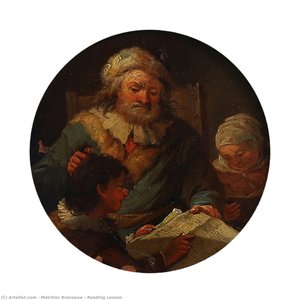
In the golden era of Dutch and Flemish artistry, few names evoke the intimate charm of everyday life as poignally as Melchior Brassauw. Born in the vibrant intellectual hub of Leiden, Netherlands, around 1615, Brassauw emerged during a period when the art world was shifting its gaze from the grand, sweeping narratives of mythology toward the profound beauty found in the mundane. His journey was deeply rooted in the traditions of his homeland, yet his brush possessed a unique ability to transform a simple domestic scene into a dramatic stage of light and shadow. This mastery of chiaroscuro—the deliberate interplay between brilliance and obscurity—became the hallmark of his career, allowing him to breathe life into textures, fabrics, and the very air surrounding his subjects.
The foundation of Brassauw’s technical prowess can be traced back to his formative years under the guidance of Gerard Pietersz. van Zijl. As a pupil of Van Zijl, Brassauw inherited a devotion to meticulous observation and a keen eye for the natural world. From his mentor, he learned that realism was not merely about the accurate depiction of form, but about capturing the emotional resonance of a moment through light. This influence is evident in how Brassauw approached his canvases; he did not simply paint figures, but rather sculpted them using light, creating a sense of volume and depth that pulls the viewer into the heart of the composition.
A Tapestry of Genre and Detail
While many of his contemporaries sought fame through epic historical scenes, Brassauw found his true calling in genre painting. His work serves as a window into the 17th-century soul, capturing ordinary individuals engaged in the quiet, rhythmic activities of daily existence. Whether depicting a musical gathering or a solitary moment of reflection, his paintings are characterized by an extraordinary attention to detail that borders on the miraculous. One might find themselves lost in the intricate weave of a silken sleeve, the subtle sheen of a polished tabletop, or the soft, fleeting expression captured on a sitter's face.
This dedication to detail served a higher purpose than mere decoration; it was an exploration of atmosphere. By focusing on the tactile qualities of his subjects, Brassauw created a palpable sense of presence. His compositions often feature:
- Dramatic Contrast: The use of deep shadows to frame brightly lit focal points, directing the viewer's eye with surgical precision.
- Textural Realism: A profound ability to differentiate between the cold hardness of metal, the warmth of skin, and the delicate softness of lace.
- Narrative Intimacy: The creation of small, self-contained worlds that invite the observer to contemplate the quiet dignity of human life.
Legacy and Historical Significance
The historical significance of Melchior Brassauw lies in his ability to elevate the "low" subject matter of genre painting to the level of high art. He proved that there was as much drama to be found in a room filled with musicians as there was in a battlefield or a palace. His work remains a vital part of the Dutch Golden Age legacy, representing the era's profound shift toward humanism and the celebration of the lived experience. Through his mastery of light, he ensured that even the most fleeting moments of the past would remain eternally luminous.
Today, his contributions are preserved in prestigious institutions such as the Rijksmuseum, where works like A Musical Company continue to captivate audiences with their timeless elegance. Brassauw’s ability to marry the technical rigor of his training with a deeply emotive style ensures that his place in the pantheon of great masters remains secure, reminding us all that there is profound beauty to be found in the shadows of the everyday.
Klausimai ir atsakymai
Ar galiu peržiūrėti Melchior Brassauw darbus pagal spalvų paletę?
Norėdami rasti Melchior Brassauw darbus konkrečia spalvų paleta, apsilankykite paveikslautojo Pagrinti pagal spalvų paletę puslapyje.
Kokie kiti Melchior Brassauw vardai yra žinomi?
Melchior Brassauw taip pat žinomas (a) pavadinimais Melchior Brisjouw, Melchior Brassaiur, Melchior Brausser, Melchior Breschaw, Brassieurs.
Kur ir kada gimė Melchior Brassauw?
Melchior Brassauw gimė Leiden, 1615 m.