A Life Forged in Memory and Resilience
The life of Roman Halter is a profound testament to the endurance of the human spirit amidst the darkest chapters of history. Born in Chodecz, Poland, as the youngest of seven children in a traditional Jewish family, his early years were irrevocably altered by the outbreak of war. At just twelve years old, Halter was deported to the Lodz Ghetto, an experience that would later become a haunting wellspring for his creative explorations. His journey through the horrors of the Holocaust—moving from the ghetto to Auschwitz, Stutthof, and Dresden—was marked by a singular moment of survival when he managed to escape from a cart during a transport to the Chełmno extermination camp. It was his skill as a metal worker in the Lodz Ghetto that ultimately served as a shield, saving him from certain death. After the war, Halter found refuge in Britain, eventually settling in London, where he would transform his survival into a multifaceted career as an architect, writer, and artist.
Architectural Precision and Artistic Vision
Halter’s professional evolution was deeply intertwined with his architectural training. After establishing successful practices in London and Cambridge, he brought a structural discipline to his visual arts. In 1973, he moved to Israel, where his architectural expertise led to a significant commission: designing and constructing the main gate to Yad Vashem, the world center for Holocaust remembrance in Jerusalem. This achievement stands as a monumental intersection of his life's history and his technical mastery. By 1976, Halter transitioned into a full-time artist, embracing a multi-media practice that spanned painting, sculpture, and stained glass. His work in stained glass, in particular, allowed him to utilize the metal-working skills he had honed during his youth, creating luminous windows that explored themes of light, memory, and spiritual reflection.
The Interplay of Trauma and Tranquility
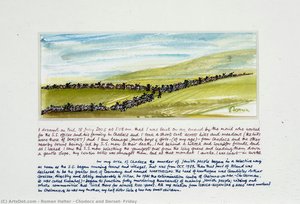
As his career matured, Halter’s work became a poignant dialogue between the horrific memories of his past and the peaceful landscapes of his present. His artistic style often reflected a quiet intensity, with some of his oil paintings exhibiting an influence of early modernism, reminiscent of the isolated figures found in the works of Edward Hopper. In later years, particularly from 2000 onwards, Halter began to confront his nightmares with unprecedented clarity. He developed a moving series of watercolours that juxtaposed the traumatic recollections of occupied Poland with the idyllic, serene views of the Dorset countryside. Through this technique, he created a visual bridge between two worlds: the indelible scars of the Holocaust and the restorative beauty of nature. His legacy remains etched in both the physical structures he designed and the deeply personal, evocative imagery that continues to resonate within collections such as the Ben Uri Collection.
Klausimai ir atsakymai
Kur galiu pamatyti visus Roman Halter kūrybos darbus?
Visi ši ši internetinė svetainė esantys Roman Halter kūriniai galima peržiūrėti puslapyje Visi kūriniai.
Iš kokios šalies yra Roman Halter?
Roman Halter gimė Poland.
Ar galiu peržiūrėti Roman Halter darbus pagal medžiagą?
Visi mediai puslapio darbai Roman Halter kūryboje suskirstyti pagal technikas.