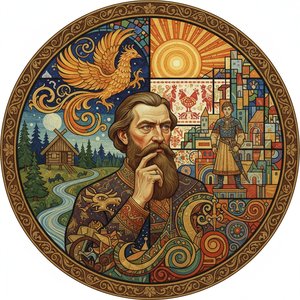
Vladimir Lukich Borovikovsky: A Life in Portraiture
Early Life and Training
- Born: July 24, 1757, in Myrhorod (present-day Ukraine).
- Family Background: His father, Luka Borovyk, was a Ukrainian Cossack and an amateur icon painter. This early exposure significantly influenced young Vladimir’s artistic beginnings.
- Initial Artistic Pursuits: Borovikovsky began his career painting icons for local churches, honing his skills in religious art before transitioning to portraiture.
Rise to Prominence and Imperial Patronage
- Key Moment: A pivotal moment arrived when Borovikovsky’s friend, Vasyl Kapnist, commissioned him to create allegorical paintings for Empress Catherine II's visit to Kremenchuk.
- Imperial Recognition: The Empress was deeply impressed by his work and requested he relocate to Saint Petersburg, marking a turning point in his career.
- Move to St. Petersburg: After September 1788, Borovikovsky established himself in the imperial capital, adopting the more aristocratic surname “Borovikovsky.”
Artistic Style and Influences
- Stylistic Characteristics: Borovikovsky’s portraits are known for their intimacy, sentimental quality, and delicate rendering of textures.
- Influences: He was influenced by Dmitry Levitzky and Johann Baptist Lampi, receiving private lessons from both. The ideas of Prince Nikolay Lvov also profoundly shaped his artistic vision.
- Artistic Movement: His work bridges the Rococo and Romanticism movements, exhibiting elements of both styles.
Notable Works and Major Achievements
- Key Portraits: Some of his most celebrated works include portraits of Catherine II, Count Razumovsky, Dmitry Levitzky, Morteza Qoli Khan Qajar, and the iconic portrait of M.I. Lopukhina.
- Portrait of Catherine II (1794): This work secured his appointment as an academician by the Academy of Arts.
- Prolific Output: Borovikovsky created approximately 500 portraits during his lifetime, with around 400 surviving today.
Later Life and Legacy
- Freemasonry: In 1819, Borovikovsky became a Freemason, which influenced his later artistic focus.
- Return to Icon Painting: He increasingly dedicated himself to icon painting in his later years, including the creation of an iconostasis for the Smolensky Cemetery Church.
- Death and Burial: Vladimir Lukich Borovikovsky passed away on April 6, 1825, and was interred in the Lazarus Cemetery of the Alexander Nevsky Monastery in Saint Petersburg.
- Historical Significance: He is considered Russia’s leading portraitist of the Romantic era, capturing the essence of Russian nobility and society at a pivotal moment in history.
问答环节
Ar galima rasti Vladimir Lukich Borovikovsky kūrybos darbų pagal spalvą?
Vladimir Lukich Borovikovsky kūrybą pagal spalvas galite tyrinėti puslapio Spektro indeksas svetainėje.
Kuriame istoriniame laikotarpyje kūrė Vladimir Lukich Borovikovsky?
Vladimir Lukich Borovikovsky kūrė Early Modern laikotarpiu. Šis laikotarpis nustato kūrybinę veiklą istoriniame kontekste.
Kiek Vladimir Lukich Borovikovsky kūrinių galima peržiūrėti?
Kataloge, esančiame Visi kūriniai puslapio, galite peržiūrėti 165 kūriniai kūrinius, autoriaus: Vladimir Lukich Borovikovsky.