

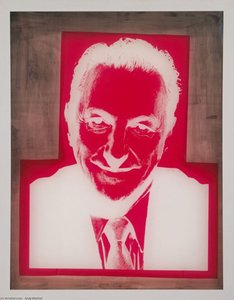
1976. Silkscreen.

§ 1Catalogusgegevens


Dit kunstwerk is auteursrechtelijk beschermd
De kunstwerken die op deze pagina worden weergegeven, zijn beschermd door de auteursrechtwetgeving, wat betekent dat het ons wettelijk niet is toegestaan om identieke reproducties te maken of te verkopen. Deze bescherming wordt gehandhaafd onder internationale overeenkomsten zoals de Conventie van Bern en door nationale wetgeving, waaronder de bepalingen van de Amerikaanse auteurswet - Titel 17. Alle rechten voorbehouden. Reproduceren of distribueren van afbeeldingen is niet toegestaan zonder uitdrukkelijke schriftelijke toestemming van WahooArt.com en de rechthebbenden.
Als een respectvol en legaal alternatief bieden wij op maat gemaakte, handgeschilderde kunstwerken aan die geïnspireerd zijn op het origineel. Onze bekwame en professionele kunstenaars bestuderen zorgvuldig de stijl, sfeer en artistieke essentie van het origineel om een nieuw, uniek werk te creëren dat dezelfde emotie oproept – terwijl het een op zichzelf staande, originele creatie blijft.
Deze methode voldoet volledig aan de auteursrechtwetgeving, omdat het niet gaat om het kopiëren of dupliceren van het beschermde kunstwerk. In plaats daarvan is er sprake van een creatieve herinterpretatie — een nieuw schilderij dat door het origineel wordt geïnspireerd, maar er niet identiek aan is.
 Lees meer over
§ 2Abstract
Beschrijving verzamelobject
A striking red hammer and sickle emblem sits atop a chair in this powerful 1976 Pop Art silkscreen by Andy Warhol that captures Cold War tensions and invites you to explore his iconic political imagery.
Biografie kunstenaar
Ontdek Andy Warhol's iconische Pop Art (1928-1987) – silkscreens van Marilyn, Campbell’s Soup Cans & celebrity cultuur. Een kunstenaar die de kunstgeschiedenis opnieuw vorm gaf!
§ 3Toelichting
The Resonance of Red: Encountering Warhol’s Political Still Life
In the vast landscape of Pop Art, few images command attention with such stark, unapologetic clarity as Andy Warhol’s 1976 masterpiece, Hammer and Sickle. At first glance, the viewer is met with a deceptively simple composition: a vibrant, blood-red emblem of the hammer and sickle superimposed upon the quiet, unassuming presence of a chair. Yet, beneath this surface-level simplicity lies a profound tension, a visual dialogue that captures the very essence of the Cold War era. Warhol, a master of transforming the mundane into the monumental, utilizes this piece to bridge the gap between political propaganda and fine art, inviting us to contemplate the intersection of ideology and everyday existence. The presence of other scattered objects—a pair of scissors, a knife, and a bottle—adds a layer of domesticity that contrasts sharply with the revolutionary weight of the central symbol, creating a sense of an interrupted moment in time, where the tools of industry and the artifacts of daily life collide.
Technique as Democracy: The Power of the Screen
To truly grasp the impact of this work, one must look toward Warhol’s revolutionary use of the silk screen printing process. This technique, which allowed for the production of multiple identical prints, was not merely a choice of convenience but a profound philosophical statement on the democratization of art. By utilizing screenprinting, Warhol stripped away the traditional aura of the "unique" masterpiece, instead embracing the rhythmic, mechanical nature of mass production. This method allowed for the achievement of incredibly vibrant colors and precise tonal gradations that make the red of the emblem pulse against its backdrop with an almost electric intensity. For the collector or interior designer, this technique offers a unique opportunity to possess a piece that embodies the industrial spirit of the 20th century. The repetition inherent in his process mirrors the very nature of the symbols he depicts—symbols designed for mass consumption and widespread recognition—thereby blurring the lines between high culture and the pervasive imagery of popular propaganda.
An Enduring Statement for Contemporary Interiors
For those seeking to infuse a modern space with intellectual depth and visual drama, Hammer and Sickle serves as an incomparable focal point. It is far more than mere decoration; it is a provocative conversation starter that challenges the viewer to look beyond the aesthetic and engage with the historical currents of the late 1970s. The bold, graphic nature of the work makes it particularly suited for contemporary settings where minimalism meets conceptual strength. Whether placed in a curated gallery or as a striking element in a sophisticated residential study, the piece brings an unmistakable energy—a blend of industrial grit and artistic refinement. Owning a high-quality reproduction of this work allows one to celebrate Warhol’s legacy of provocation, ensuring that the echoes of revolution and the beauty of Pop Art continue to resonate powerfully within the walls of the modern home.
Veelgestelde vragen
Hoe wordt de stemming van "Hammer and Sickle" door Andy Warhol beschreven?
De algehele stemming van "Hammer and Sickle" door Andy Warhol is Bold. De stemming beschrijft de algemene atmosfeer van het werk.
Welke afmeting van "Hammer and Sickle" door Andy Warhol past in de aanbevolen kamer?
Voor een Living Room wordt voor "Hammer and Sickle" een afdruk van Large aanbevolen.
Wat stelt "Hammer and Sickle" door Andy Warhol voor?
De thema's die aanwezig zijn in "Hammer and Sickle" door Andy Warhol omvatten symbolism, communism, industrial, tool, iconography, reproduction, warholesque. Samen vatten zij de onderwerpen van het kunstwerk samen.





 Schakel over naar print


 Voor kunstwerken of reproducties die aan één zijde groter zijn dan 105 cm (ongeveer 41 inch), wordt de lijst als een losse set verzonden. Deze methode garandeert een veilige levering en voorkomt schade tijdens het transport.


