


 Voorvertoning
 Verstuur
 Delen
Delen
 Details bekijken
 Gids
Gids

 Download
 Vergelijkbare items
 Röntgenonderzoek
 Diavoorstelling
 Vraag & antwoord
 Statistieken
File Cutters

- 31.0 x 47.0 cm


 Lees meer
Ontvang een bestand dat klaar is voor drukwerk en de kwaliteit van het online voorbeeld ver overstijgt. Elke digitale afbeelding die wij verkopen, is afkomstig van een high-resolution master uit onze database — meestal tussen de 5.000 en 15.000 pixels breed — zodat u met vertrouwen groot kunt afdrukken, nauwkeurig kunt bijsnijden of fijne details kunt reproduceren.
Geen enkel bestand verlaat ons atelier onbewerkt. Een digitaal expert controleert de kleuren aan de hand van het originele schilderij en corrigeert deze indien nodig, om vervolgens de helderheid en details te verbeteren met professionele retoucheertechnieken — waarbij de penseelstreek en stijl van de kunstenaar altijd strikt worden gerespecteerd. Het resultaat is een afbeelding die oogt als het schilderij zelf, en niet als een gescande foto met een filter.
U keurt de afbeelding goed voordat de bestelling wordt afgerond: onze expert stuurt u binnen 72 uur een e-mail ter beoordeling. Niet tevreden? Vraag om aanpassingen of correcties, of vraag een terugbetaling aan als de kwaliteit niet aan de verwachtingen voldoet.
Dit is de kwaliteit waarop uitgevers, designstudio's, galeries en drukkerijen vertrouwen.
Digitale afbeeldingen
Download een bestand met hoge resolutie voor persoonlijke weergave, afdrukken en creatieve projecten. ( Schakel over naar print Bestel handgeschilderde reproductie)
Inbegrepen bij elke bestelling van een digitale afbeelding
Professionele digitale levering, gegarandeerd
Wanneer u kiest voor AllPaintingsStore.com, ontvangt u niet alleen een afbeelding – u krijgt een professioneel verbeterd digitaal kunstwerk, met precisie vervaardigd en voorzien van een tevredenheidsgarantie. Dit is alles wat automatisch bij uw bestelling is inbegrepen:

Snelle levering per e-mail
Uw hoogwaardige digitale afbeeldingsbestand wordt binnen 72 uur na bestelling naar u gemaild – klaar voor direct gebruik.

AI-verbeterd digitaal bestand
Uw kunstwerk wordt professioneel geoptimaliseerd met behulp van geavanceerde AI-tools en handmatige bewerkingen, waardoor maximale details, helderheid en kleurnauwkeurigheid worden gegarandeerd.

Gratis levenslange herlevering van digitale bestanden
Je bestand per ongeluk verwijderd of kwijtgeraakt? Geen zorgen – we sturen het u op elk gewenst moment gratis opnieuw toe.

Geen invoerkosten – nooit
Geniet direct van uw kunstwerk zonder invoerrechten, belastingen of verzendkosten – digitale downloads zijn altijd belastingvrij.

Garantie op kleurgetrouwheid
Met behulp van professionele hulpmiddelen en kleurbeheer zorgen wij ervoor dat uw digitale afbeelding de originele kleuren zo nauwkeurig mogelijk weergeeft.

100 dagen tevredenheidsgarantie
Mocht u niet tevreden zijn met uw digitale afbeelding, dan passen wij deze aan of storten wij 100% terug binnen 100 dagen – zonder vragen te stellen.

100% Geld-terug-garantie
Niet tevreden? Ontvang een volledige terugbetaling binnen 100 dagen na ontvangst van uw digitale bestand – zonder vragen te stellen.

Korting bij grote bestellingen
Koop 3 afbeeldingen, bespaar 10% - Koop 5, bespaar 15% - Koop 10+, bespaar 20%. Ideaal voor creatieve projecten, galerieën en bureaus.
Industrial Setting and Women's Roles
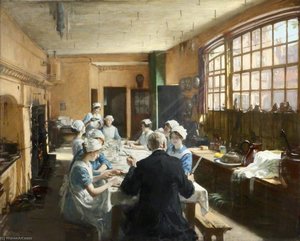
The scene depicts a group of women seated at tables with sewing machines, engaged in the production of clothing items such as dresses. The atmosphere suggests an industrial setting where teamwork and collaboration are essential. This painting highlights the significant role women played in the workforce during this period, often working in factories and contributing to the war effort. Key aspects of the painting include the attention to detail in the depiction of the sewing machines and the factory environment. The women appear focused and engaged in their tasks, demonstrating the importance of their work. For more information on industrial-themed paintings, visit Otto Friedrich Wilhelm Lietz: Industry in the Visual Arts at the Grohmann Museum.Artist and Style
Edward Frederick Skinner was a notable artist known for his contributions to the representation of industrial scenes. His style often featured detailed depictions of machinery and factory settings, as seen in "File Cutters" and other works like Coiling and Setting Springs and Making Bessemer Steel. These paintings provide a glimpse into the industrial era, showcasing the evolution of manufacturing processes.- Visit Painting by 'Edward Frederick Skinner': File Cutters to explore more about this artwork.
- Learn about the American frontier and its impact on industrial development.
The "File Cutters" by Edward Frederick Skinner is a significant artwork that highlights the importance of women's roles in the industrial era. Its detailed depiction of factory life and machinery makes it a fascinating piece for art enthusiasts and historians alike.
Veelgestelde vragen
Is Edward Frederick Skinner, maker van "File Cutters", bekend onder andere namen?
Edward Frederick Skinner staat ook bekend als E F Skinner.
Wat stelt "File Cutters" voor?
"File Cutters" door Edward Frederick Skinner toont: industrial labor, women workers”, “factory life”, “victorian era”, “detailed art”, “social commentary”, “1917 history”.
Wat is de dominante kleur van "File Cutters" door Edward Frederick Skinner?
Een Warm Sunset Tones tint loopt door "File Cutters" door Edward Frederick Skinner.
Vergelijkbare kunstwerken




Kunstenaarsbiografie
The Chronicler of the Industrial Soul
Edward Frederick Skinner, a name synonymous with the gritty, unvarnished reality of Britain’s industrial zenith, occupied a unique space in the early 20th-century art world. Born in London in 1865, Skinner emerged during an era defined by rapid technological expansion and a profound shift in the social fabric of the nation. While many of his contemporaries sought refuge in the ethereal beauty of idealized landscapes or the timeless grace of mythological subjects, Skinner turned his gaze toward the smoke-filled horizons of factories, mills, and workshops. His work serves as a visceral window into an age of iron and steam, capturing the transformative impact of machinery upon the human spirit and the physical landscape of England.
His artistic foundation was laid within the prestigious halls of the Slade School of Fine Art, where he underwent rigorous training under the watchful eyes of masters such as Frederic Leighton and Joseph Hooker. This academic lineage bestowed upon him a meticulous command of traditional techniques and an unwavering commitment to precision. It was this very discipline that allowed him to approach industrial subjects not with mere observation, but with a profound anatomical and structural accuracy. Skinner did not merely paint machines; he understood their weight, their texture, and the way they interacted with the light and the laborers who tended them.
A Realist Vision of Progress and Labor
The true essence of Skinner’s oeuvre lies in his refusal to romanticize the hardships of the working class. His breakthrough came through a seriesed of paintings that documented the pulsating heart of British industry. In works such as File Cutters, created in 1917, he captures the quiet intensity of women engaged in factory production. Through his brush, the rhythmic movement of sewing machines and the focused expressions of the laborers become symbols of a collective national effort. He utilized light not to soften the harshness of the factory floor, but to illuminate the dignity found within strenuous toil.
Skinner’s mastery of composition allowed him to weave complex narratives of productivity and order. In Forging Files, he employs a sophisticated use of warm colors and soft lighting to create a sense of familiarity within the industrial setting, yet he maintains an unflinching eye for the mechanical details that define the era. His ability to balance the monumental presence of heavy machinery with the delicate human elements of his subjects created a tension that mirrored the societal shifts of his time. Whether depicting the heat of a forge or the organized chaos of a machine shop, Skinner’s canvases act as historical documents, preserving the atmosphere of an era that was rapidly being reshaped by the very tools he so lovingly rendered.
War, Propaganda, and Lasting Legacy
As the shadows of World War I descended upon Europe, Skinner’s artistic mission took on a new, more urgent dimension. His talent was harnessed for the purpose of documentation and national morale, leading to commissions from the British Government. During this period, his work became an essential component of a concerted propaganda campaign, illustrating the vital role of munitions factories, naval shipyards, and the preparation of soldiers. In paintings like One of the Machine Shops, he captured the scale of wartime production, where large-scale weaponry and heavy transport were integrated into the daily landscape of labor.
The historical significance of Edward Frederick Skinner extends far beyond the aesthetic value of his oil paintings. He remains a pivotal figure for understanding the visual identity of the Industrial Age. His legacy is found in the way he bridged the gap between fine art and social documentation, elevating the factory floor to the status of a worthy subject for high art. Today, his works, many of which are preserved in institutions like the Science Museum in the United Kingdom, continue to offer profound insights into the evolution of manufacturing, the changing roles of women in the workforce, and the enduring, complex relationship between humanity and the machines we create.

Edward Frederick Skinner
1865 - 1924
Belangrijkste feiten
- Artistic Movement Or Style: Realism
- Artists Or Movements Influenced By This Artist: ['Arts and Crafts Movement']
- Artists Who Influenced This Artist: ['William Morris']
- Date Of Birth: 1865
- Date Of Death: 1924
- Full Name: Edward Frederick Skinner
- Nationality: British
- Notable Artworks:
- Factory Scene I
- Coal Mine Landscape
- Place Of Birth: London, England