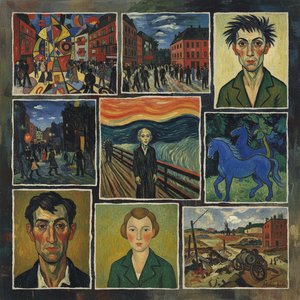
1912. Acryl op canvas.

§ 1Catalogue data


§ 2Abstract
 Lees meer
Biografie kunstenaar
Verken de intense emoties van Egon Schiele: rauwe portretten, psychologische thema's & unieke lijnen. Ontdek iconische reproducties van deze expressionistische meester.
§ 3Commentary
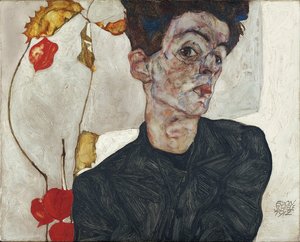
Egon Schiele’s Self Portrait: A Window into Expressionist Angst
Egon Schiele (1890-1918), an Austrian Expressionist painter, stands as a singular voice within the turbulent landscape of early 20th-century art. His oeuvre is characterized by visceral emotion and unsettling imagery—themes that find their most poignant articulation in “Self Portrait,” completed in 1912. This artwork isn’t merely a depiction of the artist; it's an unflinching exploration of his inner turmoil, reflecting the broader anxieties simmering beneath the surface of European culture at the time.
- Artistic Context: Schiele’s artistic journey was profoundly shaped by Gustav Klimt, whose opulent decorative style—particularly evident in “The Kiss”—established a precedent for bold color palettes and stylized forms. However, Schiele swiftly distanced himself from Klimt's aesthetic, forging his own path marked by jagged lines and deliberate distortions of anatomy. This stylistic rebellion cemented his position as a pivotal figure in the Expressionist movement.
- Technique & Composition: Executed in watercolor on paper, “Self Portrait” exemplifies Schiele’s mastery of medium. The muted tonal range—primarily browns and blacks punctuated by subtle reds and yellows—creates an atmosphere of intense concentration. Minimalistic composition prioritizes the face itself, emphasizing its expressive contours and conveying a palpable sense of psychological depth. Notice how Schiele utilizes negative space to amplify the impact of his subject’s gaze.
- Symbolism & Emotional Depth: The portrait captures Schiele's signature stare—a piercing gaze that seems to penetrate beyond the canvas, inviting contemplation on themes of vulnerability and self-awareness. The slight tilt of the head and the angular positioning of facial features communicate a dynamic emotion – one imbued with unease and introspection. Schiele’s deliberate omission of the thumb is particularly noteworthy; it symbolizes detachment and perhaps an inability to fully grasp oneself.
- Historical Significance: “Self Portrait” embodies the broader artistic impulse of its era, where artists sought to grapple with existential questions and convey subjective experience rather than objective representation. Alongside works by Klimt and Munch, Schiele’s contribution helped propel Expressionism toward its zenith, establishing him as a cornerstone of modern art.
Today, “Self Portrait” continues to resonate powerfully with audiences worldwide. Its raw emotion and innovative stylistic choices serve as an enduring testament to Schiele's artistic legacy. Reproductions offer a captivating glimpse into this seminal artwork—a window into the artist’s psyche and the anxieties of his time.
Further Exploration
- Discover more about Egon Schiele’s life and work: Egon Schiele
- Explore related artworks: Self Portrait as St Sebastian (poster), Self-Portrait by Egon Schiele
- Find inspiration for interior design: Interior Design Inspiration
Veelgestelde vragen
Zijn de kleuren van "Self Portrait" door Egon Schiele verzadigd of gedempt?
"Self Portrait" door Egon Schiele heeft een Subtiel kleurgebruik verzadiging.
Wat voor soort kunstwerk is "Self Portrait" door Egon Schiele?
"Self Portrait" door Egon Schiele wordt geclassificeerd als Wanddecoratie. Deze categorie beschrijft het type kunstwerk dat het origineel is.
Kan ik een olieverfreproductie van "Self Portrait" bestellen?
Handgeschilderde reproducties van "Self Portrait" door Egon Schiele zijn verkrijgbaar via deze website: een met de hand geschilderde olieverfreproductie op linnen canvas, te bestellen op de Handgeschilderde reproductie pagina.


 Schakel over naar print


 Voor kunstwerken of reproducties die aan één zijde groter zijn dan 105 cm (ongeveer 41 inch), wordt de lijst als een losse set verzonden. Deze methode garandeert een veilige levering en voorkomt schade tijdens het transport.