1911. Acrylic On Canvas, 5.0 x 34.0 cm. Wien Museum.

§ 1Catalogusgegevens

- 5.0 x 34.0 cm


§ 2Abstract
Beschrijving verzamelobject
Discover Egon Schiele’s ‘Self Portrait as St. Sebastian,’ a powerful Expressionist poster depicting suffering & martyrdom. Explore its unique style, historical context & artistic influence.
 Lees meer
Biografie kunstenaar
Verken de intense emoties van Egon Schiele: rauwe portretten, psychologische thema's & unieke lijnen. Ontdek iconische reproducties van deze expressionistische meester.
§ 3Toelichting
Egon Schiele’s ‘Self Portrait’: A Study in Vulnerability and Expressionist Intensity
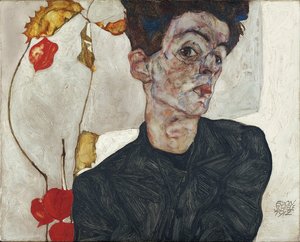
The painting “Self Portrait” by Egon Schiele, completed in 1911, stands as a cornerstone of Austrian Expressionism—a movement that sought to convey raw emotion and psychological turmoil through distorted forms and unsettling imagery. Measuring just 5 x 34 cm, this deceptively modest canvas belies the profound depth of feeling it embodies, offering viewers an intimate glimpse into Schiele’s tormented inner world. It's a piece that continues to fascinate scholars and collectors alike, prompting ongoing discussions about its artistic merit and symbolic significance.Subject Matter and Composition: A Confrontation with Mortality
Schiele’s self-portrait depicts a woman—likely Edith Harms, his wife—positioned in profile against a stark white background. Her gaze is direct, unflinching, meeting the viewer head-on, conveying an unsettling blend of vulnerability and defiance. The woman's hand reaches upwards towards her face, obscuring her eyes with fingers curled inward – a gesture that speaks volumes about anxiety and concealment. This posture immediately establishes a dialogue between the artist and the audience, inviting contemplation on themes of isolation and psychological struggle. Schiele’s masterful use of composition draws attention to the central figure, emphasizing her expressive facial features and highlighting the tension inherent in her gaze. The simplicity of the background serves to amplify this impact, allowing the viewer to focus entirely on the woman's emotional state.Style and Technique: Distortion as Emotional Revelation
Schiele’s distinctive style is characterized by bold lines, angular shapes, and a deliberate flattening of perspective—techniques that are hallmarks of Expressionism. He eschewed traditional realism in favor of conveying inner feelings through visual distortion. The painting utilizes thick impasto – applying paint thickly onto the canvas – creating textural surfaces that contribute to the overall sense of unease. Schiele’s meticulous attention to detail, particularly in rendering the woman's hair and skin tones, underscores his commitment to capturing subtle nuances of emotion. Unlike many artists of his time who aimed for idealized beauty, Schiele deliberately rejected conventional aesthetics, prioritizing psychological truth over visual perfection.Historical Context: The Shadow of Trauma
Created during a period marked by significant personal upheaval—Schiele’s father succumbed to syphilis shortly before he was born, and his sister tragically died young—the painting reflects the pervasive anxieties surrounding mortality that permeated Viennese intellectual circles at the time. Expressionism emerged as a reaction against the optimism of late Victorian culture, grappling with themes of disillusionment, trauma, and existential dread. Schiele’s work aligns perfectly with this artistic impulse, articulating profound psychological concerns through unsettling imagery and emotionally charged brushstrokes. The painting's creation coincided with Schiele’s marriage to Edith Harms, a union that would bring him both joy and sorrow as he navigated the challenges of domestic life amidst his artistic pursuits.Symbolism: Gesture and Expression
The upward-reaching hand is arguably the most potent symbol within the portrait. It represents not only physical concealment but also an attempt to shield oneself from overwhelming emotion—a gesture that resonates with Schiele’s own struggles with mental health. The woman's gaze, unwavering and slightly averted, embodies defiance against despair while simultaneously conveying a palpable sense of vulnerability. These visual cues invite viewers to consider the complexities of human experience and to confront uncomfortable truths about the human condition.Emotional Impact: A Window into the Artist’s Soul
“Self Portrait” transcends mere representation; it is an emotional distillation—a visceral portrayal of Schiele's inner turmoil. The painting compels us to contemplate themes of anxiety, isolation, and the inescapable awareness of death. Its unsettling beauty lies precisely in its ability to evoke empathy and provoke introspection. It remains a testament to Schiele’s artistic genius and his unwavering commitment to exploring the darkest recesses of human consciousness—a captivating piece that continues to inspire awe and contemplation decades after its creation.Veelgestelde vragen
Waar komen de bezoekers van "Self-Portrait" door Egon Schiele vandaan?
De Statistieken-pagina van "Self-Portrait" door Egon Schiele toont statistieken over de publieksbezoeken: het aantal maandelijkse bezoeken aan dit kunstwerk, een vergelijking met de meest bekeken werken van de kunstenaar en de herkomst van de bezoekers.
In welke stroming en in welk tijdperk kan "Self-Portrait" door Egon Schiele worden geplaatst?
"Self-Portrait" behoort tot de Expressionist Anxiety-stroming en de maker ervan was werkzaam in het Moderne tijd-tijdperk.
Wat is de aanbevolen afmeting voor de print van "Self-Portrait" door Egon Schiele?
Voor "Self-Portrait" wordt een afdrukformaat van Large aanbevolen. Andere formaten zijn beschikbaar met dezelfde verhoudingen.


 Schakel over naar print


 Voor kunstwerken of reproducties die aan één zijde groter zijn dan 105 cm (ongeveer 41 inch), wordt de lijst als een losse set verzonden. Deze methode garandeert een veilige levering en voorkomt schade tijdens het transport.