


 Voorvertoning
 Verstuur
 Delen
Delen
 Details bekijken

 Download
 Vergelijkbare items
 Röntgenonderzoek
 Diavoorstelling
untitled (5154)

 Lees meer
Giclée / Kunstafdrukken
Giclée- of canvasafdruk van museumkwaliteit met een snelle productie en flexibele afwerkingsmogelijkheden. ( Bestel handgeschilderde reproductie Koop afbeelding)




P118B $10

P118H $10

P118W $10

P438Z $10

P508JH $12

P508YH $12

P805H $10

P805Z $10

P919BZ $10

P919G $10

P919XJ $10

P959ZH $10

P968JZ $12

W106C $8

W218G $10

W218JH $8

W218Y $10

W307PJ $10

W316G $10

W316PJ $8

W316Y $10

W398PJ $8

W4111J $10

W500HY $15

W500JH $15

W692G $12

W849H $8

W940BG $15

W953PJ $8




Kies uit onze vooraf ingestelde maten die overeenkomen met de originele verhoudingen van het kunstwerk.

U kunt uw eigen afmetingen opgeven om in een specifieke lijst of ruimte te passen. Als de door u gekozen maat niet overeenkomt met de proporties van het originele kunstwerk, zullen wij de afbeelding bijsnijden of uitbreiden met een gespiegelde of effen rand. Een digitaal mockup wordt ter goedkeuring naar u verzonden voordat de productie begint.
Houd er rekening mee dat de preview op het scherm de werkelijke bijsneding of uitbreiding niet weergeeft. Alleen de mockup toont de uiteindelijke compositie nauwkeurig.
Hoewel aangepaste maten beschikbaar zijn, raden wij aan een afmeting uit de vooraf bepaalde lijst te kiezen om de originele proporties te behouden.
Wereldwijde levering () binnen 2 weken in plaats van de standaard 4/5 weken. (24 augustus)

Gratis wereldwijde expressverzending

Hoogwaardig linnen canvas

Volledige verzendverzekering

Garantie op terugbetaling van invoerrechten

Garantie op exacte kleurweergave

Retourbeleid van 60 dagen (alleen bij defecten)

100% Geld-terug-garantie

Korting bij meerdere afnames
 De optie voor glas is alleen beschikbaar bij een formaat kleiner dan 110 cm.

untitled (5154)
Giclée / Kunstafdrukken
Afmetingen reproductie
-


Eindtotaal
$ 65
Beschrijving verzamelobject
A Portrait of Vulnerability: Exploring Egon Schiele’s Untitled (5154)
The image presents a striking depiction of a woman, rendered in the unmistakable style of Austrian Expressionist painter Egon Schiele. Captured with meticulous detail, this artwork transcends mere representation; it delves into themes of introspection and psychological depth—a hallmark of Schiele's oeuvre. The photograph showcases a figure positioned prominently against a muted backdrop, emphasizing her torso and hands delicately resting upon her breasts. This posture immediately draws the viewer’s eye, inviting contemplation on notions of femininity and vulnerability.- Artist: Egon Schiele (1890-1918) – A pivotal figure in Expressionism, Schiele's work is characterized by its raw emotion and distorted forms, reflecting the anxieties of his time.
- Style: Expressionist – Schiele’s style prioritizes conveying inner feelings rather than objective reality. Bold lines and unsettling perspectives contribute to a palpable sense of unease.
- Technique: Watercolor and Ink – The artist skillfully employs watercolor and ink, layering textures and hues to achieve remarkable depth and luminosity. This technique lends itself beautifully to capturing subtle nuances of emotion.
- The twisted body shape—a signature element of Schiele's style—symbolizes psychological distortion and reflects the artist’s own internal struggles.
- The muted color scheme contributes to a sense of solemnity and introspection, mirroring the emotional landscape depicted in the artwork.
Vergelijkbare kunstwerken


Biografie van de kunstenaar
A Life Forged in Expression
Egon Schiele’s life, a turbulent and intensely personal journey, unfolded from 1890 to 1918 within the vibrant yet often unsettling landscape of Vienna. Born in Tulln an der Donau, Austria, his early years were shadowed by profound loss – the death of his father due to syphilis at just fourteen, followed tragically by the demise of his sister Elvira. Raised initially by his mother and later under the watchful eye of his uncle Leopold Czihaczek, Schiele’s childhood lacked the stability common to many, fostering within him a remarkable independence and an acute sensitivity. From a young age, he displayed a deep fascination with trains – a motif that would subtly reappear throughout his work, symbolizing both movement and perhaps, the relentless passage of time. Though initially discouraged by his father for pursuing drawing as a distraction from more “practical” endeavors, Schiele’s innate talent blossomed, laying the foundation for his future artistic expression. These formative experiences—illness, loss, and an unconventional upbringing—instilled within him a profound awareness of mortality and the fragility of human existence, themes that would become central to his art.The Crucible of Vienna: Artistic Development
Schiele’s formal artistic training began at the Kunstgewerbeschule in Vienna, but he quickly found himself stifled by its conservative approach. Seeking a more expressive outlet, he transferred to the Akademie der bildenden Künste, only to discover that even this institution's academic traditions felt restrictive. Dissatisfied with the rigid constraints of traditional art education, Schiele deliberately chose to forge his own path, rejecting formal training altogether – a bold decision reflecting his unwavering artistic conviction. Crucially, he found inspiration in the work of Gustav Klimt, deeply admiring Klimt’s decorative style and exploration of symbolism. Klimt's influence was significant, yet Schiele ultimately diverged from his mentor’s aesthetic, developing a distinctly individual voice characterized by stark honesty and psychological intensity. He became a founding member of the Neues Wiener Kunstgruppe (New Viennese Art Group) in 1909, alongside other progressive artists who challenged the prevailing artistic norms of the time. His early works—often unsettling portraits and self-portraits—began to emerge as powerful statements of emotional turmoil, featuring distorted figures and a palpable sense of vulnerability. These paintings weren’t merely representations of physical form; they were explorations of the inner landscape – the anxieties, desires, and fears that haunted the human psyche. He sought to depict not what he *saw*, but what he *felt*.Raw Emotion and Unflinching Truth
Egon Schiele's art is immediately recognizable for its raw honesty and psychological depth. He fearlessly confronted themes often considered taboo – sexuality, death, anxiety, isolation – with an unflinching gaze. His distinctive style features elongated figures, contorted poses, and expressive lines that convey a sense of unease and emotional intensity. The human form, particularly the nude, became his primary subject, not as an object of idealized beauty but as a vessel for exploring the complexities of human experience. Self-portraits constitute a significant portion of his oeuvre, offering intimate glimpses into his inner world—a world often marked by loneliness and self-doubt. He didn’t shy away from depicting himself in unflattering or vulnerable poses, revealing a profound level of self-awareness and introspection. Beyond self-portraiture, Schiele created numerous portraits of others, capturing their likenesses with an unsettling realism that seemed to penetrate beneath the surface. Recurring motifs like the *Physalis* plant – symbolizing death and transience with its delicate, papery husk – further underscore this preoccupation with mortality. His use of line is particularly striking; it’s not merely a tool for defining shape but an expressive force that conveys emotion and psychological tension.A Legacy Cut Short: Achievements & Significance
Despite facing censorship and legal challenges—including a brief imprisonment for allegedly corrupting minors with his art—Schiele gained recognition within Vienna’s avant-garde circles. His work challenged the conventions of the time, provoking both admiration and outrage. By the time of his untimely death during the Spanish flu pandemic in 1918 at the age of twenty-eight, he had established himself as a leading figure in Austrian Expressionism. Significant works such as *Self-Portrait with Physalis*, *Couple Embracing*, and *Field Landscape (Kreuzberg near Krumau)* stand as testaments to his artistic genius. His influence on subsequent generations of artists is undeniable, particularly those interested in exploring psychological themes and challenging conventional artistic norms. Schiele’s bold approach to form and subject matter continues to resonate with audiences today, making him one of the most important and influential figures in early 20th-century art. His paintings are now held in major museum collections worldwide, including the Leopold Museum in Vienna and the Egon Schiele Art Centrum in Český Krumlov, ensuring his artistic legacy endures. He left behind a body of work that is not merely aesthetically compelling but profoundly human—a testament to the power of art to confront the complexities of existence with honesty, courage, and unwavering vision.- Key Themes: Mortality, sexuality, isolation, psychological turmoil.
- Influences: Gustav Klimt, Viennese Secession, personal trauma.
- Style Characteristics: Elongated figures, contorted poses, expressive lines, raw emotion.
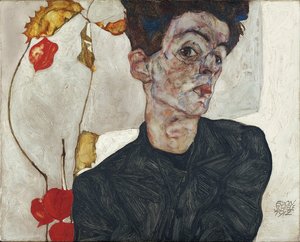
Egon Schiele
1890 - 1918 , Oostenrijk
Belangrijkste feiten
- Artistic Movement Or Style: Expressionisme
- Artists Or Movements Influenced By This Artist: ['Expressionisme']
- Artists Who Influenced This Artist: ['Gustav Klimt']
- Date Of Birth: 12 juni 1890
- Date Of Death: 31 oktober 1918
- Full Name: Egon Schiele
- Nationality: Oostenrijks
- Notable Artworks:
- Self-Portrait
- Kouppel omhelzing
- Veldschilderij
- Place Of Birth: Tulln an der Donau, Oostenrijk
Gerelateerde artikelen
Egon Schiele's Top 25 Meesterwerken: Kunstprints voor een Unieke Woonstijl
Ontdek de 25 meest iconische werken van Egon Schiele! Duik diep in zijn expressionistische wereld vol intense portretten en emotionele kracht. Vind museumkwaliteit reproducties & unieke wanddecoratie op AllPaintingsStore.com. Exploreer de collectie online!

Egon Schiele: Expressionism, Anxiety & the Modern Condition – A Comprehensive Exploration
Explore the emotionally charged world of Egon Schiele (1890-1918). Discover his Expressionist masterpieces, psychological themes, and lasting impact on modern art. A comprehensive guide for collectors & enthusiasts.
Top 10 Expressionistische Meesterwerken: Kunst voor uw Interieur | AllPaintingsStore
Ontdek de 10 meest invloedrijke expressionistische meesterwerken! Van Munch's 'De Schreeuw' tot Kandinsky's abstractie. Leer over kunst, emotie & kleur. Museumkwaliteit reproducties op AllPaintingsStore.com – uw bron voor unieke wanddecoratie.

Top 10 Expressionistische Meesterwerken: Kunst die Échte Emotie Spreekt | AllPaintingsStore.nl
Ontdek de 10 meest iconische Expressionistische meesterwerken! Van Munch's 'De Schreeuw' tot Kandinsky's abstractie. Leer over de kunstenaars, technieken & emoties achter deze beweging. Museumkwaliteit reproducties op AllPaintingsStore.com.

The Enduring Allure of the Nude: A Historical & Artistic Exploration of the Human Form
Explore the captivating history of nude art! Discover iconic paintings & artists from classical to modern eras. Uncover symbolism, techniques & find museum-quality reproductions at AllPaintingsStore.


