Geld-terug-garantie · 100 dagen Gratis wereldwijde verzending
449.564kunstwerken 30.613kunstenaars 4.660musea 32talen
Catalogusvermelding

untitled (9656)

Acrylic On Canvas.

Afb. 1. Egon Schiele, untitled (9656). Weergegeven als de reproductie die u specificeert: , .

§ 1Catalogusgegevens

§ 2Abstract

Beschrijving verzamelobject

Explore Egon Schiele’s "untitled (9656)", a provocative ink drawing embodying Expressionism's raw emotion & dynamic lines. Discover this unique piece & Schiele’s legacy.

Biografie kunstenaar

Verken de intense emoties van Egon Schiele: rauwe portretten, psychologische thema's & unieke lijnen. Ontdek iconische reproducties van deze expressionistische meester.

§ 3Toelichting

A Study in Sensuality and Line: Exploring Egon Schiele’s Untitled Figure

This captivating work by Egon Schiele is a prime example of his distinctive style – a potent blend of Art Nouveau's flowing lines with the raw emotionality that foreshadowed Expressionism. Executed with striking confidence, this untitled piece (9656) presents a female nude not as an idealized form, but as a powerfully present and psychologically charged figure.

Subject & Composition

The composition focuses intently on the torso and legs of the subject, emphasizing the curves of the body through dynamic posing. It’s a deliberate cropping that heightens the intimacy and immediacy of the image. The pose itself is provocative, suggesting both vulnerability and defiance – a recurring theme in Schiele's oeuvre. Rather than aiming for anatomical precision, Schiele prioritizes capturing the *feeling* of the form, resulting in an intentionally distorted yet compelling representation.

Style & Technique

Schiele’s masterful use of black ink against a pale yellow/cream background creates a dramatic contrast that accentuates the figure's contours. The lines are not merely outlines; they *are* the form, fluid and gestural, conveying movement and energy. Varying line weights and hatching techniques build depth and texture, adding visual interest despite the overall flatness of perspective. The technique suggests a rapid execution, almost as if Schiele were compelled to capture the image directly from his inner vision. It’s likely watercolor washes subtly enhance the shading and tonal variations within the ink drawing.

Historical Context & Influences

Born in 1890, Schiele lived a tragically short life but left an indelible mark on early 20th-century art. He was part of a generation grappling with societal upheaval and exploring new modes of expression. Influenced by Gustav Klimt – whom he initially met as a student – Schiele quickly developed his own unique voice, pushing boundaries further into psychological territory. His work often courted controversy due to its frank depiction of sexuality and the human body, challenging conventional artistic norms. He was associated with the Vienna Secession movement, which rejected academic traditions in favor of experimentation.

Symbolism & Emotional Impact

While not overtly symbolic, the artwork’s emotional resonance is undeniable. The subject's gaze (implied, though her face isn’t fully visible) and body language suggest a complex inner life – perhaps one of longing, vulnerability, or even rebellion. Schiele was deeply interested in exploring the psychological state of his subjects, and this piece embodies that fascination. The work evokes a sense of raw honesty and emotional intensity, inviting viewers to contemplate the complexities of human experience.

Collecting & Interior Design

A reproduction of this artwork would be a striking addition to any collection focused on Expressionism or early 20th-century art. Its bold lines and dramatic contrast make it a visually arresting piece that can serve as a focal point in a variety of interior design schemes. It pairs well with minimalist décor, providing a powerful counterpoint to clean lines and neutral palettes. Alternatively, it complements more eclectic spaces, adding depth and sophistication. The artwork’s intimate scale makes it suitable for smaller rooms or as part of a gallery wall arrangement.

Further Exploration

  • Explore other works by Egon Schiele to understand the breadth of his artistic vision.
  • Investigate the Vienna Secession movement and its impact on Austrian art.
  • Consider artists like Broncia Koller-Pinell and Heinrich Böhler, contemporaries who shared similar stylistic concerns.
  • Visit museums such as the Leopold Museum in Vienna or the Egon Schiele Art Centrum in Český Krumlov to experience his work firsthand.

Veelgestelde vragen

Is "untitled (9656)" door Egon Schiele een portret, landschap of vierkante compositie?

"untitled (9656)" door Egon Schiele heeft een Landscape-formaat. Het formaat beschrijft de verhoudingen van de compositie.

In welke ruimte in huis past een reproductie van "untitled (9656)" goed?

Een reproductie van "untitled (9656)" past uitstekend in een Living Room.

Uit welk land komt het Expressionism werk "untitled (9656)"?

"untitled (9656)" werd gecreëerd door Egon Schiele, geboren in Oostenrijk, binnen de Expressionism-stroming. De herkomst van de kunstenaar verbindt het werk met Expressionism, zoals beoefend door kunstenaars uit Oostenrijk.
§ 4De kunstenaar

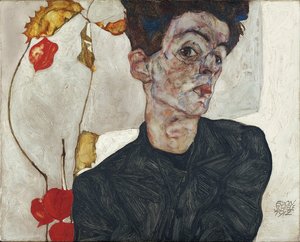
Egon Schiele

Egon Schiele

1890 - 1918, Oostenrijk

Snelle feiten over Egon Schiele

  • Artistic Movement Or Style: Expressionisme
  • Artists Or Movements Influenced By This Artist: ['Expressionisme']
  • Artists Who Influenced This Artist: ['Gustav Klimt']
  • Date Of Birth: 12 juni 1890
  • Date Of Death: 31 oktober 1918
  • Full Name: Egon Schiele
  • Nationality: Oostenrijks
  • Notable Artworks:
    • Self-Portrait
    • Kouppel omhelzing
    • Veldschilderij
  • Place Of Birth: Tulln an der Donau, Oostenrijk

Biografie kunstenaar

A Life Forged in Expression

Egon Schiele’s life, a turbulent and intensely personal journey, unfolded from 1890 to 1918 within the vibrant yet often unsettling landscape of Vienna. Born in Tulln an der Donau, Austria, his early years were shadowed by profound loss – the death of his father due to syphilis at just fourteen, followed tragically by the demise of his sister Elvira. Raised initially by his mother and later under the watchful eye of his uncle Leopold Czihaczek, Schiele’s childhood lacked the stability common to many, fostering within him a remarkable independence and an acute sensitivity. From a young age, he displayed a deep fascination with trains – a motif that would subtly reappear throughout his work, symbolizing both movement and perhaps, the relentless passage of time. Though initially discouraged by his father for pursuing drawing as a distraction from more “practical” endeavors, Schiele’s innate talent blossomed, laying the foundation for his future artistic expression. These formative experiences—illness, loss, and an unconventional upbringing—instilled within him a profound awareness of mortality and the fragility of human existence, themes that would become central to his art.

The Crucible of Vienna: Artistic Development

Schiele’s formal artistic training began at the Kunstgewerbeschule in Vienna, but he quickly found himself stifled by its conservative approach. Seeking a more expressive outlet, he transferred to the Akademie der bildenden Künste, only to discover that even this institution's academic traditions felt restrictive. Dissatisfied with the rigid constraints of traditional art education, Schiele deliberately chose to forge his own path, rejecting formal training altogether – a bold decision reflecting his unwavering artistic conviction. Crucially, he found inspiration in the work of Gustav Klimt, deeply admiring Klimt’s decorative style and exploration of symbolism. Klimt's influence was significant, yet Schiele ultimately diverged from his mentor’s aesthetic, developing a distinctly individual voice characterized by stark honesty and psychological intensity. He became a founding member of the Neues Wiener Kunstgruppe (New Viennese Art Group) in 1909, alongside other progressive artists who challenged the prevailing artistic norms of the time. His early works—often unsettling portraits and self-portraits—began to emerge as powerful statements of emotional turmoil, featuring distorted figures and a palpable sense of vulnerability. These paintings weren’t merely representations of physical form; they were explorations of the inner landscape – the anxieties, desires, and fears that haunted the human psyche. He sought to depict not what he *saw*, but what he *felt*.

Raw Emotion and Unflinching Truth

Egon Schiele's art is immediately recognizable for its raw honesty and psychological depth. He fearlessly confronted themes often considered taboo – sexuality, death, anxiety, isolation – with an unflinching gaze. His distinctive style features elongated figures, contorted poses, and expressive lines that convey a sense of unease and emotional intensity. The human form, particularly the nude, became his primary subject, not as an object of idealized beauty but as a vessel for exploring the complexities of human experience. Self-portraits constitute a significant portion of his oeuvre, offering intimate glimpses into his inner world—a world often marked by loneliness and self-doubt. He didn’t shy away from depicting himself in unflattering or vulnerable poses, revealing a profound level of self-awareness and introspection. Beyond self-portraiture, Schiele created numerous portraits of others, capturing their likenesses with an unsettling realism that seemed to penetrate beneath the surface. Recurring motifs like the *Physalis* plant – symbolizing death and transience with its delicate, papery husk – further underscore this preoccupation with mortality. His use of line is particularly striking; it’s not merely a tool for defining shape but an expressive force that conveys emotion and psychological tension.

A Legacy Cut Short: Achievements & Significance

Despite facing censorship and legal challenges—including a brief imprisonment for allegedly corrupting minors with his art—Schiele gained recognition within Vienna’s avant-garde circles. His work challenged the conventions of the time, provoking both admiration and outrage. By the time of his untimely death during the Spanish flu pandemic in 1918 at the age of twenty-eight, he had established himself as a leading figure in Austrian Expressionism. Significant works such as *Self-Portrait with Physalis*, *Couple Embracing*, and *Field Landscape (Kreuzberg near Krumau)* stand as testaments to his artistic genius. His influence on subsequent generations of artists is undeniable, particularly those interested in exploring psychological themes and challenging conventional artistic norms. Schiele’s bold approach to form and subject matter continues to resonate with audiences today, making him one of the most important and influential figures in early 20th-century art. His paintings are now held in major museum collections worldwide, including the Leopold Museum in Vienna and the Egon Schiele Art Centrum in Český Krumlov, ensuring his artistic legacy endures. He left behind a body of work that is not merely aesthetically compelling but profoundly human—a testament to the power of art to confront the complexities of existence with honesty, courage, and unwavering vision.
  • Key Themes: Mortality, sexuality, isolation, psychological turmoil.
  • Influences: Gustav Klimt, Viennese Secession, personal trauma.
  • Style Characteristics: Elongated figures, contorted poses, expressive lines, raw emotion.

§ 5Vergelijkbare werken

§ 6Vragen

Snelle feiten

  • notable elements: provocative pose, dynamic stance, strong contrast
  • dimensions: Unknown
  • style: expressive, gestural, curvilinear
  • medium: ink drawing, possibly watercolor washes

Kunstquiz

Er is slechts één goed antwoord op elke vraag.

Vraag 1:
Egon Schiele is most closely associated with which artistic movements?
Vraag 2:
What is the primary medium used in 'untitled (9656)'?
Vraag 3:
The composition of 'untitled (9656)' emphasizes which aspect of the figure?
Vraag 4:
What kind of contrast is created in 'untitled (9656)'?
Vraag 5:
The lines used in this artwork are best described as…

§ 7Citeer dit artikel

AllPaintingsStore.com, “Egon Schiele, untitled (9656)”, https://allpaintingsstore.com/nl/art/egon-schiele-untitled-9656-9GEUCW-en/ArtistReproduction/ (geraadpleegd op 7 oktober 2026).

§ 8De reproductie

Handgemaakte olieverfreproductie

Met de hand geschilderd in olieverf op canvas in uw gewenste maat en lijst, op bestelling gemaakt door onze kunstenaars. ( Schakel over naar print Schakel over naar digitale afbeeldingen)

Dit staat in de marge van het bestelformulier vermeld; de huidige stand van zaken op dat formulier luidt als volgt.

untitled (9656)

Druktechniek

Afmetingen reproductie

-

Geselecteerde topkunstenaars

Meer detail, verfijning en extra productietijd

-

Lijst voor reproductie

-

-

Voor kunstwerken of reproducties die aan één zijde groter zijn dan 105 cm (ongeveer 41 inch), wordt de lijst als een losse set verzonden. Deze methode garandeert een veilige levering en voorkomt schade tijdens het transport.

Professionele montage vereist - dit is geen doe-het-zelfproduct.
De set moet worden gemonteerd en het canvas moet worden gespannen door een ervaren professionele lijstenmaker, met gebruik van houtlijm (niet inbegrepen), een doekspanter en klemmen om de sponningen recht te houden terwijl de lijm droogt. Onjuiste montage of een ongelijkmatige spanning op het canvas kan het kunstwerk permanent beschadigen en wordt niet gedekt door onze garantie.

  • Alle massief houten onderdelen zijn inbegrepen, nauwkeurig op maat gesneden voor montage.

  • Te monteren met de meegeleverde schroeven, plus houtlijm voor de hoekverbindingen, die niet wordt meegeleverd en door uw lijstenmaker moet worden aangeschaft.

  • Professioneel gereedschap is vereist en niet inbegrepen: een spanner voor canvas en klemmen om de latten recht te houden terwijl de lijm droogt.

Belangrijk:
De hoekverbindingen vereisen houtlijm, de latten moeten met lijmklemmen worden vastgehouden tot de lijm volledig is opgedroogd, en het spannen van het canvas op het samengestelde frame vereist een doekspanter. Geen van deze artikelen is inbegrepen in de set. Wij adviseren u om een ervaren professionele lijstenmaker te raadplegen voordat u deze maat bestelt.

Naamplaatje

-

-

Beschermende vernislaag

Glanzende vernis (versterkt de kleuren en biedt bescherming tegen licht en vocht)

-

Mijn kunstwerk aanpassen

Voorbeelden van aanpassingen: vervang het gezicht door een eigen foto; voeg een huisdier toe (bijv. vervang de kat door een hond); verwerk een verborgen boodschap in de achtergrond; wijzig het landschap of andere elementen op de achtergrond.

-

Spoedlevering

Wereldwijde levering () binnen 3 tot 4 weken in plaats van de standaard 5 weken. (5 november). Geen concessies aan de kwaliteit.

-

Spoedlevering

Wereldwijde levering naar binnen 5 weken. (12 november).

Inbegrepen

Eindtotaal

€ 229

Inbegrepen bij elke bestelling

  • Gratis wereldwijde expressverzending
  • Hoogwaardig linnen canvas
  • Volledige verzendverzekering
  • Garantie op terugbetaling van invoerrechten
  • Garantie op exacte kleurweergave
  • Retourbeleid van 100 dagen (alleen bij defecten)
  • 100% Geld-terug-garantie
  • Korting bij meerdere afnames
Bestelformulier