

1910. Acryl op canvas.

§ 1Catalogusgegevens


§ 2Abstract
Beschrijving verzamelobject
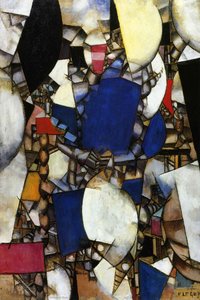
Fernand Léger's "La Couseuse" vangt de essentie van het industriële tijdperk vast met een stijlvolle combinatie van abstractie en observatie, een baanbrekende bijdrage aan moderne kunst. Ontdek nu!
 Lees meer
Biografie kunstenaar
Fernand Léger (1881-1955): Pionier van Cubisme & 'Tubism'! Ontdek baanbrekende schilderijen over moderniteit, machines & de menselijke vorm – een voorloper van Pop Art.
§ 3Toelichting
De Naaimachine
Fernand Léger’s “La Couseuse” (The Sewing Machine), painted around 1910, transcends mere depiction; it embodies the burgeoning spirit of modernity and the transformative influence of industrialization on artistic expression. This striking portrait captures a solitary man absorbed in his craft – repairing or meticulously working with a sewing machine – against a backdrop that speaks volumes about the era’s aesthetic sensibilities. Léger's masterful use of Cubism, specifically Tubism, elevates this seemingly mundane subject to an emblem of progress and geometric precision.- Style: Léger’s Tubism distinguishes itself from earlier Cubist explorations by prioritizing cylindrical forms—representing the machine’s chassis—over fragmented planes. This stylistic choice isn't simply decorative; it reflects Léger’s fascination with the mechanical world and his desire to convey its dynamism through visual abstraction.
- Technique: Léger employed oil paint on canvas, applying thick impasto strokes that imbue the surface with palpable texture. These textured brushstrokes emphasize the materiality of the machine itself, mirroring the physicality of labor within the industrial landscape. The artist’s deliberate layering creates depth and visual interest, inviting contemplation about form and function.
- Historical Context: Created during World War I, “La Couseuse” reflects the anxieties and aspirations of a generation grappling with rapid technological advancements. Léger's depiction aligns with the broader artistic movement that sought to capture the essence of the machine age—a reaction against Impressionism’s focus on fleeting sensations and an embrace of geometric abstraction as a tool for representing reality.
- Symbolism: The sewing machine itself serves as a potent symbol of productivity, precision, and societal transformation. Léger doesn't romanticize this image; rather, he presents it with unflinching honesty, highlighting the repetitive movements inherent in industrial work while simultaneously celebrating its ability to generate tangible results.
- Emotional Impact: Despite its geometric abstraction, “La Couseuse” evokes a sense of quiet contemplation and focused determination. Léger’s portrayal captures the dignity of manual labor within the context of technological progress—a subtle commentary on humanity's relationship with innovation.
Veelgestelde vragen
Welke stemming straalt "La Couseuse (De Naaimachine)" door Fernand Léger uit binnen Cubism?
"La Couseuse (De Naaimachine)" ademt een Reflectief emotionele toon uit binnen de Cubism-stroming.
Is er een diavoorstelling beschikbaar voor "La Couseuse (De Naaimachine)" door Fernand Léger?
Er is een diavoorstelling beschikbaar op de Diavoorstelling-pagina van "La Couseuse (De Naaimachine)" door Fernand Léger.
Wat is de dominante kleur in "La Couseuse (De Naaimachine)" door Fernand Léger?
"La Couseuse (De Naaimachine)" neigt naar een Goudgeel kleurenpalet tint.




 Schakel over naar print


 Voor kunstwerken of reproducties die aan één zijde groter zijn dan 105 cm (ongeveer 41 inch), wordt de lijst als een losse set verzonden. Deze methode garandeert een veilige levering en voorkomt schade tijdens het transport.


